 Back
Chapter 1: Introduction to Anatomy and Physiology – Structured Study Notes
Study Guide - Smart Notes
 Tailored notes based on your materials, expanded with key definitions, examples, and context.
Introduction to Anatomy and Physiology
Overview of Anatomy & Physiology
Anatomy and physiology are foundational sciences for understanding the structure and function of the human body. Anatomy focuses on the physical structures, while physiology examines how these structures operate to sustain life.
Anatomy: Study of body structures and their relationships.
Physiology: Study of functions and vital processes of body parts.
Structure determines function: The form of a body part influences its role.
Biology: The broader study of life, encompassing anatomy and physiology.
Characteristics and Processes of Life
All living organisms share several essential characteristics and processes that distinguish them from non-living matter.
Cellular composition: All living things are made of cells.
Complex structural arrangement: Organisms have organized structures.
Responsiveness: Ability to detect and respond to stimuli.
Homeostasis: Maintenance of a stable internal environment.
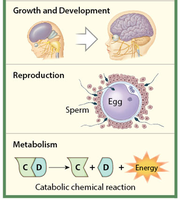
Growth and development: Increase in size and maturation.
Reproduction: Production of offspring.
Metabolism: All chemical processes in cells, including anabolic (building up) and catabolic (breaking down) reactions.
Processes of Life
Respiration: Oxygen intake and carbon dioxide removal.
Digestion: Breakdown of food into absorbable substances.
Circulation: Movement of substances within the body.
Excretion: Elimination of waste products.
Levels of Organization in the Human Body
Hierarchical Levels
The human body is organized into multiple interdependent levels, each more complex than the last. Understanding these levels is crucial for studying anatomy and physiology.
Chemical level: Atoms and molecules form the basis of all structures.
Cellular level: Cells are the smallest living units; their functions depend on organelles.
Tissue level: Groups of similar cells performing specific functions.
Organ level: Two or more tissues working together for specialized functions.
Organ system level: Groups of organs performing coordinated functions.
Organism level: The complete living being, composed of all organ systems.
Cell Theory and Cell Types
Cell theory is a fundamental concept in biology, stating that cells are the basic structural and functional units of life.
Principles of cell theory:
All living things are composed of cells.
Cells arise from pre-existing cells.
Cells perform all vital functions.
Cell function relates to structure: Examples include muscle cells (contraction), red blood cells (transport), bone cells (maintenance), fat cells (storage), and nerve cells (communication).
Tissues and Their Functions
Types of Tissues
Tissues are groups of similar cells and cell products that perform specific functions. Histology is the study of tissues.
Epithelial tissue: Forms barriers, covers surfaces, lines tracts, and produces secretions.
Connective tissue: Supports and connects other tissues; matrix varies from liquid (blood) to solid (bone).
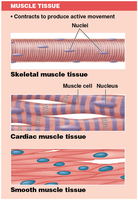
Muscle tissue: Contracts to produce movement; includes skeletal, cardiac, and smooth muscle.
Nervous tissue: Transmits information via neurons and supports neurons with neuroglia.
Organs and Organ Systems
Organs
An organ is a functional unit composed of multiple tissue types. Its function is determined by the combination and organization of tissues.
Example: The heart contains cardiac muscle, epithelial, connective, and neural tissues.
Organ Systems
Organ systems consist of organs that interact to perform a specific range of functions. There are eleven major organ systems in the human body, all interdependent.
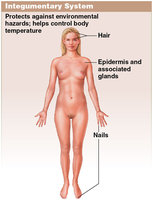
Integumentary system: Protection and temperature regulation.
Skeletal system: Support, protection, mineral storage, blood cell formation.
Muscular system: Movement, support, heat generation.
Nervous system: Rapid control and coordination.
Endocrine system: Hormone secretion and long-term regulation.
Cardiovascular system: Transport of cells and materials.
Lymphatic system: Defense and fluid return.
Respiratory system: Gas exchange and sound production.
Digestive system: Food processing and nutrient absorption.
Urinary system: Waste elimination and water balance.
Reproductive system: Production of sex cells and hormones; embryonic development (female).
Homeostasis and Feedback Mechanisms
Homeostatic Regulation
Homeostasis is the maintenance of a stable internal environment. It relies on regulatory mechanisms involving a receptor, control center, and effector.
Receptor: Detects changes in the environment.
Control center: Processes information and issues commands.
Effector: Responds to restore balance.
Dynamic equilibrium: Values oscillate around a set point, not fixed.
Negative and Positive Feedback
Negative feedback: Effector opposes the original stimulus, minimizing change. Primary mechanism for homeostasis.
Positive feedback: Effector enhances the original stimulus, leading to rapid completion of a process. Not used for homeostasis.
Anatomical Terminology and Body Orientation
Anatomical Position and Directional Terms
Standardized terms are used to describe locations and directions in the body, based on the anatomical position.
Anatomical position: Standing, hands at sides, palms forward, feet together, eyes forward.
Supine: Lying face up.
Prone: Lying face down.
Directional terms: Anterior/ventral, posterior/dorsal, superficial, deep.
Abdominopelvic Regions and Quadrants
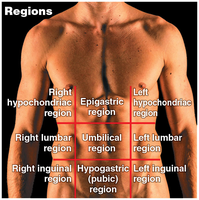
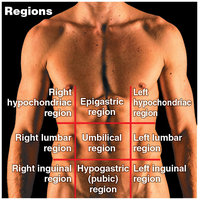
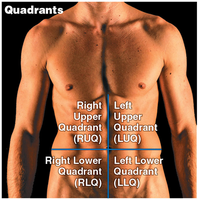
The abdomen is divided into regions and quadrants to aid in locating organs and diagnosing conditions.
Four quadrants: RUQ, LUQ, RLQ, LLQ.
Nine regions: Right/left hypochondriac, right/left lumbar, right/left inguinal, epigastric, umbilical, hypogastric.
Sectional Planes and Body Cavities
Sectional Planes
Sectional planes are used to describe internal views of the body.
Frontal (coronal) plane: Divides anterior from posterior.
Sagittal plane: Divides left from right (midsagittal and parasagittal).
Transverse (horizontal) plane: Divides superior from inferior.
Body Cavities
Body cavities protect internal organs and allow them to change shape. They are lined by serous membranes and subdivided into major regions.
Thoracic cavity: Contains pleural cavities (lungs) and mediastinum (heart).
Abdominopelvic cavity: Contains abdominal (digestive organs) and pelvic (urinary, reproductive) cavities.
Pericardial cavity: Surrounds the heart, lined by pericardium.
Peritoneal cavity: Lined by peritoneum; some organs are retroperitoneal or infraperitoneal.
Summary Table: Levels of Organization
Level | Description | Example |
|---|---|---|
Chemical | Atoms and molecules | Water, proteins |
Cellular | Smallest living units | Muscle cell, neuron |
Tissue | Groups of similar cells | Cardiac muscle tissue |
Organ | Two or more tissues | Heart, liver |
Organ System | Group of organs | Cardiovascular system |
Organism | Complete living being | Human |
Key Equations
Catabolic Reaction:
Additional info: This equation represents the breakdown of molecules (catabolism) to release energy, a fundamental process in metabolism.
