 Back
Chapter 1: Introduction to Anatomy and Physiology – Structured Study Notes
Study Guide - Smart Notes
 Tailored notes based on your materials, expanded with key definitions, examples, and context.
Introduction to Anatomy and Physiology
Science and the Study of the Human Body
Anatomy and physiology are foundational sciences for understanding the structure and function of the human body. Scientific methods—observation, experimentation, and analysis—have led to significant advances in this field. The relationship between form and function is central: anatomical structures are designed to perform specific physiological tasks.
Human anatomy: Study of the structure of the human body.
Human physiology: Study of the functions of the human body.
Form and function: Anatomical form is always suited to its physiological function.
Learning Modalities and Study Skills
Success in anatomy and physiology requires effective study strategies tailored to individual learning modalities. Engaging multiple senses enhances retention and understanding.
Visual: Reading, diagrams, illustrations, multimedia.
Auditory: Listening to lectures, discussions, mnemonics.
Tactile: Manipulating models, performing experiments.
Kinesthetic: Movement-based activities, active note-taking, drawing.
SQ3R Method: Survey, Question, Read, Recite, Review for textbook study.
Time management: Weekly schedules, study groups, use of resources.
Exam preparation: Understand exam format, use practice resources, manage health and stress.
Characteristics of Living Organisms
Properties Shared by Living Organisms
All living organisms exhibit distinct properties that define life:
Cellular composition: Cells are the basic units of life.
Metabolism: Chemical reactions that build up (anabolism) or break down (catabolism) substances.
Growth: Increase in cell size or number.
Excretion: Removal of waste products.
Responsiveness: Ability to sense and react to stimuli.
Movement: Movement of organism, cells, or materials within cells.
Reproduction: Production of new cells or organisms.
Levels of Structural Organization and Body Systems
Hierarchical Levels of Organization
The human body is organized into progressively larger structural levels:
Chemical level: Atoms and molecules form the foundation.
Cellular level: Molecules combine to form cells.
Tissue level: Groups of cells and extracellular matrix perform common functions.
Organ level: Two or more tissue types form organs with specialized tasks.
Organ system level: Organs grouped to carry out broad functions (e.g., cardiovascular, digestive).
Organism level: All organ systems function together as a complete human body.
The 11 Organ Systems
The human body contains 11 organ systems, each with specific functions essential for survival and homeostasis.
Additional info: Examples include the cardiovascular system (heart and blood vessels), digestive system (food processing), and others such as respiratory, nervous, endocrine, and musculoskeletal systems.
Types of Anatomy and Physiology
Approaches to Studying the Human Body
Systemic anatomy: Study by organ systems.
Regional anatomy: Study by body regions.
Surface anatomy: Study of surface markings.
Gross anatomy: Structures visible to the naked eye.
Microscopic anatomy: Structures visible only with a microscope (histology and cytology).
Physiology: Study of function, often by organ system (e.g., neurophysiology, cardiovascular physiology).
The Language of Anatomy and Physiology
Word Roots, Prefixes, and Suffixes
Scientific terminology is built from word roots, prefixes, and suffixes, allowing precise communication about anatomical structures and functions.
Anatomical Position
Anatomical position is the standard reference for describing locations and regions of the body:
Body upright, feet shoulder-width apart, arms at sides, palms forward.
"Right" and "left" refer to the subject's sides, not the observer's.
Directional Terms
Directional terms describe the relative locations of body parts:
Anterior (ventral): Front
Posterior (dorsal): Back
Superior (cranial): Toward head
Inferior (caudal): Toward tail
Proximal: Closer to origin
Distal: Further from origin
Medial: Closer to midline
Lateral: Further from midline
Superficial: Closer to surface
Deep: Further from surface
Regional Terms
The body is divided into axial (head, neck, trunk) and appendicular (limbs) regions, with further subdivisions for precise localization.
Region | Description |
|---|---|
Axial | Head, neck, trunk |
Appendicular | Upper and lower limbs |
Cervical | Neck |
Crural | Leg |
Thoracic | Chest |
Patellar | Knee |
Tarsal | Ankle |
Mental | Chin |
Inguinal | Groin |
Lumbar | Lower back |
Hypochondriac | Below rib cartilage |
Planes of Section
Planes of section are used to study and describe anatomical structures:
Sagittal plane: Divides body into right and left sections (midsagittal = equal, parasagittal = unequal).
Frontal (coronal) plane: Divides body into anterior and posterior sections.
Transverse (horizontal) plane: Divides body into superior and inferior sections.
Oblique plane: Divides body at an angle.
Body Cavities and Membranes
Major Body Cavities
Body cavities protect internal organs and allow movement and expansion:
Posterior cavity: Cranial (brain) and vertebral (spinal cord).
Anterior cavity: Thoracic (pleural, mediastinum, pericardial) and abdominopelvic (abdominal, pelvic, peritoneal).
Abdominopelvic Quadrants and Regions
The abdominopelvic cavity is divided for clinical reference:
Quadrants: RUQ, RLQ, LUQ, LLQ.
Regions: Hypochondriac, epigastric, lumbar, umbilical, iliac, hypogastric.
Serous Membranes
Serous membranes line body cavities and cover organs, reducing friction:
Visceral layer: In contact with organ.
Parietal layer: Attached to surrounding structures.
Serous fluid: Lubricates and prevents friction.
Three main serous membranes:
Pleural: Surrounds lungs.
Pericardial: Surrounds heart.
Peritoneal: Surrounds abdominal organs (not all organs; kidneys are retroperitoneal).
Medical Imaging
Imaging Techniques
Medical imaging allows visualization of internal structures without surgery:
X-ray: Uses ionizing radiation.
CT scan: Computer-generated 3D images from X-ray data.
MRI: Uses magnetic fields to produce 3D images.
Core Principles in Anatomy and Physiology
Homeostasis
Homeostasis is the maintenance of a stable internal environment. Disturbances can lead to disease or death. Variables such as temperature and chemical composition are regulated within narrow ranges.
Feedback Loops
Feedback loops are mechanisms for maintaining homeostasis:
Negative feedback: Opposes initial change, returns variable to normal range.
Positive feedback: Amplifies initial stimulus, shuts off when normal range is restored (e.g., blood clotting, childbirth).
Example equation:
Where is the change in a regulated variable.
Common Misconceptions about Homeostasis
Negative feedback is not "bad"; positive feedback is not always "good"—they refer to direction of response.
Homeostasis does not mean a static environment; variables fluctuate within normal ranges.
Feedback loops are not simply "on" or "off"; they operate dynamically.
Only variables with receptors can be regulated.
Principle of Complementarity of Structure and Function
Structure is always suited to function at every level of organization.
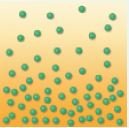
Gradients
Gradients drive many physiological processes:
Temperature gradient: Difference in temperature between regions.
Concentration gradient: Difference in concentration between regions.
Pressure gradient: Difference in pressure between regions.
Cell-Cell Communication
Cells communicate via chemical messengers and electrical signals to coordinate functions and maintain homeostasis.
Summary Table: Levels of Organization
Level | Description |
|---|---|
Chemical | Atoms and molecules |
Cellular | Cells formed from molecules |
Tissue | Groups of cells and matrix |
Organ | Two or more tissue types |
Organ System | Group of organs |
Organism | Complete human body |
Additional info:
Images included are directly relevant to the explanation of gradients and cell-cell communication.
Study notes are structured to cover all major topics from Chapter 1, suitable for ANP college students.
