 Back
Chapter 1: Introduction to Anatomy and Physiology – Study Notes
Study Guide - Smart Notes
 Tailored notes based on your materials, expanded with key definitions, examples, and context.
Introduction to Anatomy and Physiology
Overview
Anatomy and physiology are foundational sciences in understanding the structure and function of the human body. The study of anatomy focuses on the body's structures, while physiology explores how these structures function to sustain life. The relationship between form and function is a central theme in this discipline.
Types of Anatomy and Physiology
Approaches to Studying Anatomy
Systemic Anatomy: Examines the body by individual organ systems (e.g., cardiovascular, skeletal).
Regional Anatomy: Divides the body into regions (e.g., head, neck) for study.
Surface Anatomy: Focuses on surface markings and features visible without dissection.
Gross Anatomy: Studies structures visible to the naked eye.
Microscopic Anatomy: Examines structures only visible with a microscope, including histology (tissues) and cytology (cells).
Subfields of Physiology
Neurophysiology: Studies the nervous system, including the brain and nerves.
Cardiovascular Physiology: Focuses on the heart and blood vessels.
Physiologists may also study chemical, cellular, tissue, or organ-level processes.
Characteristics of Living Organisms
Key Properties Shared by All Living Things
Cellular Composition: All living organisms are composed of cells, the basic units of life.
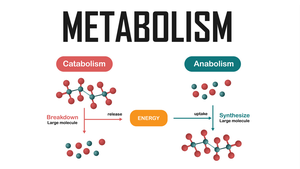
Metabolism: The sum of all chemical reactions in the body, including both anabolic (building up) and catabolic (breaking down) processes.
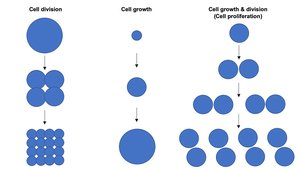
Growth: Increase in size (of cells) or number (of cells) in an organism.
Excretion: Removal of metabolic waste products.
Responsiveness (Irritability): Ability to sense and react to environmental changes.
Movement: Includes movement of the organism, cells, or materials within the body.
Reproduction: Production of new cells for growth and repair, and production of offspring.
Levels of Structural Organization and Body Systems
Hierarchy of Organization
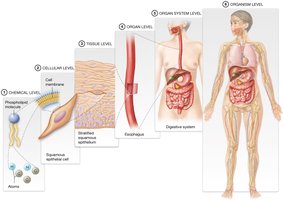
The human body is organized into six structural levels:
Chemical Level (atoms, molecules)
Cellular Level (cells)
Tissue Level (groups of similar cells)
Organ Level (two or more tissue types)
Organ System Level (organs working together)
Organism Level (the complete human body)
The 11 Organ Systems of the Human Body
Each organ system has specific functions essential for survival. The systems work together to maintain homeostasis and overall health.
System | Main Functions |
|---|---|
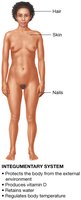
Integumentary | Protection, vitamin D production, water retention, temperature regulation |
Skeletal | Support, protection, movement, blood cell production, calcium storage |
Muscular | Movement, heat production, control of body openings |
Nervous | Regulation, sensation, movement, mental functions |
Endocrine | Hormone secretion, regulation of body functions |
Cardiovascular | Transport of blood, nutrients, wastes, and gases |
Lymphatic | Fluid return, immunity |
Respiratory | Gas exchange, acid-base balance |
Digestive | Digestion, absorption, waste elimination |
Urinary | Waste removal, fluid/electrolyte/acid-base balance |
Reproductive | Production of gametes, hormone secretion, reproduction |
The Language of Anatomy and Physiology
Word Roots, Prefixes, and Suffixes
Scientific terms in anatomy and physiology are constructed from word roots, prefixes, and suffixes. For example, myo- means muscle, and card- means heart.
Anatomical Position
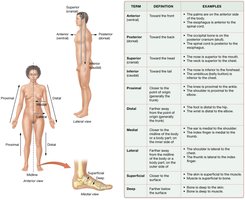
The anatomical position is the standard reference for describing body parts and regions. The body stands upright, feet shoulder-width apart, arms at the sides, and palms facing forward. Terms like "right" and "left" always refer to the subject's right and left, not the observer's.

Directional Terms
Directional terms describe the locations of structures relative to other structures or locations in the body.
Term | Definition | Example |
|---|---|---|
Anterior (Ventral) | Toward the front | The sternum is anterior to the heart. |
Posterior (Dorsal) | Toward the back | The spine is posterior to the stomach. |
Superior (Cranial) | Toward the head | The head is superior to the chest. |
Inferior (Caudal) | Toward the feet | The stomach is inferior to the heart. |
Medial | Closer to the midline | The nose is medial to the eyes. |
Lateral | Farther from the midline | The thumb is lateral to the pinky. |
Proximal | Closer to the point of origin | The shoulder is proximal to the elbow. |
Distal | Farther from the point of origin | The fingers are distal to the wrist. |
Superficial | Closer to the surface | The skin is superficial to the muscles. |
Deep | Farther from the surface | The bones are deep to the muscles. |
Regional Terms
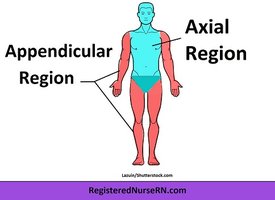
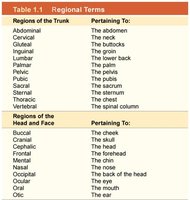
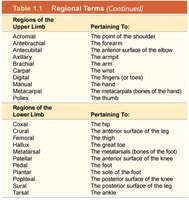
The body is divided into the axial region (head, neck, trunk) and the appendicular region (upper and lower limbs). Each region is further subdivided into specific anatomical areas.
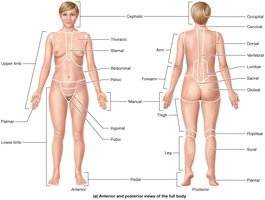
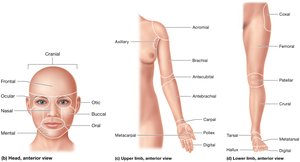
Region | Pertaining To |
|---|---|
Abdominal | The abdomen |
Cervical | The neck |
Gluteal | The buttocks |
Femoral | The thigh |
Brachial | The arm |
Carpal | The wrist |
Plantar | The sole of the foot |
Planes of Section
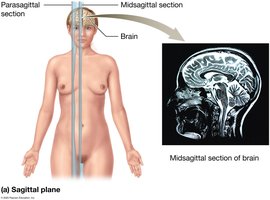
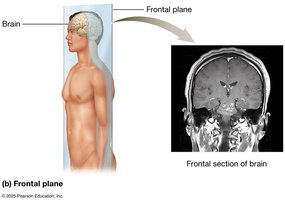
To study internal structures, the body is divided using planes of section:
Sagittal Plane: Divides the body into right and left sections. The midsagittal (median) plane divides it equally; the parasagittal plane divides it unequally.
Frontal (Coronal) Plane: Divides the body into anterior (front) and posterior (back) sections.
Transverse (Horizontal) Plane: Divides the body into superior (upper) and inferior (lower) sections.
Oblique Plane: Divides the body at an angle, useful for complex structures.
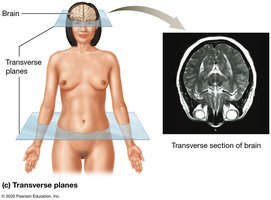

Organization of the Human Body: Body Cavities
Major Body Cavities
Body cavities are fluid-filled spaces that protect internal organs and allow for their movement and expansion. The two main cavities are the posterior (dorsal) and anterior (ventral) body cavities.
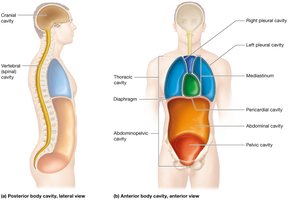
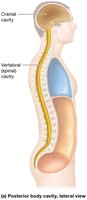
Posterior Body Cavity: Includes the cranial cavity (protects the brain) and vertebral (spinal) cavity (protects the spinal cord). These are continuous and filled with cerebrospinal fluid (CSF).
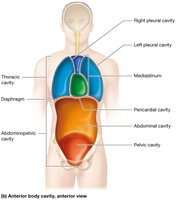
Anterior Body Cavity: Divided by the diaphragm into the thoracic cavity (superior) and abdominopelvic cavity (inferior).
Thoracic Cavity: Contains pleural cavities (lungs), mediastinum (heart, trachea, esophagus), and pericardial cavity (heart).
Abdominopelvic Cavity: Subdivided into abdominal (digestive organs) and pelvic (reproductive, urinary organs) cavities. The peritoneal cavity is a subcavity within the abdomen.
Abdominopelvic Quadrants and Regions
Quadrants: Right upper (RUQ), right lower (RLQ), left upper (LUQ), left lower (LLQ).
Nine Regions: Right/left hypochondriac, epigastric, right/left lumbar, umbilical, right/left iliac (inguinal), hypogastric.
Serous Membranes
Serous membranes are thin, double-layered tissues that line body cavities and cover organs. They consist of a visceral layer (in contact with the organ) and a parietal layer (attached to the cavity wall). The space between layers contains serous fluid, which reduces friction.
Pleural Membranes: Surround the lungs.
Pericardial Membranes: Surround the heart.
Peritoneal Membranes: Surround some abdominal organs; organs behind the peritoneum are called retroperitoneal.
Core Principles in Anatomy and Physiology
Homeostasis
Homeostasis is the maintenance of a stable internal environment. Physiological processes operate to keep variables such as temperature and chemical composition within a narrow range. Homeostatic imbalances can lead to disease or death.
Feedback Loops
Feedback loops are mechanisms that maintain homeostasis. They involve:
Receptor (Sensor): Detects changes in a variable.
Control Center: Compares the change to a set point and determines the response.
Effector: Initiates a response to return the variable to normal.
Negative Feedback
Negative feedback opposes the initial change, reducing the output and returning the variable to its set point. This is the most common feedback mechanism in the body.
Positive Feedback
Positive feedback reinforces the initial change, amplifying the response. It is less common and usually occurs within a negative feedback loop for rapid responses (e.g., blood clotting).
Other Core Principles
Structure and Function: The form of a structure is always suited to its function (principle of complementarity).
Gradients: Differences in temperature, concentration, or pressure between two regions drive physiological processes.
Cell-to-Cell Communication: Cells communicate via chemical messengers or electrical signals to coordinate body functions and maintain homeostasis.
Example: Nerve cells communicate with muscle cells to trigger contraction, maintaining posture and movement.
Additional info: Understanding these core principles is essential for further study in anatomy and physiology, as they provide the framework for how the body maintains stability and responds to internal and external changes.
