 Back
Chapter 1: Introduction to Anatomy and Physiology – Study Guide
Study Guide - Smart Notes
 Tailored notes based on your materials, expanded with key definitions, examples, and context.
Introduction to Anatomy and Physiology
Overview
Anatomy and Physiology (A&P) is the scientific study of the structure and function of the human body. Understanding the relationship between form and function is essential for comprehending how the body operates and maintains health.
Human anatomy: Study of the structure of the human body.
Human physiology: Study of the functions of the body.
Form and function are inextricably linked.
How to Succeed in Your Anatomy and Physiology Course
Learning Modalities
Different students learn best through different senses, known as learning modalities:
Visual: Reading, diagrams, illustrations, animations.
Auditory: Listening to lectures, discussions, mnemonics.
Tactile: Manipulating models, hands-on experiments.
Kinesthetic: Movement-based activities, drawing, speaking, and acting out concepts.
Using multiple modalities enhances retention and understanding.
Study Skills and Strategies
SQ3R Method: Survey, Question, Read, Recite, Review.
Active reading: Take notes, sketch diagrams, summarize as you read.
Time management: Develop a weekly study schedule, use school resources, and join study groups.
Exam preparation: Learn exam format, use available resources, and practice self-care (nutrition, sleep, stress management).

Making the Best Use of Class and Lab Time
Come prepared by reviewing material before class or lab.
Take your own notes; do not rely solely on provided slides.
Experiment with different note-taking methods to find what works best for you.
Using the Textbook and Associated Materials
Textbook is divided into modules with clear learning outcomes.
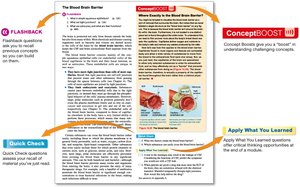
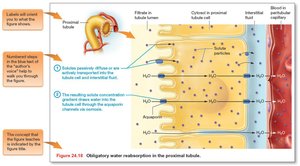
Features include Concept Boosts, Study Boosts, and self-assessment questions (Flashback, Quick Check, Apply What You Learned).
Figures and diagrams are essential for understanding complex concepts.
Companion workbook and online tools provide additional practice and assessment.
Characteristics of Living Organisms
Key Properties
Cellular composition: All living things are made of cells, the basic units of life.
Metabolism: Chemical reactions that build up (anabolism) or break down (catabolism) substances.
Growth: Increase in cell size or number.
Excretion: Removal of metabolic waste products.
Responsiveness: Ability to sense and react to environmental changes.
Movement: Of the organism, cells, or materials within the body.
Reproduction: Production of new cells or organisms.
Levels of Structural Organization and Body Systems
Hierarchy of Organization
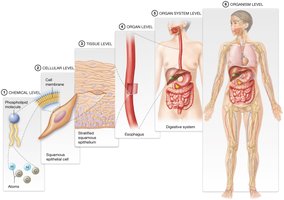
The human body is organized into six structural levels, each building on the previous:
Chemical level: Atoms and molecules (e.g., phospholipids).
Cellular level: Cells formed from molecules.
Tissue level: Groups of similar cells performing a common function.
Organ level: Two or more tissue types forming organs.
Organ system level: Groups of organs working together for a broad function.
Organism level: All organ systems functioning together as a human being.
The 11 Organ Systems of the Human Body
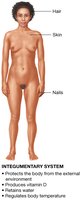
Each organ system has specific functions essential for survival. The main systems include:
Integumentary
Skeletal
Muscular
Nervous
Endocrine
Cardiovascular
Lymphatic
Respiratory
Digestive
Urinary
Reproductive
Types of Anatomy and Physiology
Approaches to Study
Systemic anatomy: Study by organ systems.
Regional anatomy: Study by body regions.
Surface anatomy: Study of surface markings.
Gross anatomy: Structures visible to the naked eye.
Microscopic anatomy: Structures visible only with a microscope (histology and cytology).
Physiology: Study of function, often by organ system (e.g., neurophysiology, cardiovascular physiology).
The Language of Anatomy and Physiology
Word Roots, Prefixes, and Suffixes
Scientific terms are built from word roots, prefixes, and suffixes, allowing precise communication about body structures and functions.
Anatomical Position
The standard reference position for the body:
Standing upright, feet shoulder-width apart, arms at sides, palms facing forward.
"Right" and "left" refer to the subject's sides, not the observer's.
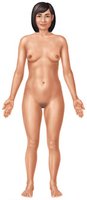
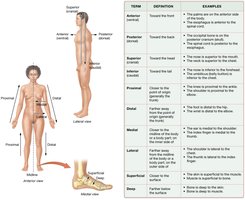
Directional Terms
Used to describe the locations of structures relative to each other:
Term | Definition | Example |
|---|---|---|
Anterior (ventral) | Toward the front | The sternum is anterior to the heart. |
Posterior (dorsal) | Toward the back | The heart is posterior to the sternum. |
Superior (cranial) | Toward the head | The head is superior to the neck. |
Inferior (caudal) | Toward the tail | The neck is inferior to the head. |
Proximal | Closer to point of origin | The shoulder is proximal to the elbow. |
Distal | Farther from point of origin | The wrist is distal to the elbow. |
Medial | Closer to midline | The nose is medial to the eyes. |
Lateral | Farther from midline | The ears are lateral to the nose. |
Superficial | Closer to surface | The skin is superficial to muscles. |
Deep | Farther from surface | The bones are deep to the skin. |
Regional Terms
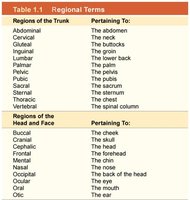
The body is divided into axial (head, neck, trunk) and appendicular (limbs) regions. Each region has specific names for clarity.
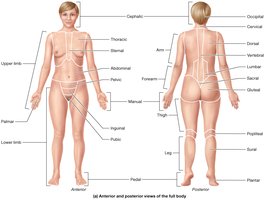
Region | Pertaining To |
|---|---|
Abdominal | The abdomen |
Cervical | The neck |
Gluteal | The buttocks |
Femoral | The thigh |
Brachial | The arm |
Carpal | The wrist |
Plantar | The sole of the foot |
Planes of Section
Used to describe cuts or sections through the body:
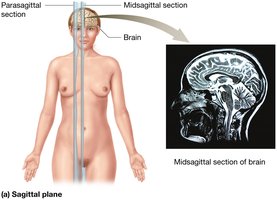
Sagittal plane: Divides body into right and left (midsagittal = equal, parasagittal = unequal).
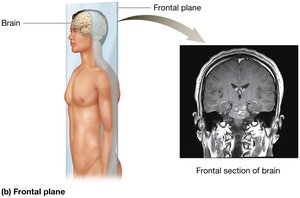
Frontal (coronal) plane: Divides body into anterior and posterior.
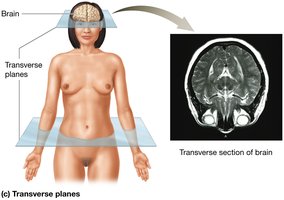
Transverse (horizontal) plane: Divides body into superior and inferior.
Oblique plane: Divides at an angle.
The Organization of the Human Body
Body Cavities
Body cavities are fluid-filled spaces that protect organs and allow for movement and expansion.
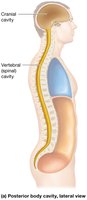
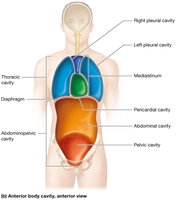
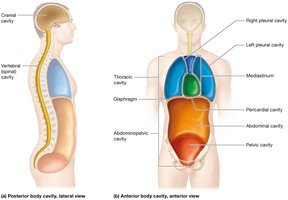
Posterior (dorsal) cavity: Cranial cavity (brain) and vertebral cavity (spinal cord).
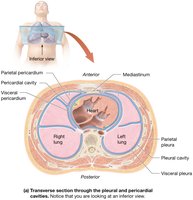
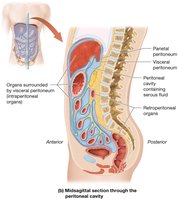
Anterior (ventral) cavity: Thoracic cavity (pleural, mediastinum, pericardial) and abdominopelvic cavity (abdominal, pelvic, peritoneal).
Abdominopelvic Quadrants and Regions
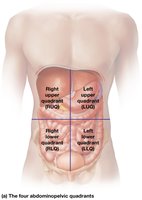
Four quadrants: RUQ, RLQ, LUQ, LLQ.
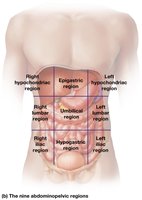
Nine regions: right/left hypochondriac, epigastric, right/left lumbar, umbilical, right/left iliac, hypogastric.
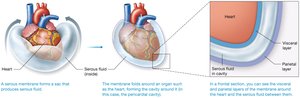
Serous Membranes
Serous membranes line body cavities and cover organs, reducing friction:
Visceral layer: In contact with organ.
Parietal layer: Attached to surrounding structures.
Serous fluid: Lubricates and prevents friction.
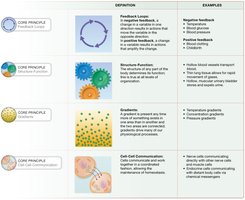
Core Principles in Anatomy and Physiology
Homeostasis
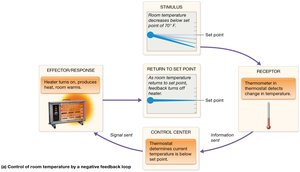
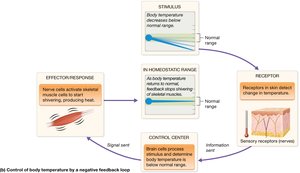
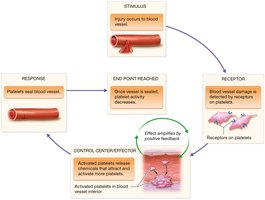
Homeostasis is the maintenance of a stable internal environment. Imbalances can lead to disease or death. Variables such as temperature and chemical composition are tightly regulated.
Feedback Loops
Negative feedback: Opposes initial change, returns variable to normal (e.g., body temperature regulation).
Positive feedback: Amplifies initial stimulus, usually within a negative feedback context (e.g., blood clotting, childbirth).
Principle of Complementarity of Structure and Function
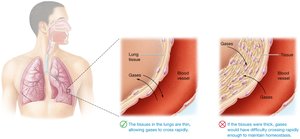
Form follows function at all levels of organization. The structure of a body part is always suited to its function.
Gradients
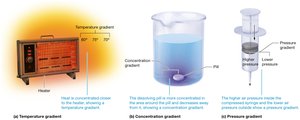
Gradients drive many physiological processes:
Temperature gradient: Difference in temperature between two regions.
Concentration gradient: Difference in concentration of a substance.
Pressure gradient: Difference in pressure between two areas.
Cell-Cell Communication
Cells communicate via chemical messengers or electrical signals to coordinate body functions and maintain homeostasis.
Additional info: This guide covers the foundational concepts of anatomy and physiology, including study strategies, body organization, terminology, and core physiological principles. Mastery of these topics is essential for success in subsequent chapters and for understanding the human body as a whole.
