 Back
BackChapter 1: Introduction to Anatomy and Physiology - Study Notes
Study Guide - Smart Notes
 Tailored notes based on your materials, expanded with key definitions, examples, and context.
Chapter 1: Introduction to Anatomy and Physiology
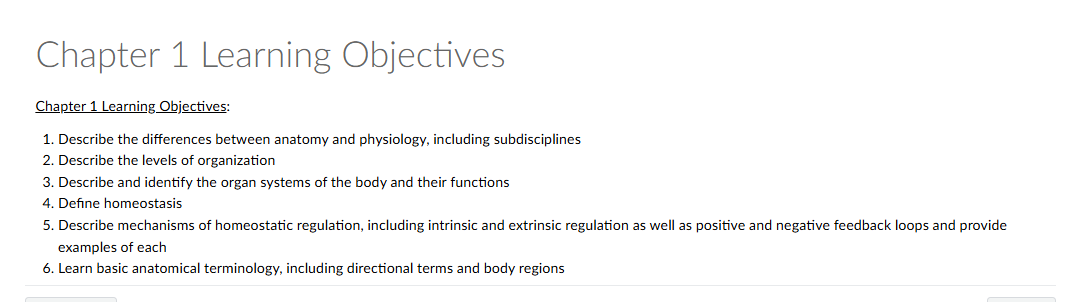
Differences Between Anatomy and Physiology
Anatomy and physiology are two closely related fields that study the structure and function of living organisms. Understanding their distinctions is fundamental to the study of health sciences.
Anatomy: The study of the structure of the body and its parts. It includes subdisciplines such as gross anatomy (structures visible to the naked eye), microscopic anatomy (structures seen under a microscope), and developmental anatomy (changes in structure over time).
Physiology: The study of the functions and processes of the body and its parts. Subdisciplines include cellular physiology, organ physiology, and systemic physiology.
Example: Anatomy describes the heart's chambers and valves, while physiology explains how the heart pumps blood.
Levels of Organization
The human body is organized into hierarchical levels, each building upon the previous one to form complex structures and functions.
Chemical Level: Atoms and molecules essential for life.
Cellular Level: Cells, the basic units of life.
Tissue Level: Groups of similar cells performing a common function.
Organ Level: Structures composed of two or more tissue types working together.
Organ System Level: Groups of organs that perform major functions.
Organism Level: The complete living being.
Organ Systems of the Body and Their Functions
The body consists of several organ systems, each with specific functions essential for survival and health.
Integumentary System: Protects the body, regulates temperature.
Skeletal System: Provides support, protection, and movement.
Muscular System: Enables movement and maintains posture.
Nervous System: Controls and coordinates body activities.
Endocrine System: Regulates processes via hormones.
Cardiovascular System: Transports nutrients, gases, and wastes.
Lymphatic System: Defends against infection and disease.
Respiratory System: Facilitates gas exchange.
Digestive System: Breaks down food and absorbs nutrients.
Urinary System: Removes waste and maintains fluid balance.
Reproductive System: Enables reproduction.
Homeostasis
Homeostasis is the process by which the body maintains a stable internal environment despite external changes.
Definition: The maintenance of a constant internal state, such as temperature, pH, and fluid balance.
Example: Regulation of blood glucose levels.
Mechanisms of Homeostatic Regulation
Homeostatic regulation involves various mechanisms to keep internal conditions within set limits.
Intrinsic Regulation: Local control within an organ or tissue.
Extrinsic Regulation: Control by external systems, such as the nervous or endocrine system.
Feedback Loops: Mechanisms that respond to changes in the internal environment.
Negative Feedback: Reverses a change to restore balance. Example: Body temperature regulation.
Positive Feedback: Amplifies a change. Example: Blood clotting.
Basic Anatomical Terminology
Understanding anatomical terminology is essential for accurately describing locations and relationships in the body.
Directional Terms: Describe positions relative to the body (e.g., anterior, posterior, superior, inferior).
Body Regions: Specific areas of the body (e.g., thoracic, abdominal, pelvic).
Example: The heart is medial to the lungs.
Additional info: Expanded explanations and examples were added to provide academic context and ensure completeness for exam preparation.
