Back
BackChapter 1: Introduction to Human Anatomy and Physiology – Study Notes
Study Guide - Smart Notes
 Tailored notes based on your materials, expanded with key definitions, examples, and context.
Introduction to Human Anatomy and Physiology
Overview of Anatomy and Physiology
Anatomy and physiology are foundational sciences in understanding the human body. Anatomy focuses on the structure and organization of body parts, while physiology examines the functions and mechanisms of these parts. The two disciplines are closely linked, as the structure of a body part often determines its function. Anatomists use observation and dissection, whereas physiologists rely on experimentation to uncover how the body works.
Anatomy: Study of body structures and their relationships.
Physiology: Study of body functions and processes.
Interdependence: Structure determines function; function reflects structure.
Levels of Organization
Hierarchical Structure of the Human Body
The human body is organized into a hierarchy of structural levels, each building upon the previous. Understanding these levels is essential for grasping how the body functions as a whole.
Atoms: Smallest units of matter.
Molecules: Combinations of atoms.
Macromolecules: Large, complex molecules (e.g., proteins, nucleic acids).
Organelles: Specialized structures within cells.
Cells: Basic units of structure and function in living things.
Tissues: Groups of similar cells performing a common function.
Organs: Structures composed of multiple tissue types with specific functions.
Organ Systems: Groups of organs working together.
Organism: The complete living being.
Characteristics of Life
Defining Features of Living Organisms
All living things share certain characteristics that distinguish them from non-living matter. Collectively, these characteristics constitute metabolism, the sum of all chemical and physical processes in the body.
Movement: Change in position or motion of internal parts.
Responsiveness: Ability to sense and react to changes.
Growth: Increase in size without change in shape.
Reproduction: Production of new organisms or cells.
Respiration: Obtaining oxygen, removing carbon dioxide, and releasing energy from food.
Digestion: Breakdown of food into simpler forms.
Absorption: Passage of substances through membranes into body fluids.
Circulation: Movement of substances in body fluids.
Assimilation: Changing absorbed substances into chemically different forms.
Excretion: Removal of metabolic wastes.
Maintenance of Life
Requirements for Human Survival
Organisms require specific environmental factors to survive. Both the quality and quantity of these factors are crucial for maintaining life.
Water: Most abundant chemical in the body; essential for metabolic processes, temperature regulation, and as a solvent.
Food: Provides nutrients for energy, growth, and regulation of chemical reactions.
Oxygen: Required for cellular respiration and energy release from food.
Heat: Product of metabolism; influences reaction rates.
Pressure: Atmospheric pressure is necessary for breathing; hydrostatic pressure moves blood through vessels.
Homeostasis
Maintaining a Stable Internal Environment
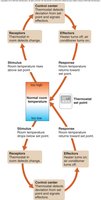
Homeostasis is the maintenance of a stable internal environment. It is achieved through control systems that include receptors (detect changes), a set point (normal value), and effectors (muscles or glands that respond). Most homeostatic mechanisms operate by negative feedback, which counteracts changes from the set point.
Negative Feedback: Responses move in the opposite direction of the change, reducing deviation from the set point.
Positive Feedback: Responses enhance the change, moving further from the set point (e.g., blood clotting, childbirth).
Organization of the Body
Major Body Cavities
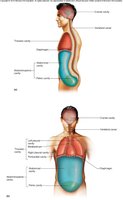
The body is divided into the axial portion (head, neck, trunk) and the appendicular portion (limbs). The axial portion contains several major cavities that house organs.
Cranial cavity: Contains the brain.
Vertebral cavity: Contains the spinal cord.
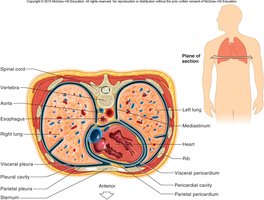
Thoracic cavity: Contains the heart, lungs, and mediastinum.
Abdominopelvic cavity: Subdivided into abdominal (digestive organs, spleen) and pelvic (end of large intestine, bladder, reproductive organs) cavities.
Diaphragm: Muscle separating thoracic and abdominopelvic cavities.
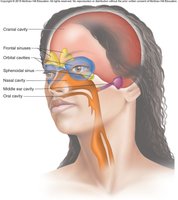
Smaller Cavities in the Head
Oral cavity: Mouth
Nasal cavity: Nose
Orbital cavities: Eyes
Middle ear cavities: Ears
Thoracic and Abdominopelvic Membranes
Body cavities are lined with double-layered serous membranes:
Pleural membranes: Line thoracic cavity and cover lungs.
Pericardial membranes: Surround the heart.
Peritoneal membranes: Line abdominopelvic cavity and cover organs.
Organ Systems
Overview of Human Organ Systems
The human body consists of several organ systems, each with specific functions essential for survival and homeostasis.
Integumentary System: Skin, hair, nails; protection, temperature regulation, sensation.
Skeletal System: Bones, ligaments; support, protection, movement, blood formation.
Muscular System: Muscles; movement, posture, heat production.
Nervous System: Brain, spinal cord, nerves; integration, coordination, response to stimuli.
Endocrine System: Glands; hormone secretion, metabolic regulation.
Cardiovascular System: Heart, blood vessels; transport of substances.
Lymphatic System: Lymph nodes, vessels, spleen; fluid balance, immunity.
Digestive System: Mouth, stomach, intestines; nutrient breakdown and absorption.
Respiratory System: Lungs, airways; gas exchange.
Urinary System: Kidneys, bladder; waste removal, water/electrolyte balance.
Reproductive System: Gonads, reproductive organs; production of offspring.
Anatomical Terminology
Standard Position and Directional Terms
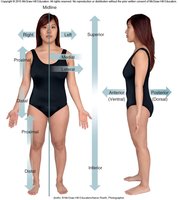
To describe locations and relationships of body parts, anatomists use standardized terminology. The anatomical position is the reference posture: body erect, face forward, arms at sides, palms forward.
Superior: Above another part
Inferior: Below another part
Anterior (Ventral): Toward the front
Posterior (Dorsal): Toward the back
Medial: Closer to the midline
Lateral: Toward the side
Bilateral: Paired structures, one on each side
Ipsilateral: Same side
Contralateral: Opposite side
Proximal: Closer to point of attachment
Distal: Farther from point of attachment
Superficial (Peripheral): Near the surface
Deep: More internal
Body Sections (Planes)
Body sections are used to describe internal views and imaging:
Sagittal: Divides body into right and left portions.
Median (Midsagittal): Divides body into equal right and left halves.
Parasagittal: Divides body into unequal right and left portions.
Transverse (Horizontal): Divides body into superior and inferior portions.
Frontal (Coronal): Divides body into anterior and posterior portions.
Body Regions
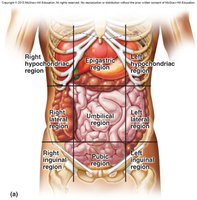
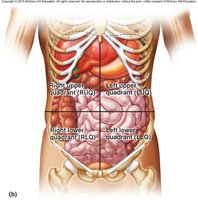
The abdominal area can be divided for clinical and anatomical reference:
Nine Regions: Epigastric, right/left hypochondriac, umbilical, right/left lumbar, hypogastric, right/left iliac (inguinal).
Four Quadrants: Right upper (RUQ), left upper (LUQ), right lower (RLQ), left lower (LLQ).
Terms for Various Body Regions
Specific terms are used to describe regions of the body (e.g., brachial for arm, femoral for thigh, etc.).