 Back
Chapter 1 Study Guidance: The Human Body—An Orientation
Study Guide - Smart Notes
 Tailored notes based on your materials, expanded with key definitions, examples, and context.
Q1. Anatomy studies the ____________ of body parts, while physiology studies the ____________ of body parts.
Background
Topic: Introduction to Anatomy and Physiology
This question tests your understanding of the basic definitions and distinctions between anatomy and physiology.
Key Terms:
Anatomy: The study of the structure of body parts.
Physiology: The study of the function of body parts.
Step-by-Step Guidance
Recall that anatomy is concerned with the physical form, arrangement, and location of body structures.
Physiology focuses on how those structures work and interact to sustain life.
Think about examples: Anatomy would describe the shape of the heart, while physiology would explain how the heart pumps blood.
Try solving on your own before revealing the answer!
Q2. List three subdivisions of gross anatomy and two subdivisions of microscopic anatomy.
Background
Topic: Subdivisions of Anatomy
This question asks you to identify the main branches of anatomy, both at the macroscopic (gross) and microscopic levels.
Key Terms:
Gross Anatomy: Study of structures visible to the naked eye.
Microscopic Anatomy: Study of structures too small to be seen without a microscope.
Step-by-Step Guidance
Recall the main subdivisions of gross anatomy: regional, systemic, and surface anatomy.
For microscopic anatomy, think about histology and cytology.
Write down examples for each subdivision to reinforce your understanding.
Try solving on your own before revealing the answer!
Q3. Which topic of anatomy specifically studies body tissues?
Background
Topic: Microscopic Anatomy
This question tests your knowledge of the specific branch of anatomy that deals with tissues.
Key Terms:
Histology: The study of tissues.
Step-by-Step Guidance
Review the definitions of surface anatomy, histology, regional anatomy, and gross anatomy.
Identify which term is most closely associated with the study of tissues.
Try solving on your own before revealing the answer!
Q4. Renal physiology considers the operation of which specific organ system?
Background
Topic: Physiology Subdivisions
This question asks you to connect a specific physiological study (renal physiology) to the correct organ system.
Key Terms:
Renal: Refers to the kidneys.
Organ System: A group of organs that work together to perform major functions.
Step-by-Step Guidance
Recall what "renal" refers to in medical terminology.
Identify the organ system that includes the kidneys and is responsible for waste removal and fluid balance.
Try solving on your own before revealing the answer!
Q5. In your own words, describe “the principle of complementarity of structure and function.”
Background
Topic: Structure-Function Relationship
This question tests your ability to explain how anatomical structure relates to physiological function.
Key Terms:
Complementarity: The idea that structure and function are interrelated.
Step-by-Step Guidance
Think about how the shape or arrangement of a body part enables its function.
Consider examples, such as how the structure of bones allows them to support weight.
Formulate a concise explanation in your own words.
Try solving on your own before revealing the answer!
Q6. Figure 1.1 in your text shows one example of the complementarity of structure and function. Give another example of this key concept.
Background
Topic: Structure-Function Relationship
This question encourages you to apply the principle of complementarity to a new example.
Key Terms:
Structure-Function Relationship: How the form of a body part enables its function.
Step-by-Step Guidance
Recall the example from Figure 1.1, then brainstorm another body part where structure is closely tied to function.
Think about organs like the lungs, heart, or hands.
Describe your chosen example, focusing on how its structure supports its function.
Try solving on your own before revealing the answer!
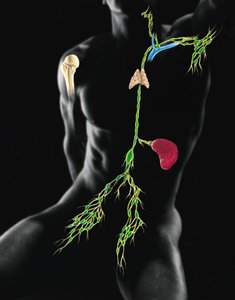
Q4. Which body system is shown?
Background
Topic: Organ Systems of the Human Body
This question asks you to identify the body system depicted in the provided image.
Key Terms:
Organ System: A group of organs working together to perform a function.
Step-by-Step Guidance
Examine the image carefully and note the organs and structures highlighted.
Identify the main organs shown (such as lymph nodes, spleen, thymus).
Recall which organ system these organs belong to and what their primary function is.
Try solving on your own before revealing the answer!
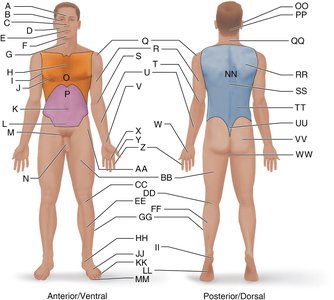
Q3. Assign the letters (A-WW) to the corresponding regional terms used to designate specific body areas.
Background
Topic: Anatomical Regions
This question tests your ability to identify and label anatomical regions using a diagram.
Key Terms:
Regional Terms: Names for specific areas of the body.
Step-by-Step Guidance
Refer to the provided diagram and match each letter to the correct anatomical region.
Use your textbook or lecture notes to review the names and locations of each region.
Start with familiar terms like gluteal, umbilical, and thorax, then work through the rest.
Try solving on your own before revealing the answer!
