 Back
BackChapter 1: The Human Body – An Orientation
Study Guide - Smart Notes
 Tailored notes based on your materials, expanded with key definitions, examples, and context.
Anatomy and Physiology
Definitions and Scope
Anatomy and physiology are foundational sciences for understanding the human body. Anatomy is the study of the structure of body parts and their relationships, while physiology focuses on the functions of these parts.
Gross anatomy: Structures visible to the naked eye.
Microscopic anatomy: Structures not visible without magnification.
Developmental anatomy: Structural changes throughout the lifespan.
Physiology examines how body parts work and interact to sustain life.
Subdivisions of Anatomy
Gross Anatomy
Gross anatomy is divided into three main subdivisions:
Regional anatomy: Study of all structures in a specific area.
Systemic anatomy: Study of body systems individually.
Surface anatomy: Study of internal structures as related to the skin surface.
Microscopic Anatomy
Cytology: Study of cells.
Histology: Study of tissues.
Developmental Anatomy
Embryology: Study of developmental changes before birth.
Specialized Branches of Anatomy
Pathological anatomy: Structural changes caused by disease.
Radiographic anatomy: Internal structures visualized by imaging (X-rays, MRI, CT).
Levels of Structural Organization
Hierarchy of Complexity
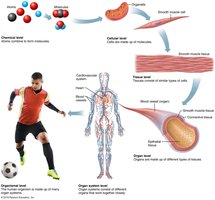
The human body is organized into six structural levels, each building upon the previous:
Chemical level: Atoms combine to form molecules.
Cellular level: Cells are composed of molecules.
Tissue level: Groups of similar cells form tissues.
Organ level: Organs are made of different types of tissues.
Organ system level: Organ systems consist of different organs working together.
Organismal level: The human organism is made up of all organ systems.
Organ Systems of the Body
Overview
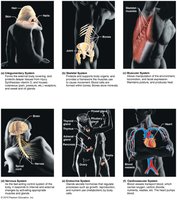
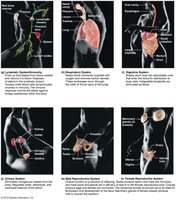
Organ systems work cooperatively to perform necessary life functions. All cells depend on organ systems for survival needs.
Interrelationships Among Organ Systems
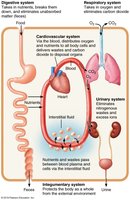
Body systems interact to maintain homeostasis and support life. For example, the cardiovascular system distributes nutrients and oxygen, while the digestive and respiratory systems supply these substances.
Necessary Life Functions
Eight Essential Functions
Maintaining boundaries: Separation between internal and external environments (e.g., skin, plasma membranes).
Movement: Movement of body parts (skeletal muscle) and substances (cardiac and smooth muscle).
Responsiveness: Ability to sense and respond to changes (e.g., withdrawal reflex, control of breathing rate).
Digestion: Breakdown and absorption of food.
Metabolism: All chemical reactions in cells, including catabolism and anabolism.
Excretion: Removal of metabolic and digestive wastes (urea, CO2, feces).
Reproduction: Cellular division for growth/repair and production of offspring.
Growth: Increase in size of body parts or organism.
Survival Needs
Five Key Requirements
Nutrients: Chemicals for energy and cell building (carbohydrates, fats, proteins, minerals, vitamins).
Oxygen: Essential for ATP production.
Water: Most abundant chemical; site of chemical reactions.
Normal body temperature: Affects rate of chemical reactions.
Appropriate atmospheric pressure: Necessary for breathing and gas exchange.
Homeostasis
Definition and Importance
Homeostasis is the maintenance of a stable internal environment despite external changes. It requires continuous monitoring and regulation of internal conditions such as temperature, blood pressure, and blood sugar.
Normal ranges are essential for optimal health.
Disturbances increase the risk of disease.
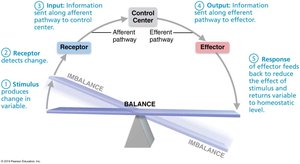
Components of a Control System
Three Main Components
Receptor (Sensor): Monitors environment and detects changes.
Control Center: Receives input, determines set point, and decides response.
Effector: Receives output and acts to reduce or enhance the stimulus.
Responses can be negative or positive feedback.
Feedback Systems
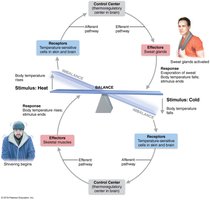
Negative Feedback
Negative feedback reverses deviations from a normal set point, restoring balance. Examples include regulation of body temperature and blood sugar.
Body temperature regulation: Nervous mechanism.
Blood sugar regulation: Hormonal mechanism (insulin).
Positive Feedback
Positive feedback intensifies a change and moves the body further from the normal range, usually until a specific endpoint is reached. Example: childbirth, where oxytocin enhances labor contractions.

Summary Table: Levels of Structural Organization
Level | Description |
|---|---|
Chemical | Atoms and molecules |
Cellular | Cells made of molecules |
Tissue | Groups of similar cells |
Organ | Different tissues forming organs |
Organ System | Organs working together |
Organismal | All organ systems combined |
Summary Table: Necessary Life Functions
Function | Description |
|---|---|
Maintaining boundaries | Separates internal and external environments |
Movement | Movement of body parts and substances |
Responsiveness | Sensing and responding to changes |
Digestion | Breakdown and absorption of food |
Metabolism | Chemical reactions in cells |
Excretion | Removal of wastes |
Reproduction | Cell division and offspring production |
Growth | Increase in size |
Key Equations
ATP Production:
