 Back
Chapter 1: The Human Body – An Orientation (Essentials of Human Anatomy & Physiology)
Study Guide - Smart Notes
 Tailored notes based on your materials, expanded with key definitions, examples, and context.
The Study of Anatomy and Physiology
Definitions and Scope
Anatomy and physiology are foundational sciences in understanding the human body. Anatomy is the study of the structure and shape of the body and its parts, while physiology focuses on how these parts function and interact.
Gross anatomy: Study of large, easily observable structures.
Microscopic anatomy: Study of structures too small to be seen with the naked eye, such as cells and tissues.
Structure determines function: The form of a body part enables its function (e.g., thin walls of lung air sacs allow gas exchange).
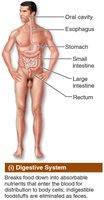
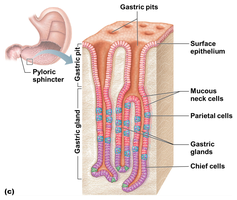
Example: Gross anatomy can be illustrated by examining the organs of the digestive system, while microscopic anatomy can be explored by studying the cellular structure of the stomach.
Levels of Structural Organization
Hierarchy of Complexity
The human body is organized into six structural levels, each building upon the previous:
Atoms: Smallest units of matter.
Cells: Basic units of life.
Tissues: Groups of similar cells performing a common function.
Organs: Structures composed of two or more tissue types.
Organ systems: Groups of organs working together for a common purpose.
Organism: The living human body as a whole.
The Body’s Organ Systems
Overview and Functions
The human body consists of eleven major organ systems, each with specific functions essential for life.
Integumentary system: Protects, waterproofs, and regulates temperature; includes skin, hair, and nails.
Skeletal system: Provides support, protection, and site for blood cell formation; includes bones and joints.
Muscular system: Produces movement and heat; includes skeletal muscles.
Nervous system: Fast-acting control system; includes brain, spinal cord, nerves, and sensory receptors.
Endocrine system: Secretes hormones for regulation of growth and reproduction.
Cardiovascular system: Transports blood, nutrients, gases, and hormones; includes heart and blood vessels.
Lymphatic system: Cleanses blood and houses immune cells.
Respiratory system: Supplies oxygen and removes carbon dioxide; includes lungs and airways.
Digestive system: Breaks down food, absorbs nutrients, eliminates waste.
Urinary system: Eliminates waste, regulates water and electrolytes.
Reproductive system: Produces offspring; includes testes and ovaries.
The Language of Anatomy
Special Terminology
Precise anatomical terms are used to describe positions, directions, regions, and structures to avoid misunderstanding.
Anatomical position: Standard reference position: standing erect, feet parallel, arms at sides, palms forward.
Directional and Regional Terms
Orientation and Directional Terms
Directional terms explain the location of one body structure relative to another.
Superior (cranial): Toward the head or upper part.
Inferior (caudal): Away from the head or lower part.
Anterior (ventral): Toward the front.
Posterior (dorsal): Toward the back.
Medial: Toward the midline.
Lateral: Away from the midline.
Proximal: Close to the origin or point of attachment.
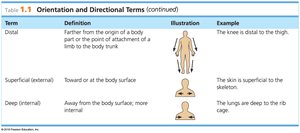
Distal: Farther from the origin or point of attachment.
Superficial (external): Toward the body surface.
Deep (internal): Away from the body surface; more internal.
Term | Definition | Illustration | Example |
|---|---|---|---|
Distal | Farther from the origin of a body part or the point of attachment of a limb to the body trunk | Body diagram | The knee is distal to the thigh. |
Superficial (external) | Toward or at the body surface | Body diagram | The skin is superficial to the skeleton. |
Deep (internal) | Away from the body surface; more internal | Body diagram | The lungs are deep to the rib cage. |
Regional Terms
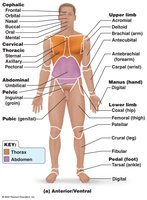
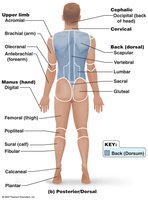
Regional terms identify specific areas of the body. The anterior (ventral) and posterior (dorsal) landmarks are commonly used.
Body Planes and Sections
Types of Planes
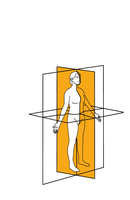
Body planes are imaginary lines used to divide the body for anatomical study.
Sagittal plane: Divides body into left and right parts.
Median (midsagittal) plane: Divides body into equal left and right parts.
Frontal (coronal) plane: Divides body into anterior and posterior parts.
Transverse (cross) plane: Divides body into superior and inferior parts.
Body Cavities
Major Cavities and Subdivisions
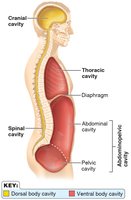
The body contains two main internal cavities: dorsal and ventral.
Dorsal cavity: Includes cranial (brain) and spinal (spinal cord) cavities.
Ventral cavity: Includes thoracic (heart, lungs) and abdominopelvic (digestive, urinary, reproductive organs) cavities, separated by the diaphragm.
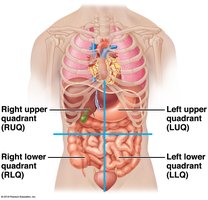
The abdominopelvic cavity can be further subdivided into four quadrants and nine regions for clinical reference.
Homeostasis
Definition and Importance
Homeostasis is the maintenance of relatively stable internal conditions, essential for normal body functioning and survival. It is a dynamic equilibrium controlled mainly by the nervous and endocrine systems.
Homeostatic imbalance: Disturbance in homeostasis can lead to disease.
Elements of a Homeostatic Control System
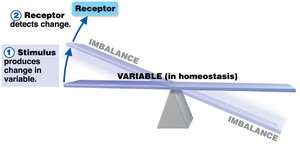
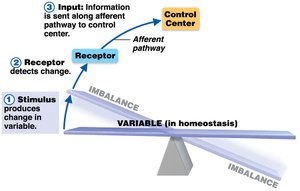
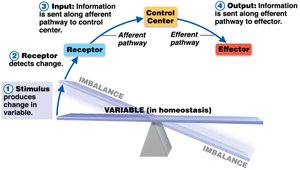
All homeostatic control mechanisms have three components:
Receptor: Detects changes (stimuli) in the environment and sends information to the control center via the afferent pathway.
Control center: Determines the set point, integrates information, and decides the response.
Effector: Provides the means for the response, receiving instructions from the control center via the efferent pathway.
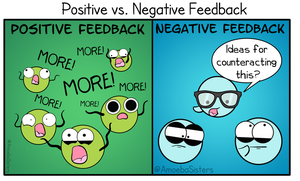
Feedback Mechanisms
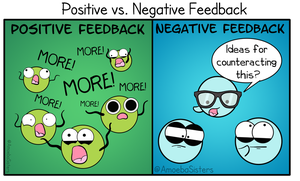
Homeostatic regulation is achieved through feedback mechanisms:
Negative feedback: Most common; shuts off or reduces the original stimulus (e.g., body temperature regulation).
Positive feedback: Rare; increases the original stimulus (e.g., blood clotting, childbirth).
Summary Table: Major Organ Systems and Functions
Organ System | Main Components | Primary Functions |
|---|---|---|
Integumentary | Skin, hair, nails | Protection, temperature regulation, vitamin D synthesis |
Skeletal | Bones, joints | Support, protection, movement, blood cell formation |
Muscular | Skeletal muscles | Movement, heat production |
Nervous | Brain, spinal cord, nerves | Control, communication, response to stimuli |
Endocrine | Glands, hormones | Regulation of growth, metabolism, reproduction |
Cardiovascular | Heart, blood vessels | Transport of nutrients, gases, hormones |
Lymphatic | Lymph nodes, vessels | Immunity, fluid balance |
Respiratory | Lungs, airways | Gas exchange |
Digestive | Stomach, intestines, accessory organs | Digestion, absorption, waste elimination |
Urinary | Kidneys, bladder | Waste elimination, water/electrolyte balance |
Reproductive | Testes, ovaries | Production of offspring |
