 Back
Chapter 1: The Human Body – An Orientation
Study Guide - Smart Notes
 Tailored notes based on your materials, expanded with key definitions, examples, and context.
Introduction to Anatomy and Physiology
Definitions and Scope
Anatomy and physiology are foundational sciences for understanding the structure and function of the human body. Anatomy is the study of the structure of organisms and their parts, while physiology focuses on the functions of living organisms and their parts. Pathology is the scientific study of disease, examining abnormal conditions and their effects on body structure and function.
The Scientific Method
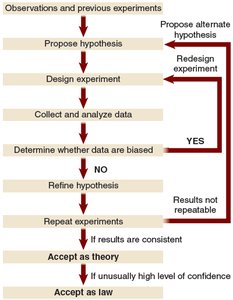
The scientific method is a systematic approach used in biological and medical research to ensure reliable and repeatable results. It involves observation, hypothesis formation, experimental design, data collection, analysis, and refinement of hypotheses. If results are consistent, theories and laws may be established.
Observation: Gathering information from previous experiments.
Hypothesis: Proposing a testable explanation.
Experiment: Designing and conducting tests.
Analysis: Collecting and analyzing data.
Refinement: Adjusting hypotheses based on results.
Levels of Structural Organization
Hierarchy of Organization
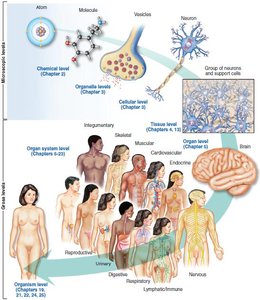
The human body is organized into a hierarchy of structural levels, each building upon the previous. This organization is essential for understanding how the body functions as a whole.
Chemical Level: Atoms and molecules form the basis of all matter.
Cellular Level: Cells are the smallest structural units, composed of various chemicals.
Tissue Level: Groups of similar cells form tissues.
Organ Level: Different tissues combine to form organs.
System Level: Organs work together in systems to perform complex functions.
Anatomical Position and Directional Terms
Anatomical Position
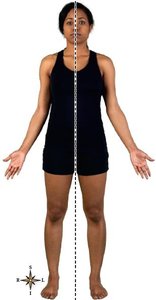
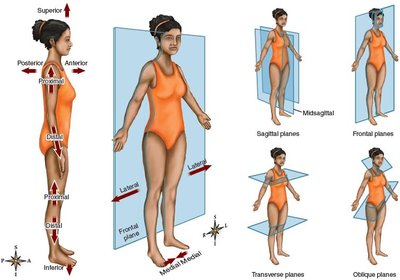
The anatomical position is the standard reference for describing locations and directions on the human body. The body stands erect, feet slightly apart, arms at the sides, and palms facing forward. This position provides a consistent frame of reference for anatomical terminology.
Directional Terms
Directional terms are used to describe the locations of structures relative to other structures or locations in the body.
Superior: Toward the head, upper, above
Inferior: Toward the feet, lower, below
Anterior (Ventral): Front, in front of
Posterior (Dorsal): Back, in back of
Medial: Toward the midline
Lateral: Away from the midline
Proximal: Nearer the trunk or point of origin
Distal: Farther from the trunk or point of origin
Superficial: Nearer the body surface
Deep: Farther from the body surface
Planes of the Body
Body planes are imaginary lines used to divide the body into sections for anatomical study.
Sagittal Plane: Divides the body into right and left sections
Midsagittal Plane: Divides the body into equal right and left halves
Frontal (Coronal) Plane: Divides the body into anterior and posterior sections
Transverse Plane: Divides the body into upper and lower sections
Body Cavities
Major Body Cavities
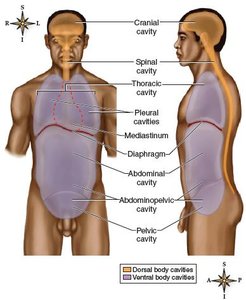
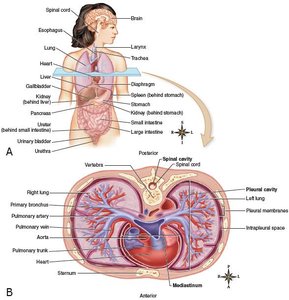
The body contains several cavities that house and protect internal organs. These cavities are classified as dorsal and ventral.
Dorsal Cavity: Includes the cranial cavity (brain) and spinal cavity (spinal cord).
Ventral Cavity: Includes the thoracic cavity (heart, lungs, mediastinum), and abdominopelvic cavity (digestive, urinary, and reproductive organs).
Organs in Body Cavities
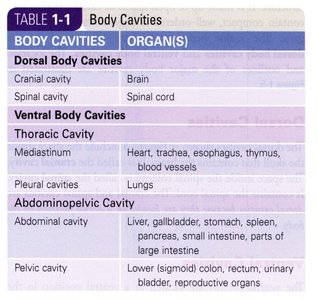
Each cavity contains specific organs, as summarized in the following table:
Body Cavity | Organ(s) |
|---|---|
Cranial cavity | Brain |
Spinal cavity | Spinal cord |
Mediastinum | Heart, trachea, esophagus, thymus, blood vessels |
Pleural cavities | Lungs |
Abdominal cavity | Liver, gallbladder, stomach, spleen, pancreas, small intestine, part of large intestine |
Pelvic cavity | Lower colon, rectum, urinary bladder, reproductive organs |
Abdominopelvic Regions and Quadrants
The abdominopelvic cavity is further divided into regions and quadrants for clinical and anatomical reference.
Nine Regions: Used for detailed anatomical study (e.g., epigastric, umbilical, hypogastric).
Four Quadrants: Used for clinical diagnosis (e.g., right upper quadrant, left lower quadrant).
Body Regions and Divisions
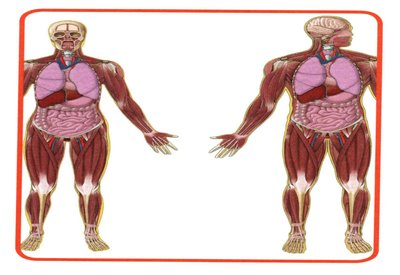
Axial and Appendicular Regions
The body is divided into two main regions:
Axial Region: Includes the head, neck, and torso (trunk).
Appendicular Region: Includes the upper and lower extremities (limbs).
Homeostasis and Feedback Mechanisms
Homeostasis
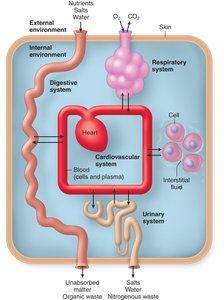
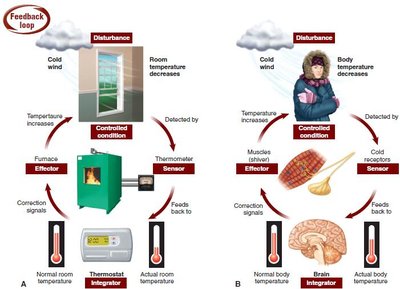
Homeostasis is the maintenance of a stable internal environment, essential for survival. The body uses feedback loops to regulate internal conditions.
Negative Feedback Loops: Counteract changes, restoring balance (e.g., temperature regulation).
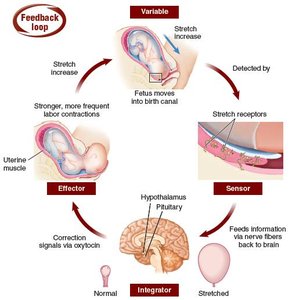
Positive Feedback Loops: Amplify changes, often leading to a specific outcome (e.g., childbirth).
Components: Sensor, control center (integrator), and effector.
Healthy Fluctuations and Age
All organs function to maintain homeostasis. The ability to maintain balance diminishes with age, with peak efficiency in young adulthood.
Review Questions
Sample Questions and Answers
The scientific study of disease is: Pathology
Neurons are included in what structural level of organization? Cellular
How is a frontal plane best described? Divides the body into anterior and posterior portions
Name the two major body cavities. Dorsal and ventral
In which abdominal region would you expect to find the appendix? Hypogastric
If you incurred an injury to the femoral region of the body, what term below describes its location? Thigh
Maintaining a relative constancy of the internal environment is defined as: Homeostasis
The events that cause rapid increases in uterine contractions before the birth of a baby are controlled by what type of feedback loop? Positive feedback loop
Summary Table: Body Cavities and Organs
Body Cavity | Organ(s) |
|---|---|
Cranial cavity | Brain |
Spinal cavity | Spinal cord |
Mediastinum | Heart, trachea, esophagus, thymus, blood vessels |
Pleural cavities | Lungs |
Abdominal cavity | Liver, gallbladder, stomach, spleen, pancreas, small intestine, part of large intestine |
Pelvic cavity | Lower colon, rectum, urinary bladder, reproductive organs |
Key Equations
Feedback Loop (Generalized)
Feedback loops can be represented mathematically as:
Where the correction signal is determined by the sensor and integrator to restore homeostasis.
Additional info:
Some anatomical terms and regions are inferred for completeness.
Tables and diagrams are recreated for clarity and academic context.
