 Back
Chapter 1: The Human Body – An Orientation (Anatomy & Physiology Study Guide)
Study Guide - Smart Notes
 Tailored notes based on your materials, expanded with key definitions, examples, and context.
Introduction to Anatomy & Physiology
Overview of Anatomy
Anatomy is the study of the structure of body parts and their relationships to one another. It is divided into several branches based on the scale and method of study.
Gross Anatomy: Study of large body parts visible to the naked eye. Includes surface anatomy, which relates internal structures to the overlying skin.
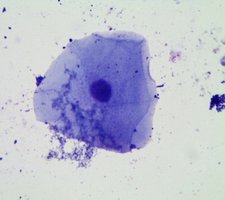
Microscopic Anatomy: Study of small structures visible only through a microscope. Includes histology (study of tissues) and cytology (study of cells).
Developmental Anatomy: Study of structural changes throughout the lifespan. Example: Embryology traces development from fertilization to birth.
Overview of Physiology
Physiology is the study of the function of body parts and how they work together to sustain life. It is closely linked to anatomy, as function always reflects structure.
Principle of Complementarity: The function of a body part depends on its structure. For example, the shape of bones allows them to support weight and facilitate movement.
Levels of Structural Organization
Hierarchy of Complexity
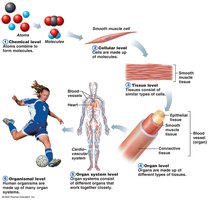
The human body is organized into a hierarchy of structural levels, each building upon the previous.
Atoms → Molecules → Organelles → Cells → Tissues → Organs → Organ Systems → Organism
The Body’s Organ Systems
Overview of Major Organ Systems
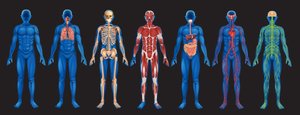
The human body consists of several organ systems, each with specific functions essential for survival.
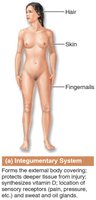
Integumentary System: Protects the body, synthesizes vitamin D, and contains sensory receptors.
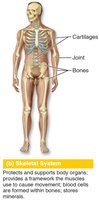
Skeletal System: Provides support, protection, and framework for movement; stores minerals and forms blood cells.
Muscular System: Allows movement, maintains posture, and produces heat.
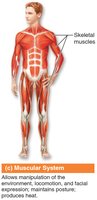
Nervous System: Fast-acting control system; responds to internal and external changes.
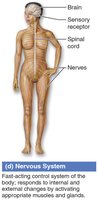
Endocrine System: Secretes hormones that regulate processes such as growth and metabolism.
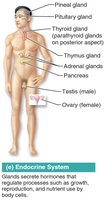
Cardiovascular System: Transports blood, nutrients, gases, and wastes.
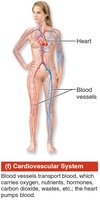
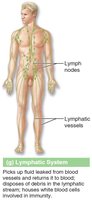
Lymphatic System: Returns leaked fluid to blood, disposes of debris, and houses immune cells.
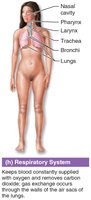
Respiratory System: Supplies blood with oxygen and removes carbon dioxide.
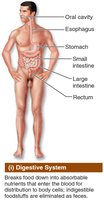
Digestive System: Breaks down food and absorbs nutrients; eliminates waste.
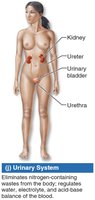
Urinary System: Eliminates nitrogenous wastes; regulates water, electrolytes, and acid-base balance.
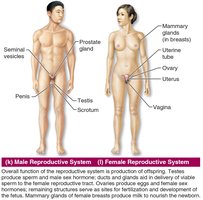
Reproductive System: Produces offspring; includes male and female reproductive organs.
Necessary Life Functions
Essential Functions for Life
To maintain life, the human body must perform several essential functions:
Maintaining boundaries: Separates internal and external environments.
Movement: Locomotion and movement of substances within the body.
Responsiveness: Ability to sense and respond to stimuli.
Digestion: Breakdown and absorption of nutrients.
Metabolism: All chemical reactions in the body; includes catabolism and anabolism.
Excretion: Removal of waste products.
Reproduction: Production of offspring and cell division for growth and repair.
Growth: Increase in size of body parts or organism.
Homeostasis
Definition and Importance
Homeostasis is the maintenance of relatively stable internal conditions despite continuous changes in the environment. It is essential for survival and is achieved through the cooperation of organ systems.
Example: Regulation of body temperature, blood glucose, and pH.
Elements of Homeostatic Control Mechanism
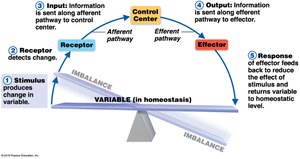
Homeostatic control mechanisms involve three main components:
Receptor (sensor): Monitors environment and detects changes (stimuli).
Control Center: Determines the set point, receives input, and decides the response.
Effector: Receives output and provides the means to respond, either reducing (negative feedback) or enhancing (positive feedback) the stimulus.
Feedback Mechanisms
Feedback mechanisms are used to maintain homeostasis:
Negative Feedback: Most common; brings conditions back to normal by reversing the direction of change.
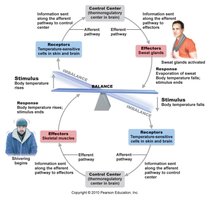
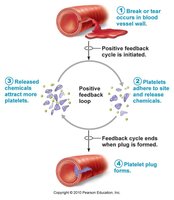
Positive Feedback: Less common; amplifies the change and moves the condition further from normal.
The Language of Anatomy
Anatomical Position and Body Divisions
The anatomical position is the standard reference for describing locations and directions on the body:
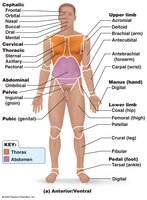
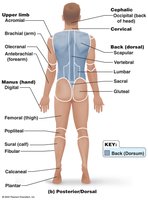
Anatomical Position: Body erect, feet slightly apart, palms facing forward, thumbs pointing away.
Body Divisions: Axial (head, neck, trunk) and Appendicular (limbs).
Regional and Directional Terms
Regional terms identify specific areas of the body, while directional terms describe the location of one body part relative to another.
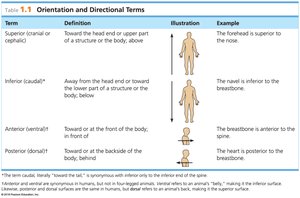
Anterior (ventral): Front of the body
Posterior (dorsal): Back of the body
Superior (cranial): Toward the head
Inferior (caudal): Away from the head
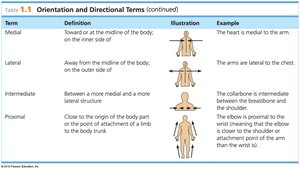
Medial: Toward the midline
Lateral: Away from the midline
Proximal: Closer to the origin
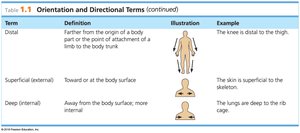
Distal: Farther from the origin
Superficial: Toward the body surface
Deep: Away from the body surface
Term | Definition | Example |
|---|---|---|
Superior (cranial) | Toward the head end or upper part of a structure | The forehead is superior to the nose |
Inferior (caudal) | Away from the head end or toward the lower part of a structure | The navel is inferior to the breastbone |
Anterior (ventral) | Toward the front of the body | The breastbone is anterior to the spine |
Posterior (dorsal) | Toward the back of the body | The heart is posterior to the sternum |
Medial | Toward the midline of the body | The heart is medial to the arm |
Lateral | Away from the midline of the body | The arms are lateral to the chest |
Proximal | Closer to the origin of a body part | The elbow is proximal to the wrist |
Distal | Farther from the origin of a body part | The knee is distal to the thigh |
Superficial | Toward or at the body surface | The skin is superficial to the skeleton |
Deep | Away from the body surface | The lungs are deep to the rib cage |
Body Planes and Sections
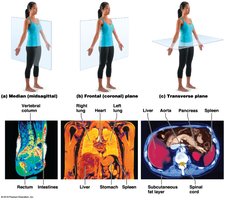
Body planes are imaginary lines used to divide the body for anatomical study:
Sagittal Plane: Divides the body into left and right parts.
Median (midsagittal) Plane: Divides the body into equal left and right parts.
Frontal (coronal) Plane: Divides the body into anterior and posterior parts.
Transverse (cross) Plane: Divides the body into superior and inferior parts.
Body Cavities
Major Body Cavities
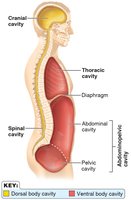
The body contains two main internal cavities that protect organs:
Dorsal Cavity: Includes the cranial and spinal cavities.
Ventral Cavity: Includes the thoracic, abdominal, and pelvic cavities.
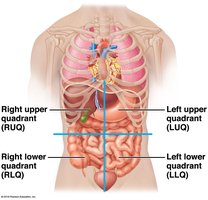
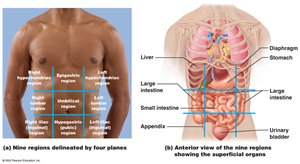
Abdominopelvic Quadrants and Regions
The abdominopelvic area is divided for clinical and anatomical reference:
Four Quadrants: Right upper (RUQ), left upper (LUQ), right lower (RLQ), left lower (LLQ).
Nine Regions: Used for more precise localization of organs.
Summary Table: Major Organ Systems
System | Main Function | Key Organs |
|---|---|---|
Integumentary | Protection, vitamin D synthesis | Skin, hair, nails |
Skeletal | Support, movement, blood cell formation | Bones, joints, cartilages |
Muscular | Movement, heat production | Skeletal muscles |
Nervous | Control, communication | Brain, spinal cord, nerves |
Endocrine | Hormone secretion, regulation | Glands (pituitary, thyroid, etc.) |
Cardiovascular | Transport of substances | Heart, blood vessels |
Lymphatic | Immunity, fluid balance | Lymph nodes, lymph vessels |
Respiratory | Gas exchange | Lungs, trachea |
Digestive | Nutrient breakdown and absorption | Stomach, intestines |
Urinary | Waste elimination, balance | Kidneys, bladder |
Reproductive | Offspring production | Testes, ovaries, uterus |
Additional info: Academic context was added to clarify developmental anatomy, homeostasis, and feedback mechanisms, as well as to expand on the functions and examples of each organ system.
