 Back
BackChapter 1: The Human Body—An Orientation (Anatomy & Physiology Study Notes)
Study Guide - Smart Notes
 Tailored notes based on your materials, expanded with key definitions, examples, and context.
The Human Body: An Orientation
Anatomy and Physiology: Definitions and Scope
Anatomy and physiology are foundational sciences in understanding the human body. Anatomy is the study of the structure of body parts and their relationships to one another, while physiology focuses on how these parts function and work together to sustain life.
Anatomy: Examines the form and organization of body structures.
Physiology: Explores the mechanisms and processes that allow the body to function.
Example: Studying the stomach's shape (anatomy) versus understanding how it digests food (physiology).
Levels of Structural Organization in the Human Body
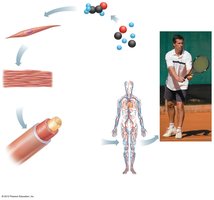
The human body is organized into hierarchical levels, each building upon the previous one. Understanding these levels is essential for grasping how complex functions arise from simple components.
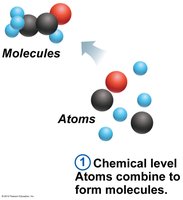
Chemical Level: Atoms combine to form molecules, the simplest level of organization.
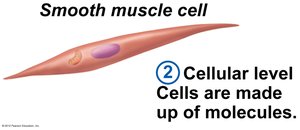
Cellular Level: Molecules form cells, the basic units of life.
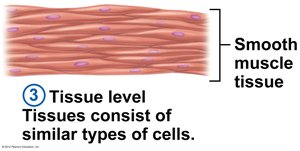
Tissue Level: Similar cells group together to form tissues.
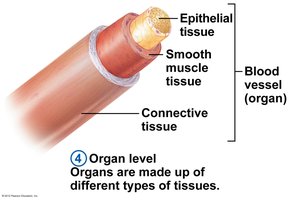
Organ Level: Different tissues combine to create organs with specific functions.
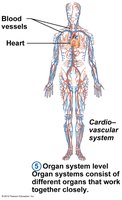
Organ System Level: Organs work together in organ systems to perform complex tasks.
Organismal Level: All organ systems combine to form the complete human organism.

Gross and Microscopic Anatomy
Anatomy can be studied at different scales:
Gross Anatomy: Study of large, easily observable structures (e.g., organs, muscles).
Microscopic Anatomy: Study of structures too small to be seen with the naked eye, requiring a microscope (e.g., cells, tissues).
Organ System Overview
The human body is composed of multiple organ systems, each with specialized functions essential for survival and homeostasis.
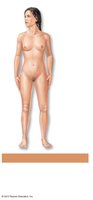
Integumentary System: Protects the body, regulates temperature, and houses sensory receptors.
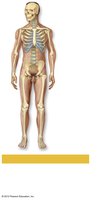
Skeletal System: Provides support, protection, and stores minerals; site of blood cell formation.
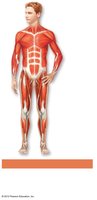
Muscular System: Enables movement, maintains posture, and produces heat.
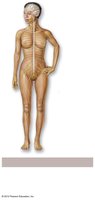
Nervous System: Fast-acting control system, responds to stimuli by activating muscles and glands.
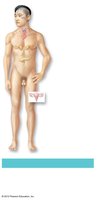
Endocrine System: Secretes hormones for regulation of growth, reproduction, and metabolism.
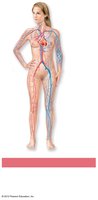
Cardiovascular System: Transports blood, nutrients, gases, and wastes.
Lymphatic System: Returns fluids to blood, cleanses blood, and is involved in immunity.
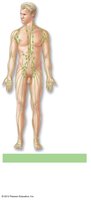
Respiratory System: Supplies blood with oxygen and removes carbon dioxide.
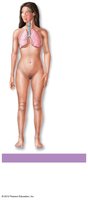
Digestive System: Breaks down food, absorbs nutrients, and eliminates waste.
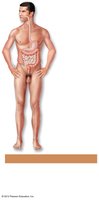
Urinary System: Eliminates nitrogenous wastes, regulates water, electrolytes, and acid-base balance.
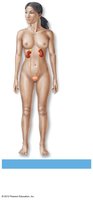
Reproductive System: Produces offspring and sex hormones.
Homeostasis: Maintaining Internal Balance
Homeostasis is the maintenance of a stable internal environment, essential for normal body functioning and survival. It is a dynamic state of equilibrium, constantly adjusted by the body’s regulatory mechanisms.
Homeostatic Imbalance: Disturbances in homeostasis can lead to disease.
Components of Homeostatic Control:
Receptor: Detects changes (stimuli) and sends information to the control center.
Control Center: Determines the set point, analyzes input, and determines the response.
Effector: Carries out the response to restore balance.
Feedback Mechanisms:
Negative Feedback: Reduces or shuts off the original stimulus (e.g., body temperature regulation).
Positive Feedback: Enhances the original stimulus (e.g., blood clotting, childbirth).
The Language of Anatomy: Terminology and Orientation
Precise anatomical terminology is used to describe body positions, directions, regions, and structures, minimizing misunderstanding in medical communication.
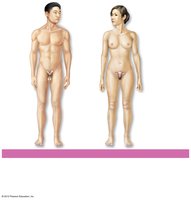
Anatomical Position: Standard reference position: body erect, feet slightly apart, palms facing forward, thumbs pointing away from the body.
Regional Terms
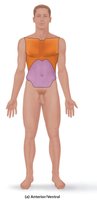
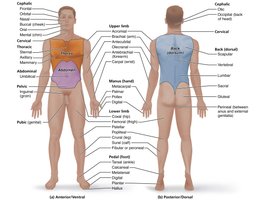
Regional terms specify particular areas of the body, divided into anterior (ventral) and posterior (dorsal) regions.
Anterior/Ventral Regions: Include cephalic (head), cervical (neck), thoracic (chest), abdominal, pelvic, upper and lower limbs, etc.
Posterior/Dorsal Regions: Include back, gluteal, lumbar, sacral, and others.
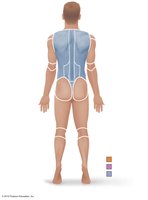
Directional Terms
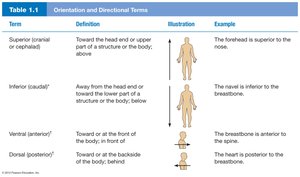
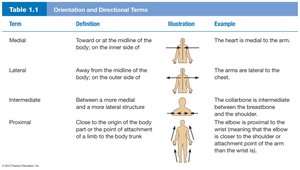
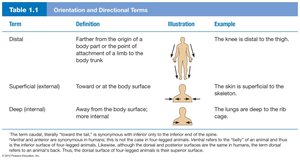
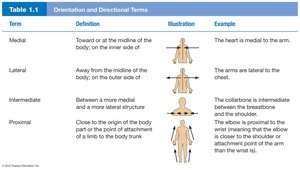
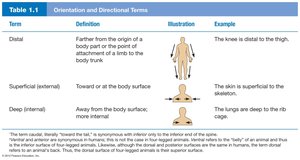
Directional terms describe the location of one body part relative to another. These terms are essential for accurately describing positions and relationships in anatomy.
Term | Definition | Example |
|---|---|---|
Superior (cranial) | Toward the head or upper part of a structure | The forehead is superior to the nose. |
Inferior (caudal) | Away from the head or toward the lower part | The navel is inferior to the breastbone. |
Ventral (anterior) | Toward or at the front of the body | The breastbone is anterior to the spine. |
Dorsal (posterior) | Toward or at the back of the body | The heart is posterior to the breastbone. |
Medial | Toward or at the midline of the body | The heart is medial to the arm. |
Lateral | Away from the midline of the body | The arms are lateral to the chest. |
Intermediate | Between a more medial and a more lateral structure | The collarbone is intermediate between the breastbone and the shoulder. |
Proximal | Closer to the origin of the body part or point of attachment | The elbow is proximal to the wrist. |
Distal | Farther from the origin of a body part | The knee is distal to the thigh. |
Superficial (external) | Toward or at the body surface | The skin is superficial to the skeleton. |
Deep (internal) | Away from the body surface; more internal | The lungs are deep to the rib cage. |
Body Planes and Sections
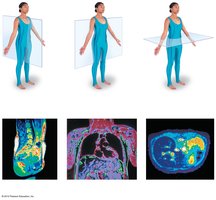
Body planes are imaginary lines used to divide the body or organs for anatomical study:
Sagittal Plane: Divides the body into left and right parts.
Midsagittal (Median) Plane: Divides the body into equal left and right halves.
Frontal (Coronal) Plane: Divides the body into anterior and posterior parts.
Transverse (Cross) Plane: Divides the body into superior and inferior parts.
Body Cavities and Membranes
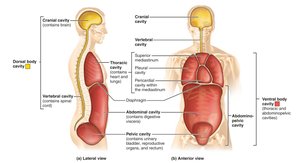
The body contains internal cavities that protect organs and allow for organ movement and expansion.
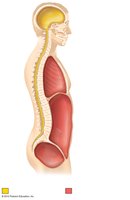
Dorsal Body Cavity: Includes the cranial cavity (brain) and vertebral cavity (spinal cord).
Ventral Body Cavity: Includes the thoracic cavity (heart, lungs) and abdominopelvic cavity (digestive, urinary, reproductive organs).
Serous Membranes (Serosa): Thin, double-layered membranes lining ventral body cavities and covering organs. Includes parietal (lines cavity walls) and visceral (covers organs) layers, with serous fluid in between for lubrication.
Examples: Pleura (lungs), pericardium (heart), peritoneum (abdominopelvic organs).
Abdominal Regions and Quadrants
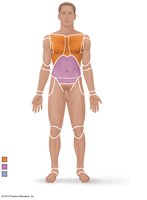
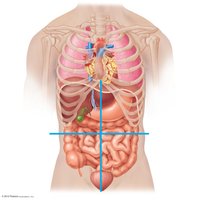
The abdomen is divided for clinical and anatomical reference:
Quadrants: Right upper (RUQ), left upper (LUQ), right lower (RLQ), left lower (LLQ).
Nine Regions: Right/left hypochondriac, epigastric, right/left lumbar, umbilical, right/left iliac (inguinal), hypogastric (pubic).
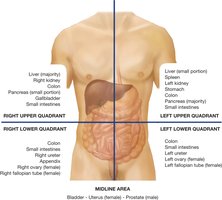
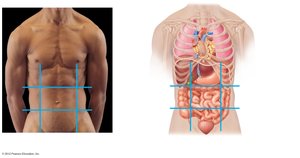
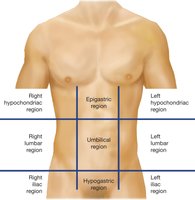
Example: Pain in the right lower quadrant (RLQ) may indicate appendicitis, while pain in the left upper quadrant (LUQ) could be related to the spleen or stomach.
Additional info: Mastery of anatomical terminology and body organization is essential for further study in anatomy and physiology, as it provides the foundation for understanding more complex systems and clinical applications.
