 Back
BackChapter 1: The Human Body—An Orientation (Study Notes)
Study Guide - Smart Notes
 Tailored notes based on your materials, expanded with key definitions, examples, and context.
Introduction to Anatomy and Physiology
Definition and Scope
Anatomy is the study of the structure of body parts and their relationships to one another, while physiology is the study of the function of the body—how body parts work to carry out life-sustaining activities. Understanding both is essential for a comprehensive knowledge of the human body.
Anatomy: Focuses on form and structure.
Physiology: Focuses on function and processes.
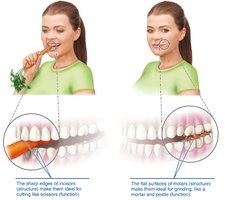
Form determines function: The structure of a body part enables its function.
Reference Standards and Anatomical Variability
Reference Individuals
Textbook values are based on a reference male (70 kg) and a reference female (57 kg). However, anatomical variability exists among individuals.
Over 90% of anatomical structures match textbook descriptions.
Minor variations (e.g., nerves or blood vessels out of place) are common.
Extreme variations are rare and usually incompatible with life.
Sex and Gender
Sex: Biological attributes (chromosomes, gene expression, hormone action, reproductive anatomy).
Gender: Psychosocial construct (behaviors, expressions, identities).
Studying Anatomy
Methods and Tools
Studying anatomy requires understanding terminology and using various techniques:
Observation
Manipulation
Palpation: Feeling organs with hands
Auscultation: Listening to organs with a stethoscope
Medical imaging: X-ray, MRI, CT, ultrasound
Subdivisions of Anatomy and Physiology
Anatomy
Gross (macroscopic) anatomy: Large structures visible to the naked eye
Regional anatomy: All structures in a specific area
System anatomy: One system at a time (e.g., cardiovascular)
Surface anatomy: Internal structures as related to overlying skin
Microscopic anatomy: Structures too small to see unaided (cytology—cells, histology—tissues)
Developmental anatomy: Structural changes throughout life (embryology—before birth)
Physiology
Subdivided by organ systems (e.g., renal, neurophysiology, cardiovascular physiology)
Focuses on cellular and molecular events
Requires understanding of chemistry and physics
Levels of Structural Organization
Hierarchy from Atoms to Organism
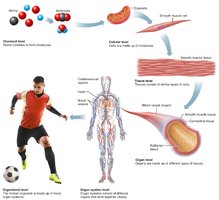
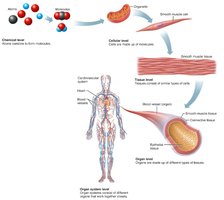
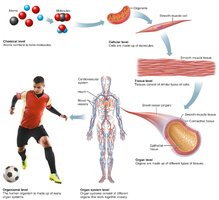
The human body is organized into a hierarchy of structural levels:
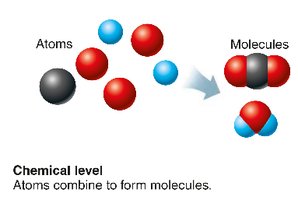
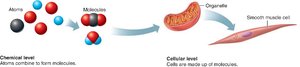
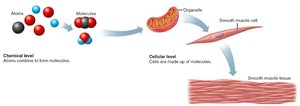
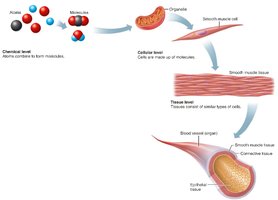
Chemical level: Atoms combine to form molecules
Cellular level: Cells are made up of molecules
Tissue level: Tissues consist of similar types of cells
Organ level: Organs are made up of different types of tissues
Organ system level: Organ systems consist of different organs that work together
Organismal level: The human organism is made up of many organ systems
The Body’s Organ Systems and Their Major Functions
Overview of the 11 Organ Systems
The human body is composed of 11 organ systems, each with specific functions essential for survival.
System | Main Functions |
|---|---|
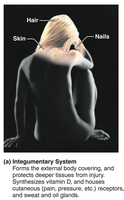
Integumentary | Protects body, synthesizes vitamin D, houses receptors and glands |
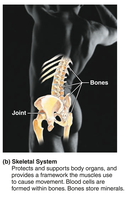
Skeletal | Supports and protects organs, provides framework, forms blood cells, stores minerals |
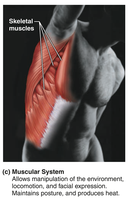
Muscular | Allows movement, maintains posture, produces heat |
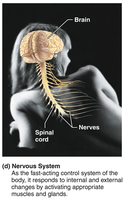
Nervous | Fast-acting control system, responds to stimuli |
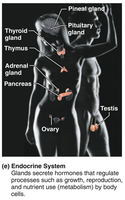
Endocrine | Secretes hormones for regulation of growth, reproduction, metabolism |
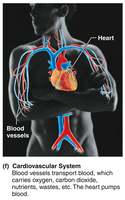
Cardiovascular | Transports blood, nutrients, gases, wastes |
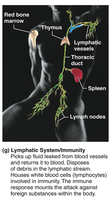
Lymphatic/Immunity | Returns leaked fluid, disposes debris, houses immune cells |
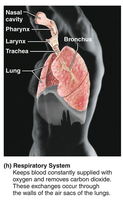
Respiratory | Supplies blood with oxygen, removes carbon dioxide |
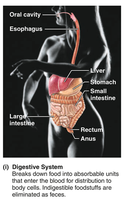
Digestive | Breaks down food, absorbs nutrients, eliminates waste |
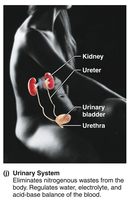
Urinary | Eliminates nitrogenous wastes, regulates water, electrolytes, acid-base balance |
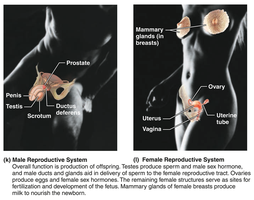
Reproductive | Produces offspring, sex hormones |
Requirements for Life
Necessary Life Functions
Maintaining boundaries: Separation between internal and external environments (e.g., plasma membranes, skin)
Movement: Of body parts, cells, and substances
Responsiveness: Ability to sense and respond to stimuli
Digestion: Breakdown and absorption of food
Metabolism: All chemical reactions in the body (catabolism, anabolism, cellular respiration)
Excretion: Removal of wastes
Reproduction: Cellular and organismal levels
Growth: Increase in size or number of cells
Survival Needs
Nutrients: Carbohydrates, proteins, fats, vitamins, minerals
Oxygen: Essential for energy production
Water: Most abundant chemical in the body
Normal body temperature: Necessary for metabolic reactions
Appropriate atmospheric pressure: Required for breathing and gas exchange
Homeostasis
Definition and Importance
Homeostasis is the maintenance of relatively stable internal conditions despite continuous environmental changes. It is a dynamic equilibrium, maintained by all organ systems.
Law of mass balance: Input equals output for substances in the body.
Homeostatic Control Mechanisms
Receptor: Monitors environment, responds to stimuli
Control center: Determines set point, analyzes input, determines response
Effector: Carries out response, reduces or enhances stimulus
Types of Feedback
Negative feedback: Most common; reduces or shuts off original stimulus (e.g., body temperature, blood glucose regulation)
Positive feedback: Enhances original stimulus; usually controls infrequent events (e.g., labor contractions, blood clotting)
Feedforward response: Anticipatory response before a change occurs (e.g., salivation before eating)
Homeostatic Imbalance
Disturbance increases risk of disease and aging-related changes.
If negative feedback is overwhelmed, positive feedback may become destructive (e.g., heart failure).
Additional info: Homeostasis is a central concept in physiology, underlying the regulation of all body systems and their integration for survival.
