 Back
BackChapter 1: The Human Body—An Orientation
Study Guide - Smart Notes
 Tailored notes based on your materials, expanded with key definitions, examples, and context.
Introduction to Anatomy and Physiology
Overview
The study of the human body begins with understanding its structure (anatomy) and function (physiology). These two disciplines are inseparable, as the form of a structure determines its function—a concept known as the principle of complementarity.
Anatomy: Study of body structures and their relationships.
Physiology: Study of how body structures work to carry out life-sustaining activities.
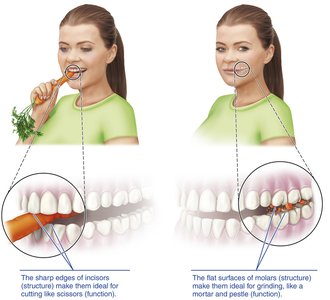
Complementarity: Structure and function are closely linked; for example, thin alveolar walls in the lungs permit efficient gas exchange.
Branches of Anatomy
Macroscopic (Gross) Anatomy
Gross Anatomy: Structures visible to the naked eye.
Regional Anatomy: All structures in a specific area (e.g., head, chest).
Systemic Anatomy: Study of one body system at a time (e.g., cardiovascular, nervous).
Surface Anatomy: Study of internal structures as they relate to the skin surface.
Microscopic and Developmental Anatomy
Microscopic Anatomy: Structures too small to see unaided.
Cytology: Study of cells.
Histology: Study of tissues.
Developmental Anatomy: Structural changes throughout the lifespan (e.g., embryology).
Studying Anatomy
Mastery of anatomical terminology is essential.
Key skills: observation, manipulation, palpation (feeling organs), auscultation (listening to sounds).
Medical imaging (X-ray, CT, MRI, ultrasound) provides internal views without surgery.
Defining Physiology
Scope and Focus
Studies the function of organ systems (e.g., renal, cardiovascular).
Focuses on cellular and molecular events.
Depends on chemical and physical principles (e.g., electrical currents, pressure, osmosis).
Complementarity of Structure and Function
Principle of Complementarity
Function always reflects structure.
Examples: Bones support due to their hard matrix; blood flows one way because valves prevent backflow.

Anatomic Variability, Sex, and Gender
Variability
90% of structures match textbook descriptions; minor variations are common.
Extreme variations are rare and often incompatible with life.
Sex and Gender
Sex: Biological attributes (chromosomes, hormones, reproductive anatomy).
Gender: Psychosocial construct (behaviors, identities).
Both influence health and clinical presentation.
Levels of Structural Organization
Hierarchy of Organization
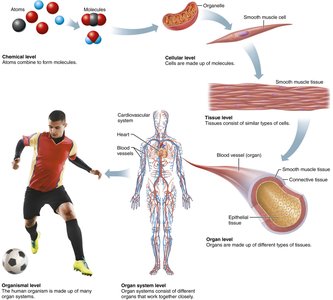
The human body is organized into a hierarchy from simplest to most complex:
Chemical Level: Atoms combine to form molecules (e.g., H2O, proteins).
Cellular Level: Cells are the basic units of life, made up of organelles and molecules.
Tissue Level: Groups of similar cells performing a common function (epithelial, connective, muscle, nervous).
Organ Level: Structures composed of two or more tissue types (e.g., stomach).
Organ System Level: Organs working together for a common purpose (11 major systems).
Organismal Level: The living human being; all systems working together.
Major Organ Systems of the Human Body
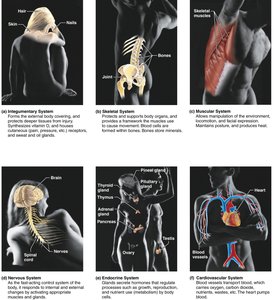
Integumentary
Skeletal
Muscular
Nervous
Endocrine
Cardiovascular
Lymphatic
Respiratory
Digestive
Urinary
Reproductive
Interrelationships Among Body Systems
System Integration
No system works in isolation; systems exchange materials and information to maintain homeostasis.
Example: Nutrients absorbed by the digestive system are circulated by the cardiovascular system and used by cells.

Requirements for Life
Vital Functions
Boundaries: Separation between internal and external environments (e.g., plasma membranes, skin).
Movement: Skeletal muscle enables movement; cardiac and smooth muscle move blood and materials.
Responsiveness: Ability to sense and respond to stimuli (e.g., withdrawal reflex, breathing rate changes).
Digestion: Breakdown of food into absorbable molecules.
Metabolism: All chemical reactions in the body (catabolism and anabolism).
Excretion: Removal of wastes (e.g., urea, CO2, feces).
Reproduction: Cellular division for growth/repair and production of offspring.
Growth: Increase in size or number of cells.
Survival Needs
Nutrients: Energy and building materials (carbohydrates, proteins, fats, vitamins, minerals).
Oxygen: Required for ATP production.
Water: Most abundant substance in the body; medium for reactions.
Normal Temperature: Affects reaction rates.
Atmospheric Pressure: Needed for adequate gas exchange in lungs.
Homeostasis
Definition and Importance
Homeostasis: Maintenance of stable internal conditions despite external changes.
Dynamic equilibrium; internal conditions vary within narrow limits.
Essential for survival and proper cell function; mainly controlled by nervous and endocrine systems.
Failure to maintain homeostasis leads to disease or dysfunction.
Control Mechanisms
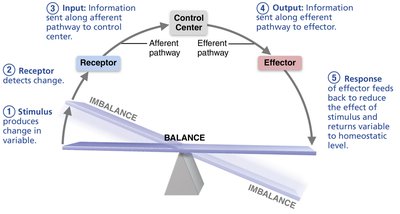
Receptor (sensor): Monitors environment and detects changes.
Control Center: Receives input, determines set point, sends instructions.
Effector: Provides the means for response (reduces or enhances the stimulus).
Negative Feedback
Most homeostatic controls operate via negative feedback.
Response reduces or shuts off the original stimulus; variable changes in the opposite direction to return to set point.
Promotes stability (self-correcting loop).

Example: Body Temperature Regulation
Controlled by the hypothalamus.
Heat: Sweat glands activated to cool the body.
Cold: Shivering generates heat.
Outcome: Return to normal temperature range.

Positive Feedback
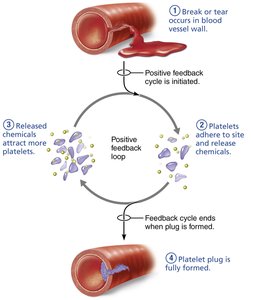
Response enhances the original stimulus; variable changes in the same direction as the initial change.
Examples: Labor contractions (oxytocin release), platelet plug formation during clotting, breastfeeding let-down reflex.


Homeostatic Imbalance
Disturbance increases risk of disease; associated with aging as control systems become less efficient.
Severe imbalance may overwhelm negative feedback and allow destructive positive feedback (e.g., heart failure).
Anatomical Terminology and Body Orientation
Standard Anatomical Position
Body erect, feet slightly apart, palms facing forward, thumbs outward.
Right and left refer to the subject's right and left, not the observer's.

Directional Terminology
Describes one body structure in relation to another.
Common pairs: Superior/Inferior, Anterior/Posterior, Medial/Lateral, Proximal/Distal, Superficial/Deep.
Always based on anatomical position.
Term | Definition | Example |
|---|---|---|
Superior (cranial) | Toward the head or upper part of a structure | The head is superior to the abdomen. |
Inferior (caudal) | Away from the head or toward the lower part | The navel is inferior to the chin. |
Anterior (ventral) | Toward the front of the body | The breastbone is anterior to the spine. |
Posterior (dorsal) | Toward the back of the body | The heart is posterior to the breastbone. |
Medial | Toward the midline | The heart is medial to the arm. |
Lateral | Away from the midline | The arms are lateral to the chest. |
Proximal | Closer to the origin of the body part | The elbow is proximal to the wrist. |
Distal | Farther from the origin | The knee is distal to the thigh. |
Superficial | Toward the body surface | The skin is superficial to the muscles. |
Deep | Away from the body surface | The lungs are deep to the skin. |

Regional Terminology
Divides the body into axial (head, neck, trunk) and appendicular (limbs) parts.
Anterior and posterior regions are further subdivided (e.g., cephalic, thoracic, abdominal, pelvic, upper/lower limb regions).

Body Planes and Sections
Sagittal Plane: Divides body into right and left parts (midsagittal = midline, parasagittal = offset).
Frontal (Coronal) Plane: Divides body into anterior and posterior parts.
Transverse (Horizontal) Plane: Divides body into superior and inferior parts.
Body Cavities and Membranes
Main Body Cavities
Dorsal Body Cavity: Protects the nervous system; includes cranial (brain) and vertebral (spinal cord) cavities, lined by meninges.
Ventral Body Cavity: Houses internal organs (viscera); subdivided by the diaphragm into thoracic (lungs, heart) and abdominopelvic (digestive, reproductive organs) cavities.
Thoracic Cavity
Pleural cavities (lungs), mediastinum (pericardial cavity, trachea, esophagus, thymus), pericardial cavity (heart).
Abdominopelvic Cavity
Abdominal cavity (stomach, intestines, spleen, liver), pelvic cavity (bladder, reproductive organs, rectum).
No physical separation between abdominal and pelvic cavities; organs shift with posture.
Serous Membranes
Thin double layers lining the ventral cavity and its organs.
Parietal serosa: Lines cavity walls.
Visceral serosa: Covers organs.
Serous fluid: Lubricates and reduces friction between layers.
Specific names: pleura (lungs), pericardium (heart), peritoneum (abdominopelvic organs).
Inflammation can cause pain and restrict organ movement.
Abdominopelvic Quadrants and Regions
Quadrants: Used clinically to locate pain/pathology (RUQ, LUQ, RLQ, LLQ).
Regions: Used by anatomists for precise localization (epigastric, umbilical, hypogastric, right/left hypochondriac, lumbar, inguinal).
Other Body Cavities
Oral/digestive, nasal, orbital, middle ear, and synovial cavities (movable joints).
