Back
BackChapter 1: The Human Body—An Orientation (Study Notes)
Study Guide - Smart Notes
 Tailored notes based on your materials, expanded with key definitions, examples, and context.
Form and Function: Anatomy vs. Physiology
Structure Reflects Function
The principle of "structure reflects function" is fundamental in anatomy and physiology. The physical structure of a body part determines its function, and vice versa.
Anatomy: The study of the structure of body parts and their relationships to one another.
Physiology: The study of the function of the body’s structural machinery—how the parts work and carry out life-sustaining activities.
Example: Muscle tissue is composed of actin and myosin filaments, which allow for contraction and movement.
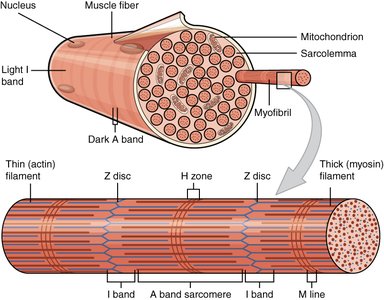
Additional info: The sliding filament model of muscle contraction is a classic example of how structure (arrangement of filaments) enables function (contraction).
Relationship Between Anatomy and Physiology
Anatomy and physiology are closely related; anatomical structures enable specific physiological functions. Variation in form and function is influenced by genetics and environmental factors, leading to diversity among individuals.

Levels of Structural Organization
Hierarchy of Organization
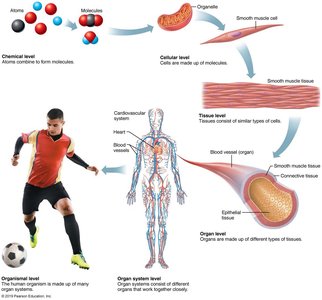
The human body is organized into a hierarchy of structural levels, each building on the previous one:
Atoms: Smallest units of matter.
Molecules: Combinations of atoms (e.g., H2O).
Cells: Basic units of life, composed of molecules.
Tissues: Groups of similar cells performing a common function.
Organs: Structures composed of at least two tissue types working together.
Organ Systems: Groups of organs that perform related functions.
Organism: A living being composed of multiple organ systems.
Major Tissue Types
The Four Basic Tissue Types
Epithelial Tissue: Covers body surfaces and lines cavities.
Connective Tissue: Supports, protects, and binds other tissues (most variable type).
Muscle Tissue: Responsible for movement (skeletal, cardiac, smooth).
Nervous Tissue: Initiates and transmits electrical impulses for communication.
The 11 Organ Systems of the Human Body
Overview and Functions
Integumentary: Skin, hair, nails—protection and boundary maintenance.
Skeletal: Bones, joints—support, protection, movement.
Muscular: Muscles, tendons—movement, posture, heat production.
Nervous: Brain, spinal cord, nerves—rapid internal communication.
Cardiovascular: Heart, blood vessels—transport of nutrients, gases, wastes.
Urinary: Kidneys, bladder—waste removal, water and electrolyte balance.
Endocrine: Glands—hormone production, regulation of body processes.
Digestive: Mouth, GI tract—breakdown and absorption of nutrients.
Lymphatic/Immune: Lymph nodes, vessels—fluid return, defense against pathogens.
Respiratory: Lungs, trachea—gas exchange (O2/CO2).
Reproductive: Testes, ovaries, uterus—production of offspring.
Essential Functions of Living Things
Basic Life Processes
Maintain Boundaries: Separation of internal and external environments (e.g., cell membranes, skin).
Movement: Of body and substances within the body.
Responsiveness: Ability to sense and respond to stimuli.
Digestion and Metabolism: Processing nutrients and energy.
Excretion: Removal of wastes.
Reproduction: Cellular and organismal reproduction.
Growth and Development: Increase in size and maturation.
Survival Needs of Living Things
Basic Requirements
Nutrients: Carbohydrates, lipids, proteins (energy/building blocks); vitamins and minerals (support functions).
Water: Solvent for chemical reactions, transport medium.
Temperature: Optimal body temperature (~37°C) for metabolic reactions.
Pressure: Atmospheric pressure for gas exchange; hydrostatic pressure for fluid movement.
Homeostasis
Definition and Importance
Homeostasis is the maintenance of a stable internal environment despite external changes. It is essential for normal body function and survival.
Regulates factors such as blood gases, ion concentrations, temperature, and water balance.
Most diseases result from homeostatic imbalance.
Factors Regulated by Homeostasis
Blood O2/CO2 levels
Ion concentrations (Na+, Ca2+, K+, Mg2+)
Temperature
Osmolarity (water balance)
Regulatory Mechanisms
Components of Regulatory Mechanisms
Receptor: Detects changes in the environment (stimuli).
Control Center: Processes information and determines response (often the brain or spinal cord).
Effector: Carries out the response to restore balance.
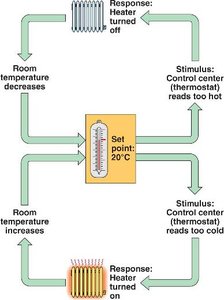
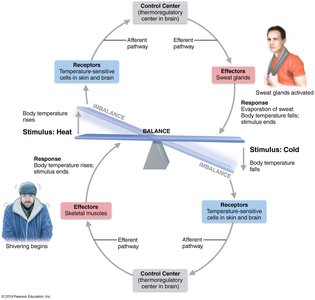
Negative vs. Positive Feedback Mechanisms
Negative Feedback: The response reduces or shuts off the original stimulus, maintaining homeostasis (e.g., body temperature regulation, blood glucose control).
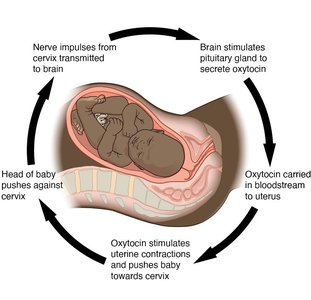
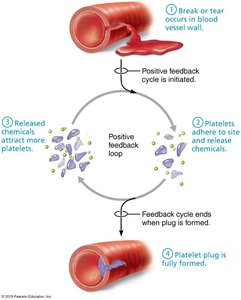
Positive Feedback: The response enhances or exaggerates the original stimulus, often leading to a rapid change (e.g., blood clotting, childbirth).
Anatomical Position and Terminology
Standard Anatomical Position
The standard anatomical position is used as a reference point for describing body parts and regions:
Standing upright, facing forward
Feet shoulder-width apart
Arms at sides, palms facing forward

Body Planes
Median (Midsagittal) Plane: Divides the body into equal right and left halves.
Frontal (Coronal) Plane: Divides the body into anterior (front) and posterior (back) parts.
Transverse (Horizontal) Plane: Divides the body into superior (upper) and inferior (lower) parts.
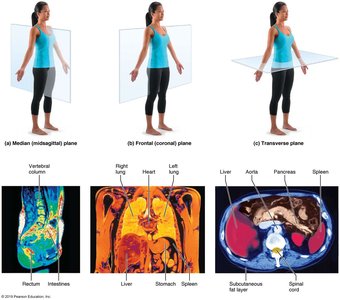
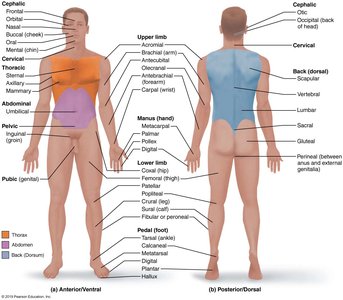
Regional Terms
Regional terms specify areas within major body divisions (axial and appendicular regions).
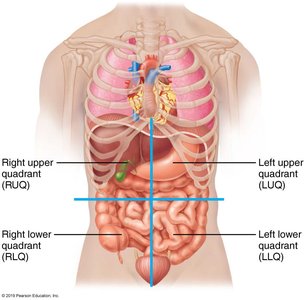
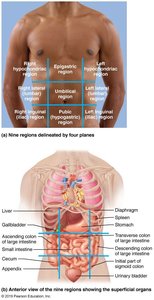
Abdominal Quadrants and Regions
Quadrants: Right Upper (RUQ), Left Upper (LUQ), Right Lower (RLQ), Left Lower (LLQ)
Nine Regions: Used for more precise localization (e.g., epigastric, umbilical, hypogastric, etc.)
Directional Terms
Superior/Inferior: Above/below
Medial/Lateral: Toward midline/away from midline
Anterior (Ventral)/Posterior (Dorsal): Front/back
Proximal/Distal: Closer to/farther from point of attachment
Superficial/Deep: Toward/away from body surface
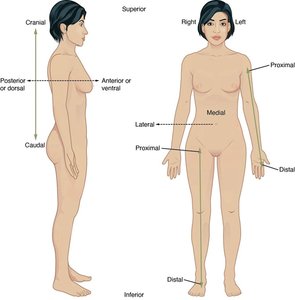
Body Cavities and Membranes
Dorsal and Ventral Body Cavities
Dorsal Cavity: Contains cranial (brain) and vertebral (spinal cord) cavities.
Ventral Cavity: Contains thoracic (heart, lungs) and abdominopelvic (digestive, urinary, reproductive organs) cavities.
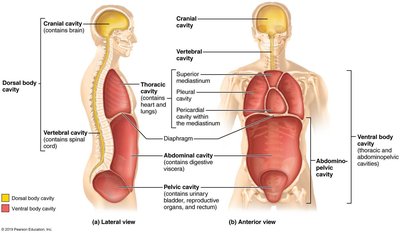
Serous Membranes
Serous membranes are double-layered membranes that line body cavities and cover organs. The parietal layer lines the cavity, while the visceral layer covers the organ. The space between is filled with serous fluid to reduce friction.
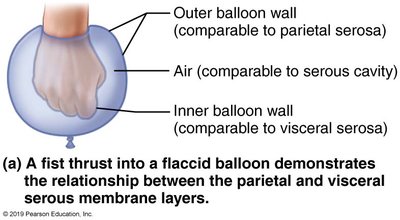
Major Serous Membranes
Pericardium: Surrounds the heart (pericardial cavity).
Pleura: Surrounds the lungs (pleural cavity).
Peritoneum: Lines the abdominal cavity (abdominal organs).
Retroperitoneal: Organs (e.g., kidneys) located behind the peritoneum.