 Back
Chapter 1: The Human Body—An Orientation (Mini-Textbook Study Notes)
Study Guide - Smart Notes
 Tailored notes based on your materials, expanded with key definitions, examples, and context.
The Human Body: An Orientation
Form and Function of Anatomy & Physiology
Anatomy and physiology are foundational sciences in understanding the human body. Anatomy is the study of the structure of body parts and their relationships, while physiology focuses on the function of these parts and how they work to sustain life.
Anatomy: Structure of body parts; includes gross (macroscopic) and microscopic anatomy.
Physiology: Function of body parts; often studied by organ systems and at cellular/molecular levels.
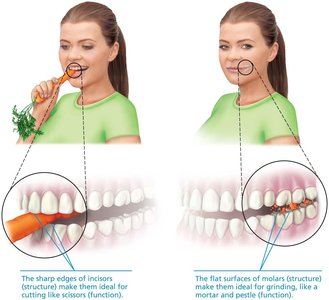
Principle of Complementarity: Structure and function are inseparable; what a structure can do depends on its form.
Example: The sharp edges of incisors are ideal for cutting, while the flat surfaces of molars are suited for grinding food.
Topics and Subdivisions of Anatomy
Gross (Macroscopic) Anatomy: Study of large, visible structures (regional, system, surface anatomy).
Microscopic Anatomy: Structures too small to see unaided (cytology—cells, histology—tissues).
Developmental Anatomy: Anatomical and physiological development throughout life (embryology—before birth).
Topics of Physiology
Subdivided by organ systems (e.g., renal, cardiovascular physiology).
Focuses on cellular and molecular mechanisms, often involving chemical reactions.
Requires understanding of physical and chemical principles (e.g., electrical currents, pressure, movement).
Structural Organization of the Human Body
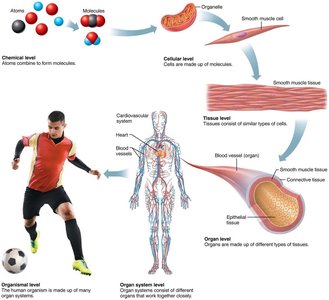
The human body is organized into hierarchical levels, from the smallest chemical components to the entire organism.
Chemical Level: Atoms combine to form molecules.
Cellular Level: Cells are made up of molecules.
Tissue Level: Tissues consist of similar types of cells.
Organ Level: Organs are made up of different types of tissues.
Organ System Level: Organ systems consist of different organs that work together.
Organismal Level: The human organism is made up of many organ systems.
Necessary Life Functions
Overview of Life Functions
To maintain life, the human body must perform several essential functions:
Maintaining Boundaries: Separation between internal and external environments (e.g., plasma membranes, skin).
Movement: Muscular system enables movement of body parts and substances (e.g., blood, food).
Responsiveness: Ability to sense and respond to stimuli (e.g., withdrawal reflex, breathing rate).
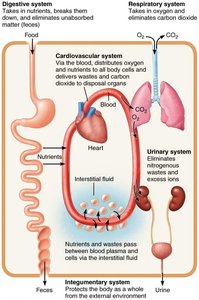
Digestion: Breakdown of food and absorption of nutrients into blood.
Metabolism: All chemical reactions in body cells, including catabolism (breakdown) and anabolism (synthesis).
Excretion: Removal of wastes (e.g., urea, CO2, feces).
Reproduction: Cellular division for growth/repair and production of offspring.
Growth: Increase in size of body part or organism.
Interrelationships Among Body Organ Systems
Organ systems work together to maintain the survival of cells and the organism as a whole.
The Body’s Organ Systems and Their Major Functions
Overview of the 11 Organ Systems
The human body is composed of 11 organ systems, each with specific functions essential for life.
Organ System | Main Functions |
|---|---|
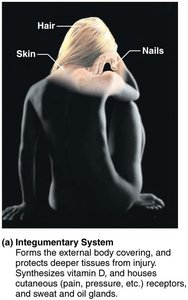
Integumentary | Protection, vitamin D synthesis, sensory reception |
Skeletal | Support, protection, movement, blood cell formation |
Muscular | Movement, posture, heat production |
Nervous | Control system, response to stimuli |
Endocrine | Hormone secretion, regulation of growth, metabolism, reproduction |
Cardiovascular | Transport of blood, nutrients, wastes |
Lymphatic/Immunity | Fluid return, immunity |
Respiratory | Gas exchange (O2/CO2) |
Digestive | Breakdown and absorption of food, waste elimination |
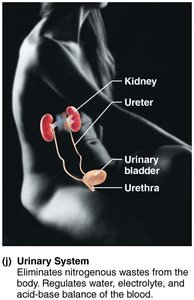
Urinary | Elimination of nitrogenous wastes, water/electrolyte balance |
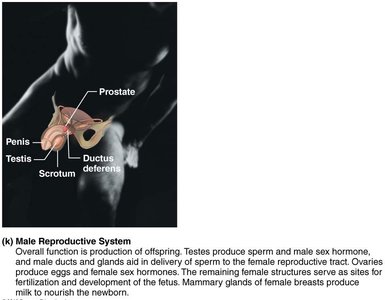
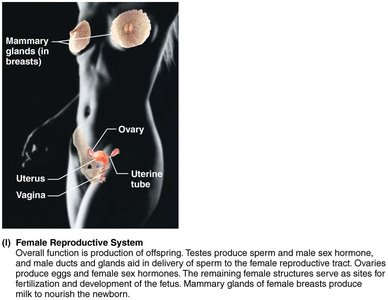
Reproductive | Production of offspring |
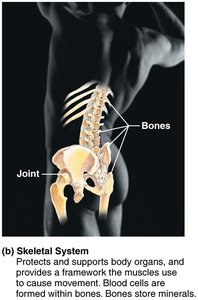
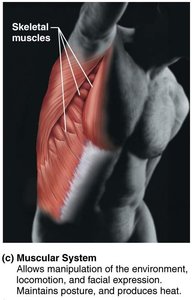
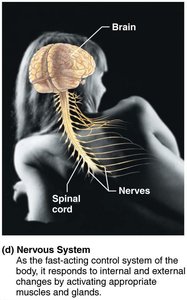
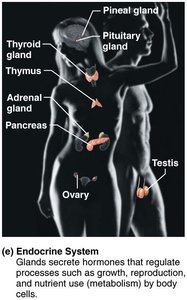
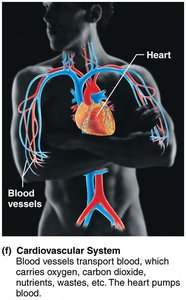
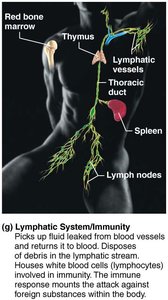
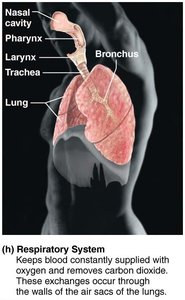
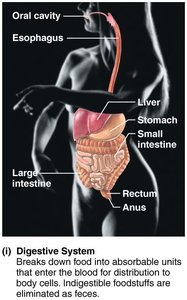
Survival Needs
Essential Factors for Survival
Nutrients: Carbohydrates (energy), proteins (cell building), fats (energy storage), vitamins/minerals (chemical reactions, structure).
Oxygen: Required for energy release from food; survival without oxygen is limited to minutes.
Water: Most abundant chemical in the body; solvent for reactions, base for secretions/excretions.
Normal Body Temperature: Must be maintained near 37°C for optimal chemical reactions.
Appropriate Atmospheric Pressure: Necessary for proper breathing and gas exchange in lungs.
Homeostasis
Definition and Importance
Homeostasis is the maintenance of relatively stable internal conditions despite external changes. It is a dynamic equilibrium, maintained by all organ systems.
Homeostatic Control Mechanisms
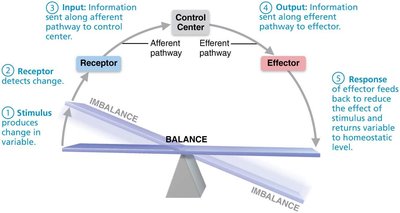
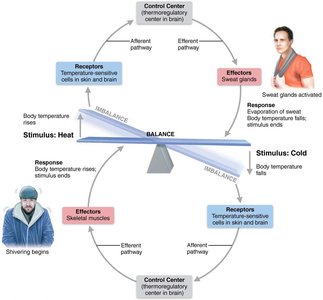
Receptor: Detects changes (stimuli) and sends information to the control center.
Control Center: Determines the set point, analyzes input, and determines response.
Effector: Carries out the response to restore balance (negative or positive feedback).
Negative Feedback
Most homeostatic mechanisms are negative feedback loops, where the response reduces or eliminates the original stimulus.
Example: Regulation of body temperature and blood glucose levels.
Positive Feedback
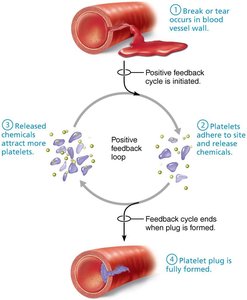
Positive feedback mechanisms enhance or amplify the original stimulus, usually controlling infrequent events.
Examples: Labor contractions (oxytocin), platelet plug formation in blood clotting.
Homeostatic Imbalance
Disturbances increase risk of disease and contribute to aging.
If negative feedback is overwhelmed, destructive positive feedback may occur (e.g., heart failure).
Anatomical Terms
Anatomical Position and Directional Terms
The standard anatomical position is body erect, feet slightly apart, palms forward. Directional terms describe the location of one body part relative to another.
Right/Left: Always refer to the subject's right/left, not the observer's.
Regional Terms
Axial: Head, neck, trunk.
Appendicular: Limbs (arms, legs).
Regional terms specify areas within these divisions.
Body Planes and Sections
Sagittal Plane: Divides body into right and left (midsagittal—midline, parasagittal—off-center).
Frontal (Coronal) Plane: Divides body into anterior and posterior (front and back).
Transverse (Horizontal) Plane: Divides body into superior and inferior (top and bottom).
Oblique Section: Cuts at angles other than 90° to vertical plane.
Body Cavities and Membranes
Major Body Cavities
Dorsal Body Cavity: Protects nervous system; includes cranial (brain) and vertebral (spinal cord) cavities.
Ventral Body Cavity: Houses internal organs (viscera); includes thoracic and abdominopelvic cavities, separated by the diaphragm.
Ventral Body Cavity Subdivisions
Thoracic Cavity: Two pleural cavities (lungs), mediastinum (heart, esophagus, trachea), pericardial cavity (heart).
Abdominopelvic Cavity: Abdominal (stomach, intestines, spleen, liver) and pelvic (bladder, reproductive organs, rectum).
Membranes in the Ventral Body Cavity
Serosa (Serous Membrane): Thin, double-layered; parietal serosa lines cavity walls, visceral serosa covers organs; separated by serous fluid.
Specific Names: Pericardium (heart), pleurae (lungs), peritoneum (abdominopelvic cavity).
Abdominopelvic Quadrants and Regions
Quadrants: Right upper (RUQ), left upper (LUQ), right lower (RLQ), left lower (LLQ).
Nine Regions: Right/left hypochondriac, epigastric, right/left lumbar, umbilical, right/left iliac (inguinal), hypogastric.
Other Body Cavities
Exposed to Environment: Oral/digestive, nasal, orbital, middle ear cavities.
Not Exposed: Synovial (joint) cavities.
Additional info: Understanding anatomical terminology, planes, and body cavities is essential for accurate communication in health sciences and clinical practice.
