 Back
BackChapter 15: Sensory Pathways and the Somatic Nervous System – Study Notes
Study Guide - Smart Notes
 Tailored notes based on your materials, expanded with key definitions, examples, and context.
Chapter 15: Sensory Pathways and the Somatic Nervous System
15-1 Sensory and Motor Pathways
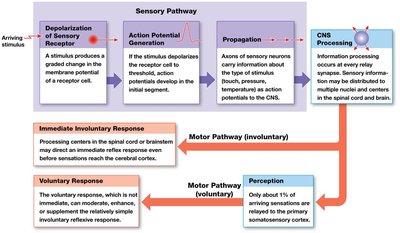
The nervous system processes sensory information through specialized pathways that relay signals from sensory receptors to the central nervous system (CNS), and then generate motor responses. Sensory pathways transmit information from the body and environment, while motor pathways control skeletal muscle activity.
Sensory pathways: Series of neurons relaying sensory information from receptors to the CNS.
Sensory receptors: Specialized cells or neuron processes that monitor specific conditions and generate action potentials when stimulated.
Afferent division: Includes somatic (body wall, limbs) and visceral (internal organs) sensory pathways.
Efferent division: Somatic motor pathways control skeletal muscles (effectors).
Motor commands may be modified by higher-order brain functions.
15-2 Sensory Receptors
Sensory receptors detect changes in the environment and convert stimuli into electrical signals (action potentials) through a process called transduction. Sensations are the arrival of sensory information in the CNS, while perception is the conscious awareness of these sensations.
General senses: Temperature, pain, touch, pressure, vibration, proprioception.
Special senses: Olfaction, gustation, vision, equilibrium, hearing (with specialized sense organs).
Receptor specificity: Each receptor is sensitive to a particular type of stimulus.
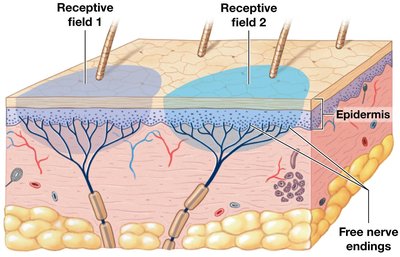
Receptive field: Area monitored by a single receptor cell; larger fields make localization harder.
Transduction and Receptor Potentials
Stimulus changes the receptor membrane potential (receptor potential).
Can be depolarizing (generator potential) or hyperpolarizing.
Strength of stimulus affects the size of the receptor potential.
Special sense receptors communicate with sensory neurons at synapses.
Interpretation of Sensory Information
Labeled line: Pathway linking a specific receptor to a specific cortical neuron; determines the perceived modality.
Sensory coding: Frequency and pattern of action potentials encode stimulus strength, duration, and variation.
Tonic vs. Phasic Receptors
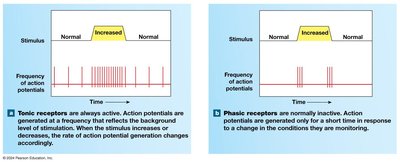
Tonic receptors: Always active; frequency of action potentials changes with stimulus intensity.
Phasic receptors: Normally inactive; respond to changes in stimulus intensity with bursts of action potentials.
Adaptation
Adaptation: Reduction in receptor sensitivity during constant stimulation.
Peripheral adaptation: Occurs at the receptor level (e.g., phasic receptors adapt quickly).
Central adaptation: Occurs in the CNS, inhibiting sensory pathway nuclei.
15-3 General Sensory Receptors
Sensory receptors can be classified by the location of the stimulus or the nature of the stimulus they detect.
Exteroceptors: Monitor external environment.
Proprioceptors: Monitor position of muscles and joints.
Interoceptors: Monitor visceral organs and functions.
Types of General Sensory Receptors
Nociceptors: Detect pain; free nerve endings with large receptive fields, tonic, little peripheral adaptation.
Thermoreceptors: Detect temperature; free nerve endings, phasic, adapt quickly.
Mechanoreceptors: Detect physical distortion (touch, pressure, vibration); contain mechanically-gated ion channels.
Chemoreceptors: Detect chemical concentrations in body fluids; fast peripheral adaptation.
Tactile Receptors in the Skin
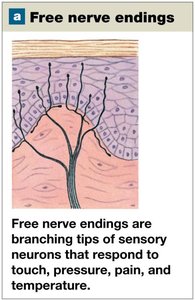
Free nerve endings: Tonic, small receptive fields, detect touch, pressure, pain, temperature.
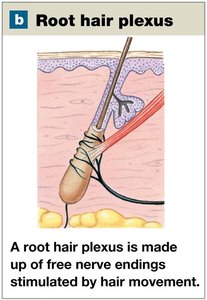
Root hair plexus: Free nerve endings around hair follicles, detect hair movement, adapt rapidly.
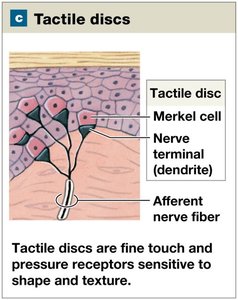
Tactile discs (Merkel discs): Tonic, fine touch and pressure, sensitive to shape and texture, small receptive fields.
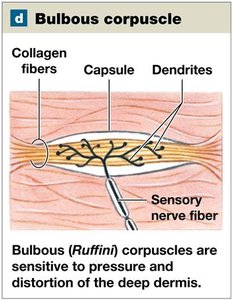
Bulbous corpuscles (Ruffini corpuscles): Tonic, sensitive to pressure and skin distortion, located in deep dermis, little adaptation.
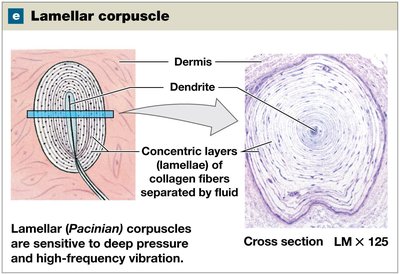
Lamellar corpuscles (Pacinian corpuscles): Phasic, deep pressure and high-frequency vibration, concentric layers of collagen.
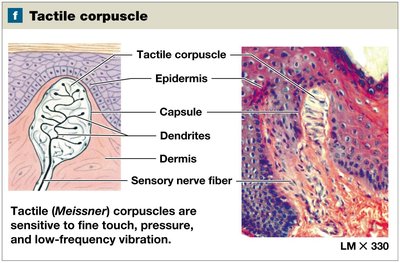
Tactile corpuscles (Meissner corpuscles): Phasic, fine touch, pressure, low-frequency vibration, abundant in sensitive areas (fingertips, lips).
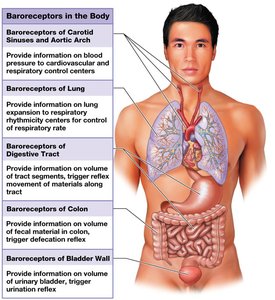
Baroreceptors
Detect pressure changes in blood vessels and hollow organs (digestive, respiratory, urinary tracts).
Free nerve endings in elastic tissues, adapt rapidly.
Proprioceptors
Monitor position of joints and muscles; only somatic sensation.
Types: Muscle spindles (muscle length), Golgi tendon organs (tension), joint capsule receptors (pressure, tension, movement).
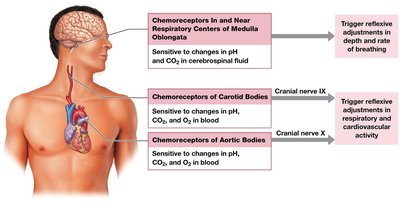
Chemoreceptors
Respond to water- and lipid-soluble substances in body fluids.
Monitor pH, CO2, and O2 in arterial blood (carotid and aortic bodies).
15-4 Sensory Pathways
Sensory information is relayed to the CNS through a series of neurons, typically involving three orders of neurons for somatic sensation.
First-order neuron: Delivers sensation from receptor to CNS (cell body in spinal or cranial nerve ganglion).
Second-order neuron: Interneuron in spinal cord or brainstem; axon crosses to opposite side (decussation).
Third-order neuron: Located in thalamus; relays information to primary somatosensory cortex.
Somatic Sensory Pathways
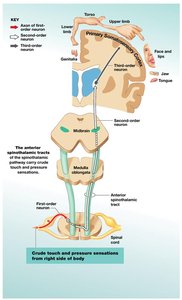
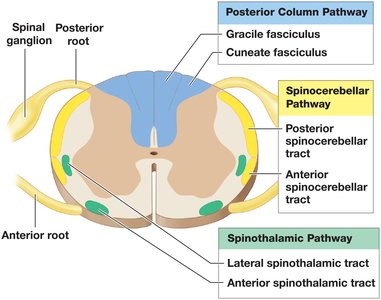
Spinothalamic pathway: Crude touch, pressure, pain, temperature.
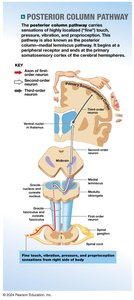
Posterior column pathway: Fine touch, vibration, pressure, proprioception.
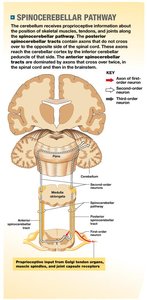
Spinocerebellar pathway: Proprioceptive information to cerebellum (not conscious).
Spinothalamic Pathway
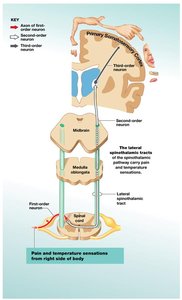
First-order neurons synapse in posterior horns; second-order neurons cross and ascend to thalamus; third-order neurons project to cortex.
Tracts: Anterior (crude touch, pressure), Lateral (pain, temperature).
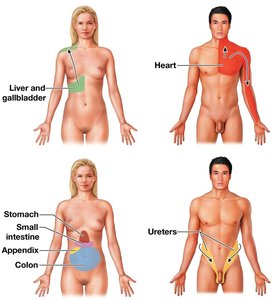
Referred pain: Visceral pain perceived as originating from body surface (e.g., heart attack felt in left arm).
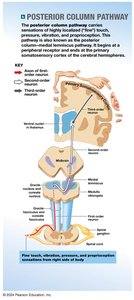
Posterior Column Pathway
First-order neurons ascend to medulla; second-order neurons decussate and ascend to thalamus; third-order neurons project to cortex.
Tracts: Gracile fasciculus (lower body), Cuneate fasciculus (upper body), Medial lemniscus (after decussation).
Sensory homunculus: Map of cortex regions corresponding to body areas; size reflects sensory neuron density.
Spinocerebellar Pathway
First-order neurons synapse in posterior horn; second-order neurons ascend to cerebellum (may decussate twice).
Tracts: Posterior and anterior spinocerebellar tracts.
Information does not reach conscious awareness.
Visceral Sensory Pathways
Interoceptors monitor visceral tissues and organs; information relayed via cranial and spinal nerves to medulla oblongata.
Solitary nuclei integrate visceral sensory information for autonomic regulation.
Somatic Motor Pathways
The somatic nervous system (SNS) controls voluntary and reflexive movements of skeletal muscles through descending motor pathways.
Always involve at least two motor neurons: upper motor neuron (CNS) and lower motor neuron (brainstem/spinal cord to muscle).
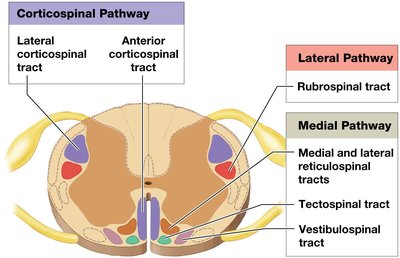
Major pathways: Corticospinal (pyramidal), medial, and lateral pathways.
Basal nuclei and cerebellum provide coordination and feedback control.
Corticospinal Pathway (Pyramidal System)
Voluntary control over skeletal muscles; upper motor neurons in primary motor cortex.
Tracts: Corticobulbar (cranial nerves), lateral corticospinal (decussate at pyramids), anterior corticospinal (decussate at spinal segment).
Motor homunculus: Map of primary motor cortex; area size reflects degree of fine motor control.
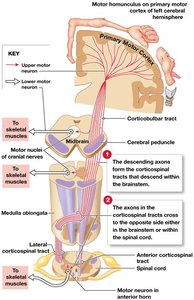
Medial and Lateral Pathways
Medial pathway: Controls muscle tone and gross movements of trunk/proximal limbs (vestibulospinal, tectospinal, reticulospinal tracts).
Lateral pathway: Controls muscle tone and precise movements of distal limbs (rubrospinal tract).
Upper motor neurons in these pathways can stimulate, facilitate, or inhibit lower motor neurons also innervated by corticospinal tracts.
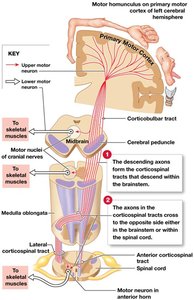
Basal Nuclei and Cerebellum
Basal nuclei: Provide background patterns for voluntary movement, modulate upper motor neuron activity via thalamus and reticular formation.
Cerebellum: Monitors proprioceptive, visual, and vestibular input; adjusts movement and inhibits unnecessary motor commands; patterns learned by repetition.
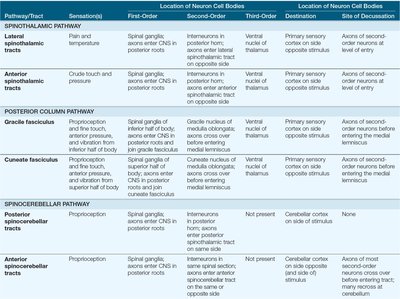
Summary Table: Major Sensory Pathways
Pathway/Tract | Sensation(s) | First-Order Neuron | Second-Order Neuron | Third-Order Neuron | Destination | Site of Decussation |
|---|---|---|---|---|---|---|
Lateral spinothalamic | Pain, temperature | Spinal ganglion, enters CNS in posterior roots | Posterior horn, crosses to opposite side | Ventral nuclei of thalamus | Primary sensory cortex | Axons of second-order neurons at level of entry |
Anterior spinothalamic | Crude touch, pressure | Spinal ganglion, enters CNS in posterior roots | Posterior horn, crosses to opposite side | Ventral nuclei of thalamus | Primary sensory cortex | Axons of second-order neurons at level of entry |
Gracile fasciculus | Fine touch, vibration, pressure, proprioception (lower body) | Spinal ganglion, enters CNS in posterior roots | Gracile nucleus of medulla oblongata, crosses to opposite side | Ventral nuclei of thalamus | Primary sensory cortex | Axons of second-order neurons in medulla oblongata |
Cuneate fasciculus | Fine touch, vibration, pressure, proprioception (upper body) | Spinal ganglion, enters CNS in posterior roots | Cuneate nucleus of medulla oblongata, crosses to opposite side | Ventral nuclei of thalamus | Primary sensory cortex | Axons of second-order neurons in medulla oblongata |
Posterior spinocerebellar | Proprioception | Spinal ganglion, enters CNS in posterior roots | Posterior horn, axons ascend uncrossed | Not present | Cerebellar cortex on same side | None |
Anterior spinocerebellar | Proprioception | Spinal ganglion, enters CNS in posterior roots | Posterior horn, axons cross to opposite side | Not present | Cerebellar cortex on opposite side | Axons of second-order neurons at level of entry |
