 Back
BackChapter 15: The Special Senses – Smell, Taste, Hearing, and Equilibrium
Study Guide - Smart Notes
 Tailored notes based on your materials, expanded with key definitions, examples, and context.
Smell (Olfaction)
Chemoreceptors and Olfactory Specificity
Chemoreceptors detect chemicals dissolved in aqueous solutions.
Smell receptors are activated by chemicals dissolved in nasal fluids.
Humans possess approximately 350 different odorant receptors, enabling the detection of a vast range of odors (from 10,000 to 1 trillion).
Pain and temperature receptors in the nasal cavity can also respond to irritants (e.g., ammonia, menthol, chili peppers).
Physiology of Smell
Odorants must be volatile (gaseous) and dissolve in the olfactory epithelium fluid to be detected.
Dissolved odorants bind to receptor proteins on olfactory cilia, opening cation channels and generating a receptor potential.
At threshold, an action potential (AP) is sent to the olfactory bulb.
Smell Transduction
Odorant binding activates a G protein (olfactory G protein, olfG).
G protein activation leads to cAMP synthesis (second messenger).
cAMP opens Na+ and Ca2+ channels:
Na+ influx causes depolarization and impulse transmission.
Ca2+ influx leads to olfactory adaptation (reduced response to sustained stimulus).
Olfactory Pathway
Information is sent to the frontal lobe (for identification) and the limbic system (for emotional responses).
Some signals pass through the thalamus, while others go directly to the hypothalamus and amygdala.
Taste (Gustation)
Taste Buds and Basic Taste Sensations
Taste buds are the sensory organs for taste, primarily located on the tongue within papillae.
Five basic taste sensations:
Sweet – sugars, saccharin, alcohol, some amino acids, some lead salts
Sour – hydrogen ions from acids
Salty – metal ions (e.g., sodium chloride)
Bitter – alkaloids (quinine, nicotine, caffeine) and some nonalkaloids (aspirin)
Umami – amino acids glutamate and aspartate (e.g., beef, cheese, MSG)
Influence of Other Sensations on Taste
Taste is approximately 80% dependent on smell; blocked nasal passages reduce taste perception.
Thermoreceptors, mechanoreceptors, and nociceptors in the mouth also influence taste perception.
Temperature, texture, and pain (e.g., from spicy foods) can enhance or detract from taste.
Hearing and Balance (Equilibrium)
Ear Structure and Function
The ear is divided into three regions:
External (outer) ear: involved in hearing only.
Middle ear (tympanic cavity): involved in hearing only.
Internal (inner) ear: involved in both hearing and equilibrium.
Hearing and equilibrium organs are structurally connected but functionally independent.
Sound: Properties and Perception
Sound is a pressure disturbance produced by a vibrating object and propagated through a medium (air).
Hearing involves converting air sound waves into fluid waves, which stimulate cochlear hair cells, sending impulses to the brain.
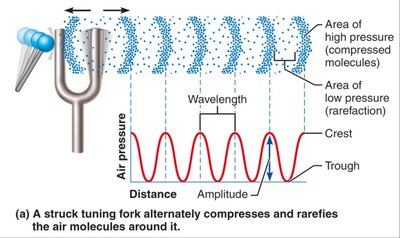
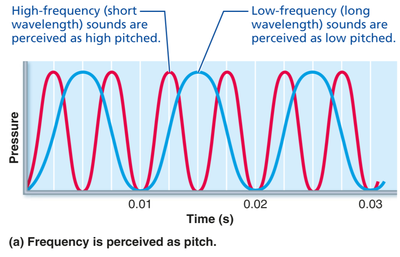
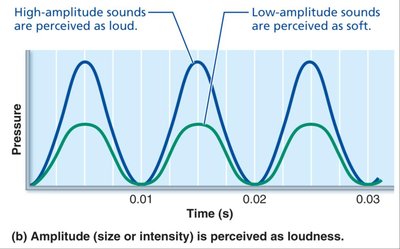
Properties of Sound
Frequency: Number of waves passing a point per unit time; determines pitch.
Wavelength: Distance between two consecutive crests; shorter wavelength = higher frequency.
Amplitude: Height of the wave's crest; determines loudness (measured in decibels, dB).
Normal conversation: ~50 dB; threshold of pain: 120 dB; prolonged exposure above 90 dB can cause hearing loss.
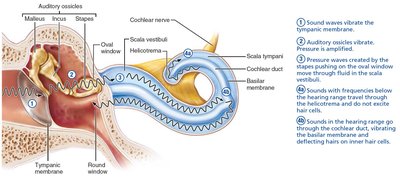
Pathway of Sound Waves Through the Ear
Sound waves vibrate the tympanic membrane.
Auditory ossicles (malleus, incus, stapes) vibrate and amplify pressure.
Pressure waves created by the stapes move through the cochlear duct, vibrating the basilar membrane and deflecting hair cells.
Only sounds within the hearing range travel through the cochlear duct and stimulate hair cells.
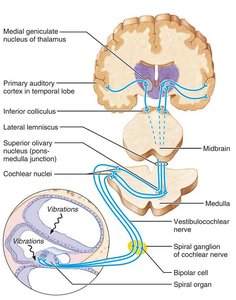
Ascending Auditory Pathway
Auditory information is transmitted from cochlear receptors (inner hair cells) to the cerebral cortex.
Pathway includes the cochlear nuclei, superior olivary nucleus, lateral lemniscus, inferior colliculus, medial geniculate nucleus of the thalamus, and finally the primary auditory cortex in the temporal lobe.
Equilibrium (Balance)
Vestibular Apparatus and Types of Equilibrium
Equilibrium is the sense of balance, relying on input from the inner ear, eyes, and stretch receptors.
The vestibular apparatus (semicircular canals and vestibule) contains equilibrium receptors.
Vestibular receptors: monitor static equilibrium (head position when still).
Semicircular canal receptors: monitor dynamic equilibrium (head movement).
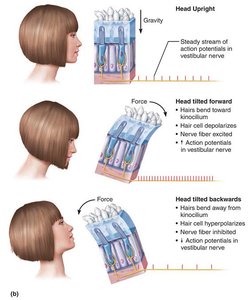
Structure and Function of a Macula
Maculae are sensory receptors in the vestibule that detect linear acceleration and head position relative to gravity.
Movement of the head causes hair cells in the macula to bend, altering the frequency of action potentials sent to the brain.
Cristae Ampullares and Rotational Acceleration
The crista ampullaris is the receptor for rotational acceleration in the semicircular canals.
Rotational movement causes endolymph to move, bending hair cells in the cristae.
Bending hairs in one direction causes depolarization (increased impulses); bending in the opposite direction causes hyperpolarization (decreased impulses).
This system detects changes in movement, not constant motion.
Equilibrium Pathway to the Brain
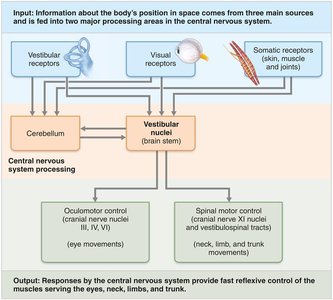
Equilibrium information is sent to reflex centers in the brain stem for rapid responses to imbalance.
Impulses travel to the vestibular nuclei (brain stem) or cerebellum.
Three main sources of input for balance and orientation:
Vestibular receptors
Visual receptors
Somatic receptors (skin, muscles, joints)
Summary Table: Special Senses and Their Receptors
Sense | Receptor Type | Location | Main Function |
|---|---|---|---|
Smell (Olfaction) | Chemoreceptor | Nasal cavity (olfactory epithelium) | Detects volatile chemicals |
Taste (Gustation) | Chemoreceptor | Taste buds (tongue, papillae) | Detects dissolved chemicals |
Hearing (Audition) | Mechanoreceptor | Cochlea (inner ear) | Detects sound waves |
Equilibrium (Balance) | Mechanoreceptor | Vestibular apparatus (inner ear) | Detects head position and movement |
