 Back
BackChapter 16: The Endocrine System – Anatomy & Physiology Study Notes
Study Guide - Smart Notes
 Tailored notes based on your materials, expanded with key definitions, examples, and context.
Overview of the Endocrine System
Introduction
The endocrine system is a complex network of organs that synthesize and secrete chemical messengers called hormones. These hormones interact with specific target cells to regulate vital functions such as fluid, electrolyte, and acid-base homeostasis, growth, and metabolic reactions.
Hormones: Chemical messengers secreted by endocrine glands.
Target cells: Cells with specific receptors for hormones.
Homeostasis: Maintenance of stable internal conditions.
Comparison of Endocrine and Nervous Systems
Both systems use chemical signals for cell-to-cell communication but differ in their mechanisms and effects.
Nervous system: Uses neurotransmitters released by neurons; effects are immediate but short-lived.
Endocrine system: Hormones are secreted into the bloodstream and act on distant target cells; effects are slower but longer-lasting.
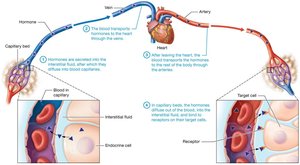
Types of Chemical Signals
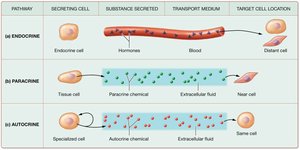
The body uses three main types of chemical signaling:
Endocrine: Hormones secreted into blood affect distant cells.
Paracrine: Chemicals affect nearby but different cell types.
Autocrine: Chemicals affect the same cell or cell type that secreted them.
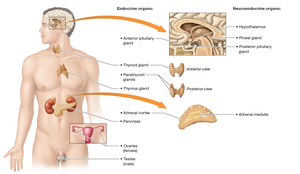
Overview of Endocrine Organs
Endocrine glands are ductless organs that regulate other cell types by producing and secreting hormones.
Primary endocrine organs: Anterior pituitary, thyroid, parathyroid, adrenal cortices, pancreas, thymus.
Secondary organs: Heart, kidneys, small intestines, testes, ovaries.
Neuroendocrine organs: Hypothalamus, pineal gland, adrenal medulla.
Hormones: Structure, Transport, and Action
Classes of Hormones
Hormones are classified by their chemical structure:
Amino-acid hormones: Hydrophilic; bind to plasma membrane receptors.
Steroid hormones: Derived from cholesterol; hydrophobic; bind to cytosolic or nuclear receptors.
Hormone Transport Through the Blood
Free hormones: Small, hydrophilic hormones travel freely in plasma.
Bound hormones: Hydrophobic hormones bind to plasma proteins, extending their lifespan and providing a reservoir.
Target Cells and Receptors
Hormones affect only target cells with specific protein receptors.
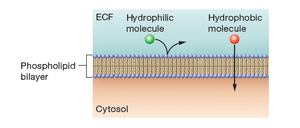
Hydrophilic hormones: Bind to membrane receptors; cannot cross plasma membrane.
Hydrophobic hormones: Cross plasma membrane; bind to cytosolic or nuclear receptors.
Regulation of Receptor Number
Up-regulation: Increased receptor number when hormone levels decline.
Down-regulation: Decreased receptor number with prolonged high hormone levels.
Effects of Hormone Actions
Hormones can:
Stimulate secretion from cells
Activate/inhibit enzymes
Stimulate/inhibit mitosis or meiosis
Open/close ion channels
Activate/inhibit gene transcription
Hormone Interactions
Synergists: Hormones with similar effects amplify each other's actions.
Antagonists: Hormones with opposing effects.
Hormone Half-Life and Elimination
Half-life: Time for plasma concentration to reduce by half.
Hydrophobic hormones have longer half-lives due to protein binding.
Hydrophilic hormones are eliminated more rapidly.
Regulation of Hormone Secretion
Hormone secretion is regulated by:
Hormonal stimuli: Response to other hormones.
Humoral stimuli: Response to ion/molecule concentration.
Neural stimuli: Response to nervous system signals.
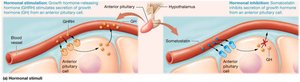
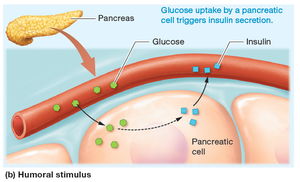
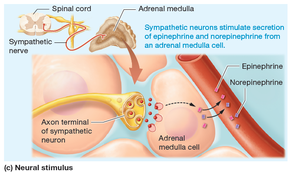
Feedback Loops in Hormone Regulation
Negative feedback loops maintain homeostasis by adjusting hormone secretion.
Stimulus: Variable deviates from normal range.
Receptor: Detects deviation.
Control center: Adjusts hormone secretion.
Effector/response: Hormone triggers response to restore normal range.
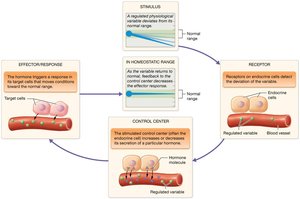
The Hypothalamus and Pituitary Gland
Structure and Functional Relationship
The hypothalamus and pituitary gland are anatomically and functionally connected, playing a central role in homeostatic regulation.
Hypothalamus: Located in diencephalon; connected to pituitary by infundibulum.
Pituitary gland: Sits in sella turcica; consists of anterior (adenohypophysis) and posterior (neurohypophysis) lobes.
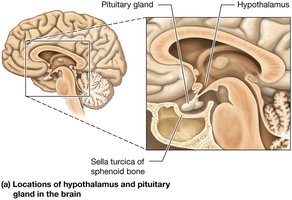
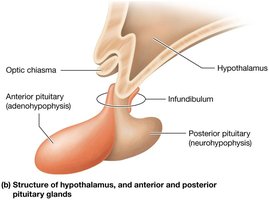
Hypothalamic-Hypophyseal Portal System
Specialized blood supply allows direct hormone delivery between hypothalamus and anterior pituitary.
Hormones of Hypothalamus and Posterior Pituitary
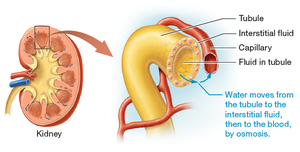
Antidiuretic hormone (ADH): Water retention; acts on kidneys and brain.
Oxytocin: Uterine contractions and milk let-down reflex.
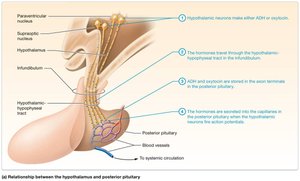
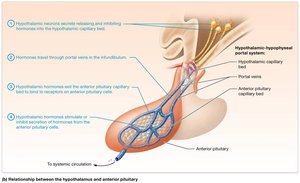
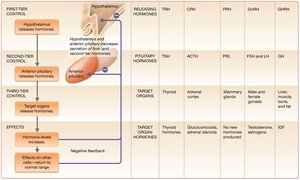
Functional Relationship of Hypothalamus and Anterior Pituitary
The hypothalamus releases tropic hormones that regulate anterior pituitary hormone secretion.
Multi-tiered negative feedback: Ensures tight regulation of hormone levels.
Tropic hormones: TSH, ACTH, PRL, LH, FSH, GH.
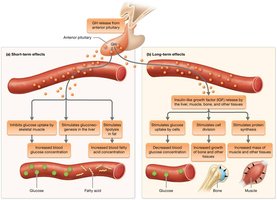
Growth Hormone (GH)
Short-term effects: Metabolic actions (fat breakdown, gluconeogenesis).
Long-term effects: Stimulates IGF production, protein synthesis, cell division, bone and muscle growth.
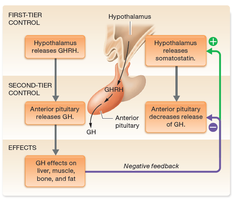
Regulation of Growth Hormone
GHRH: Stimulates GH release.
Somatostatin: Inhibits GH release.
Growth Hormone Disorders
Gigantism: GH hypersecretion before epiphyseal plate closure.
Acromegaly: GH hypersecretion after plate closure.
Pituitary dwarfism: GH hyposecretion.
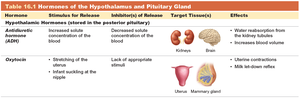
Hormones of the Hypothalamus and Pituitary Gland Table
Hormone | Stimulus for Release | Inhibitor(s) | Target Tissue(s) | Effects |
|---|---|---|---|---|
Antidiuretic Hormone (ADH) | Increased solute concentration of blood | Decreased solute concentration of blood | Kidneys, Brain | Water reabsorption, Increased blood volume |
Oxytocin | Stretching of uterus, Infant suckling | Lack of appropriate stimuli | Uterus, Mammary gland | Uterine contractions, Milk let-down reflex |
The Thyroid and Parathyroid Glands
Structure and Function
Thyroid gland: Secretes thyroid hormone and calcitonin; located anterior neck.
Parathyroid glands: Secrete parathyroid hormone (PTH); located on posterior thyroid.
Thyroid Hormone
T3 (triiodothyronine) and T4 (thyroxine): Regulate metabolic rate, thermoregulation, growth, and development.
Production regulated by negative feedback involving TRH and TSH.
Thyroid Disorders
Hyperthyroidism: Weight loss, heat intolerance, goiter, exophthalmos.
Hypothyroidism: Weight gain, cold intolerance, slow heart rate, goiter.
Parathyroid Hormone and Calcitonin
PTH: Increases blood calcium by stimulating osteoclasts, increasing intestinal absorption, and kidney reabsorption.
Calcitonin: Lowers blood calcium by inhibiting osteoclasts.
The Adrenal Glands
Structure
Adrenal cortex: Produces steroid hormones (mineralocorticoids, glucocorticoids, androgenic steroids).
Adrenal medulla: Secretes catecholamines (epinephrine, norepinephrine).
Hormones of Adrenal Cortex
Aldosterone: Regulates sodium, potassium, blood pressure, and acid-base balance.
Cortisol: Mediates stress response, increases blood glucose, anti-inflammatory.
The Endocrine Pancreas
Structure
Pancreatic islets: Contain alpha (glucagon), beta (insulin), and delta (somatostatin) cells.
Hormones and Regulation
Glucagon: Increases blood glucose by glycogenolysis, gluconeogenesis, and lipolysis.
Insulin: Lowers blood glucose by promoting uptake and storage.
Other Endocrine Glands and Hormone-Secreting Tissues
Pineal Gland
Melatonin: Regulates sleep/wake cycle.
Thymus
Thymosin, Thymopoietin: Assist in T lymphocyte maturation.
Gonads
Testes: Produce testosterone (anabolic and androgenic effects).
Ovaries: Produce estrogen and progesterone (regulate menstrual cycle, pregnancy).
Adipose Tissue
Leptin: Induces satiety, regulates feeding.
Heart
Atrial Natriuretic Peptide (ANP): Lowers blood pressure by vasodilation and natriuresis.
Kidneys
Erythropoietin (EPO): Stimulates erythrocyte production.
Renin: Maintains blood pressure.
Vitamin D: Activated in kidneys; aids calcium absorption.
Summary Table: Hormones of the Hypothalamus and Pituitary Gland
Hormone | Stimulus for Release | Inhibitor(s) | Target Tissue(s) | Effects |
|---|---|---|---|---|
Antidiuretic Hormone (ADH) | Increased solute concentration of blood | Decreased solute concentration of blood | Kidneys, Brain | Water reabsorption, Increased blood volume |
Oxytocin | Stretching of uterus, Infant suckling | Lack of appropriate stimuli | Uterus, Mammary gland | Uterine contractions, Milk let-down reflex |
Key Equations
Hormone Half-Life: (where k is the elimination rate constant)
Additional info:
Some details and explanations were expanded for academic completeness and clarity.
