 Back
BackChapter 16: The Reproductive System – Study Notes
Study Guide - Smart Notes
 Tailored notes based on your materials, expanded with key definitions, examples, and context.
The Reproductive System
Overview
The reproductive system is essential for the production of offspring and the continuation of species. It includes primary sex organs (gonads), accessory ducts, and glands, as well as external genitalia. The male and female reproductive systems have distinct structures and functions but share the common goal of gamete production and hormone secretion.
Anatomy of the Male Reproductive System
Main Structures
Testes – Primary male gonads producing sperm and testosterone.
Duct system – Includes the epididymis, ductus (vas) deferens, and urethra, which transport sperm.
Accessory glands – Seminal vesicles, prostate, and bulbo-urethral glands contribute fluids to semen.
External genitalia – Penis and scrotum.
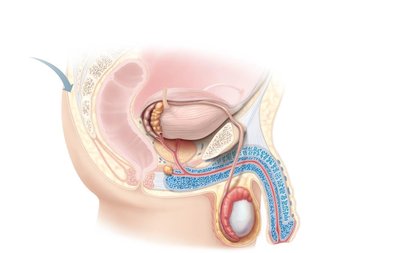
Testes
Surrounded by the tunica albuginea (fibrous capsule).
Divided into lobules by septa; each lobule contains seminiferous tubules (sperm-forming factories).
Interstitial cells between tubules produce testosterone.
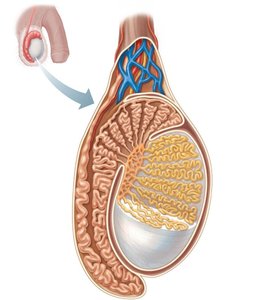
Duct System
Epididymis – Site of sperm maturation (about 20 days); stores sperm until ejaculation.
Ductus (vas) deferens – Transports sperm from epididymis to ejaculatory duct via peristalsis; part of the spermatic cord.
Urethra – Shared passage for urine and semen; divided into prostatic, membranous, and spongy (penile) regions.
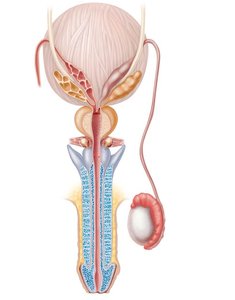
Accessory Glands and Semen
Seminal vesicles – Produce fructose-rich, alkaline fluid (60% of semen) to nourish sperm.
Prostate gland – Secretes milky fluid (25% of semen) that activates sperm; surrounds urethra.
Bulbo-urethral glands – Produce clear mucus (5% of semen) to cleanse urethra and lubricate during intercourse.
Semen – Milky mixture of sperm and glandular secretions; alkaline to neutralize vaginal acidity.
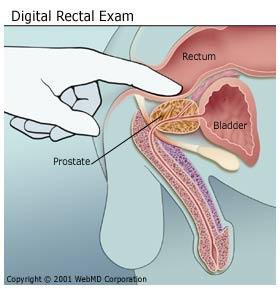
External Genitalia
Scrotum – Sac that holds testes outside the body, maintaining temperature for sperm viability.
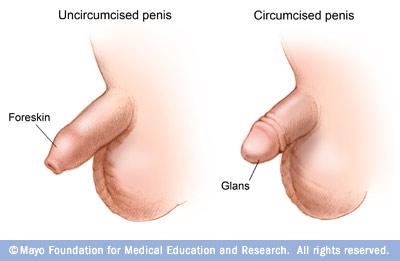
Penis – Delivers sperm to female tract; composed of shaft, glans, and prepuce (foreskin).
Circumcision – Surgical removal of the foreskin.
Spermatogenesis and Hormonal Regulation
Spermatogenesis
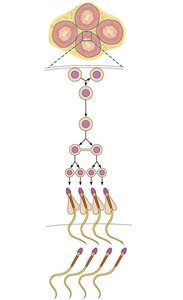
Spermatogenesis is the process of sperm cell production, beginning at puberty and continuing throughout life. It occurs in the seminiferous tubules of the testes.
Spermatogonia (stem cells) divide by mitosis; some become primary spermatocytes.
Primary spermatocytes undergo meiosis to produce four haploid spermatids (n = 23 chromosomes).
Spermiogenesis – Spermatids mature into spermatozoa (sperm cells).
Hormonal Control
FSH (Follicle-Stimulating Hormone) – Stimulates spermatogenesis.
LH (Luteinizing Hormone) – Stimulates interstitial cells to produce testosterone.
Testosterone – Promotes development of male reproductive organs, secondary sex characteristics, and sex drive.
Anatomy of the Female Reproductive System
Main Structures
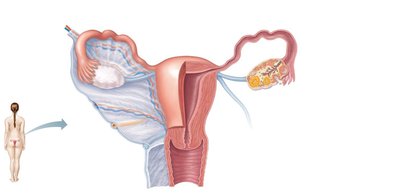
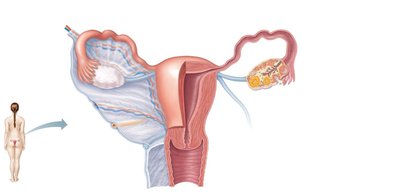
Ovaries – Female gonads producing ova and hormones (estrogen, progesterone).
Duct system – Uterine (fallopian) tubes, uterus, and vagina.
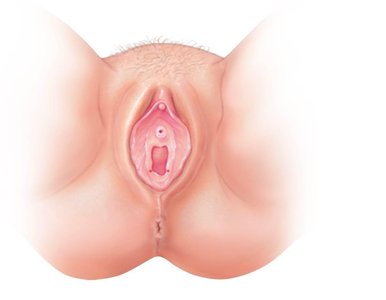
External genitalia – Vulva (mons pubis, labia, clitoris, vestibule).
Ovaries and Follicle Development
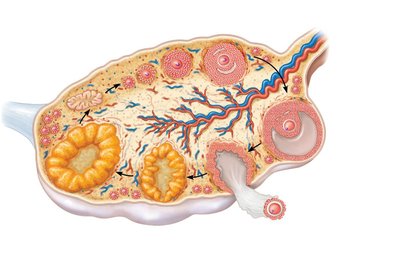
Ovaries contain ovarian follicles (oocyte + follicle cells).
Follicle stages: primary follicle → vesicular (Graafian) follicle → ovulation (release of secondary oocyte) → corpus luteum.
Duct System
Uterine (fallopian) tubes – Receive ovulated oocyte; site of fertilization; fimbriae and cilia help move oocyte.
Uterus – Muscular organ for implantation and development of embryo; regions include body, fundus, and cervix.
Vagina – Muscular canal for intercourse, childbirth, and menstrual flow.
External Genitalia (Vulva)
Mons pubis – Fatty area over pubic symphysis.
Labia majora/minora – Skin folds protecting vestibule.
Clitoris – Erectile tissue, homologous to male penis.
Vestibule – Contains urethral and vaginal orifices; greater vestibular glands secrete lubricant.
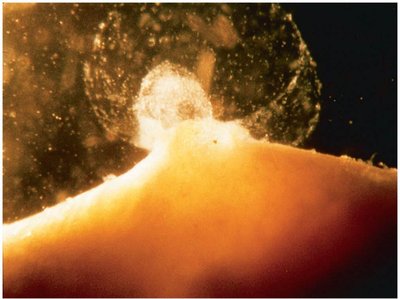
Oogenesis and the Ovarian Cycle
Oogenesis
Oogenesis is the process of ovum (egg) formation.
Oogonia (stem cells) produce primary oocytes before birth; these remain dormant until puberty.
Each month, FSH stimulates maturation of a primary oocyte, which completes meiosis I to form a secondary oocyte and a polar body.
Ovulation releases the secondary oocyte; meiosis II is completed only if fertilization occurs.
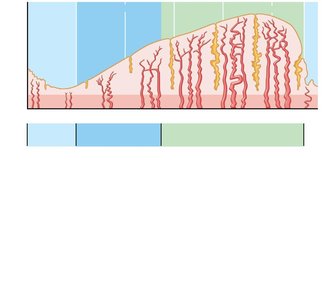
Ovarian and Uterine (Menstrual) Cycles
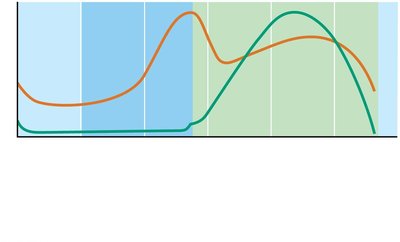
Ovarian cycle – Follicular phase (follicle growth), ovulation (day 14), luteal phase (corpus luteum activity).
Uterine (menstrual) cycle – Cyclic changes in endometrium: menstrual phase (days 1–5), proliferative phase (days 6–14), secretory phase (days 15–28).
Regulated by FSH, LH, estrogen, and progesterone.
Hormonal Regulation in Females
Estrogen and Progesterone
Estrogens – Produced by follicle cells; responsible for secondary sex characteristics and endometrial growth.
Progesterone – Produced by corpus luteum; maintains endometrium and pregnancy, prepares breasts for lactation.
Fertilization and Early Development
Fertilization
Occurs in the uterine tube when a sperm penetrates the secondary oocyte.
Fusion of sperm and egg nuclei forms a zygote (2n = 46 chromosomes).
Early Embryonic Development
Cleavage – Rapid mitotic divisions of the zygote form a morula, then a blastocyst.
Implantation – Blastocyst embeds in the endometrium about 7 days after ovulation.
Placenta – Forms to nourish embryo, remove wastes, and produce hormones.
Pregnancy and Childbirth
Pregnancy Effects
Uterus enlarges, organs shift, and physiological changes occur in cardiovascular, respiratory, urinary, and digestive systems.
Labor and Birth (Parturition)
Initiated by rising estrogen, prostaglandins, and oxytocin (positive feedback mechanism).
Three stages: dilation, expulsion (delivery), placental (afterbirth).
Developmental Aspects and Contraception
Developmental Aspects
Sex determined at fertilization (XX = female, XY = male).
Puberty triggers reproductive maturity; menopause marks end of female reproductive capacity.
Contraception Methods
Hormonal: birth control pills, patches, injections, implants.
Barrier: condoms, diaphragms, cervical caps, spermicides.
Surgical: vasectomy (male), tubal ligation (female).
Other: IUDs, rhythm method, coitus interruptus, emergency contraception (morning-after pill).
Summary Table: Comparison of Male and Female Gametogenesis
Process | Males (Spermatogenesis) | Females (Oogenesis) |
|---|---|---|
Location | Seminiferous tubules of testes | Ovarian follicles |
Initiation | Puberty | Before birth (primary oocytes), resumes at puberty |
Gametes per cycle | Millions | One (plus polar bodies) |
Meiosis completion | Before fertilization | After fertilization |
Additional info: The reproductive system is closely regulated by hormonal feedback loops involving the hypothalamus, pituitary gland, and gonads. Disruptions in these pathways can lead to infertility or developmental disorders.
