 Back
Chapter 17: The Special Senses – Study Notes
Study Guide - Smart Notes
 Tailored notes based on your materials, expanded with key definitions, examples, and context.
The Special Senses
Introduction to the Special Senses
The special senses include olfaction (smell), gustation (taste), vision, equilibrium (balance), and hearing. These senses are mediated by specialized sensory organs and pathways that allow the body to detect and interpret specific environmental stimuli.
Olfaction (Smell)
Olfactory Organs and Structure
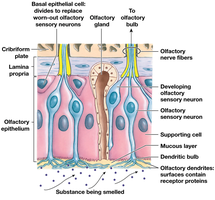
The olfactory organs are located in the nasal cavity and consist of two main layers: the olfactory epithelium and the lamina propria. Odorants are small, airborne, organic molecules that stimulate olfactory receptors.
Olfactory epithelium: Covers the inferior surface of the cribriform plate, the superior portion of the perpendicular plate, and the superior nasal conchae of the ethmoid bone.
Lamina propria: Underlies the olfactory epithelium and contains areolar tissue, blood vessels, nerves, and olfactory glands that secrete mucus.
Olfactory Sensory Neurons
Olfactory sensory neurons are highly modified nerve cells. Their dendrites extend into the surrounding mucus, and their surfaces contain olfactory receptors (odorant-binding proteins). The axons of these neurons form the olfactory nerves.
Steps of Olfaction
The process of olfaction involves several steps:
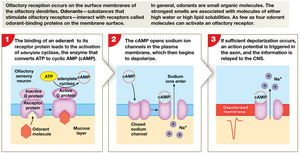
An odorant binds to a G protein–coupled receptor on the olfactory dendrite membrane.
The second messenger cAMP opens sodium ion channels, causing the neuron to depolarize and generate a generator potential.
If depolarization is sufficient, action potentials are triggered in the axon of the olfactory neuron.
Olfactory Pathways
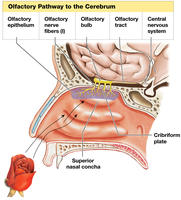
Bundles of axons from olfactory sensory neurons penetrate the cribriform plate of the ethmoid bone and synapse with neurons in the olfactory bulbs. The axons of olfactory bulb neurons form the olfactory tracts, which carry sensory information to the olfactory cortex, hypothalamus, and limbic system. Notably, olfactory information reaches the cerebral cortex without first passing through the thalamus.
Gustation (Taste)
Taste Receptors and Lingual Papillae
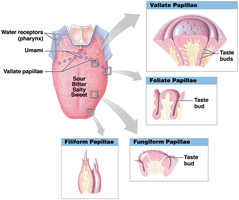
Gustation is the sense of taste, providing information about foods and liquids. Taste receptor cells (gustatory epithelial cells) are found in taste buds, which are distributed on the superior surface of the tongue and in portions of the pharynx and larynx. Taste buds are located within structures called lingual papillae:
Fungiform papillae: Scattered around the tongue, especially at the tip and sides; contain about five taste buds each.
Foliate papillae: Found in folds along the lateral margin of the tongue; contain taste buds.
Vallate papillae: Arranged in a V-shape along the posterior margin; contain about 100 taste buds each.
Filiform papillae: Found in the anterior two-thirds of the tongue; provide friction but do not contain taste buds.
Taste Bud Structure
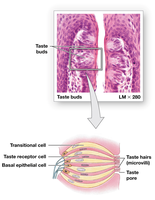
Taste buds are sensory organs containing three main cell types:
Basal epithelial cells: Stem cells that divide to produce new taste cells.
Transitional cells: Supporting cells.
Taste receptor cells: Extend microvilli (taste hairs) into the surrounding fluid through a taste pore and synapse with sensory neurons.
Gustatory Pathways
When taste receptor cells are activated by depolarizing stimuli, they release neurotransmitters that stimulate sensory neurons. These neurons form parts of the following cranial nerves:
Facial nerve (VII): Innervates taste buds of the anterior two-thirds of the tongue.
Glossopharyngeal nerve (IX): Innervates vallate papillae.
Vagus nerve (X): Innervates extralingual taste buds.
Gustatory Discrimination
There are five primary taste sensations:
Salty: Detected when sodium ions diffuse into receptor cells via sodium leak channels.
Sour: Detected when hydrogen ions diffuse into receptor cells via sodium leak channels.
Umami: Pleasant, savory taste imparted by glutamate; detected by G protein–coupled receptors.
Sweet: Detected by G protein–coupled receptors.
Bitter: Detected by G protein–coupled receptors.
Water: Detected by water receptors in the pharynx; sensory output is processed in the hypothalamus.
Vision, Equilibrium, and Hearing
Note: The provided materials focus primarily on olfaction and gustation. For a complete study guide, refer to the full chapter for details on vision, equilibrium, and hearing.
