Back
BackChapter 19: Blood – Structure, Function, and Composition
Study Guide - Smart Notes
 Tailored notes based on your materials, expanded with key definitions, examples, and context.
Chapter 19: Blood
Introduction to Blood
Blood is a vital connective tissue that performs essential functions for the maintenance of homeostasis in the human body. It is responsible for the transport of gases, nutrients, hormones, and waste products, as well as playing a critical role in protection and regulation.
Functions of Blood
1. Transport and Distribution
Oxygen (O2) is transported from the lungs to the cells of the body.
Carbon dioxide (CO2) is carried from cells to the lungs for removal.
Nutrients from the digestive system are delivered to various tissues.
Hormones from endocrine glands are transported to target cells.
Metabolic heat is distributed throughout the body.
2. Protection
Prevention of blood loss: Platelets and clotting factors are essential for hemostasis.
Immune defense: Leukocytes (white blood cells) and antibodies fight infection.
3. Regulation
Water and ion balance: Blood transfers H2O to and from tissues to maintain fluid and ion balance.
Buffer acids and bases: Maintains blood pH; blood acts as a reservoir for bicarbonate ions (HCO3-).
Body temperature: Distributes heat throughout the body and to the skin.
Blood pressure: Contributes to stabilization of blood pressure.
General Characteristics of Blood
Viscosity: Blood is more dense and viscous than water due to the cohesion of formed elements, affecting flow and cardiac workload.
pH: Slightly alkaline, ranging from 7.35 to 7.45.
Temperature: Approximately 100°F (38°C).
Volume: Dependent on body mass; generally 5–6 liters in males, 4–5 liters in females.
Estimation: Blood volume is about 7% of body weight in kilograms (1 kg = 2.2 lbs).
Components of Whole Blood
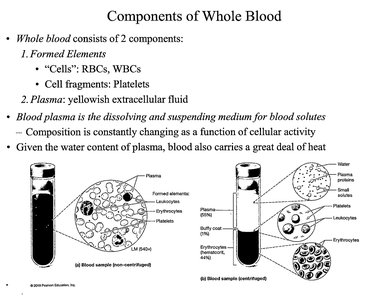
Formed Elements: Includes cells (erythrocytes/RBCs, leukocytes/WBCs) and cell fragments (platelets).
Plasma: The yellowish extracellular fluid that serves as the dissolving and suspending medium for blood solutes.
Blood plasma composition changes with cellular activity and carries a significant amount of heat due to its water content.
Components of Blood Plasma: Proteins
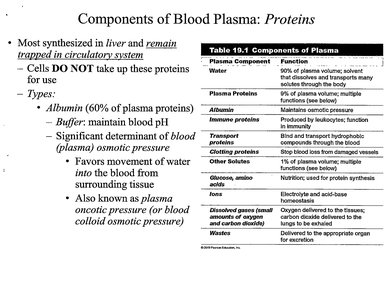
Most plasma proteins are synthesized in the liver and remain in the circulatory system.
Cells do not use these proteins for their own metabolism.
Albumin (60%): Maintains blood pH and is a major determinant of plasma osmotic pressure, drawing water into the blood from tissues.
Other proteins: Immunoglobulins, transport proteins, clotting proteins, and various enzymes/hormones.
Plasma Component | Function |
|---|---|
Water | Solvent, absorbs heat, suspends solutes |
Albumin | Osmotic pressure, buffer |
Immunoglobulins | Antibody function |
Clotting proteins | Blood clotting |
Other proteins | Transport, enzyme, hormone functions |
Dissolved gases, nutrients, wastes | Transport and metabolic functions |
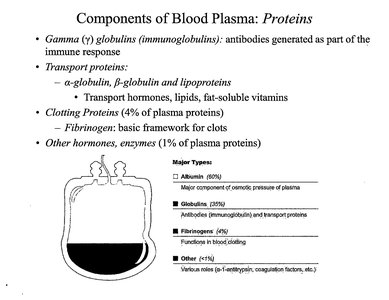
Types of Plasma Proteins
Gamma globulins (immunoglobulins): Antibodies for immune response.
Transport proteins: Alpha and beta globulins, lipoproteins (transport hormones, lipids, vitamins).
Clotting proteins: Fibrinogen forms the basic framework for clots.
Other proteins: Hormones and enzymes (about 1%).
Other Plasma Constituents
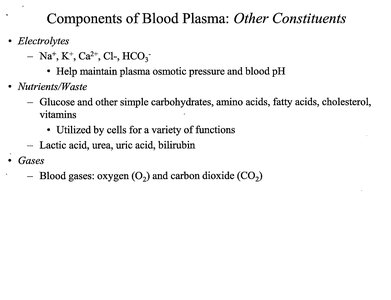
Electrolytes: Na+, K+, Ca2+, Cl-, HCO3- help maintain osmotic pressure and pH.
Nutrients/Waste: Glucose, amino acids, fatty acids, cholesterol, vitamins, lactic acid, urea, uric acid, bilirubin.
Gases: Oxygen (O2) and carbon dioxide (CO2).
Maintenance of Blood Volume: Plasma Expanders
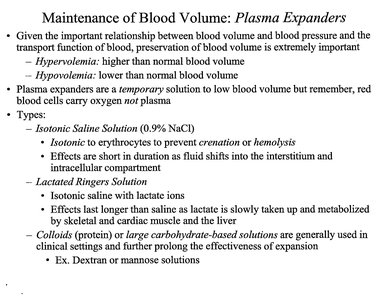
Maintaining blood volume is crucial for blood pressure and transport functions. Plasma expanders are used temporarily to restore volume but do not carry oxygen.
Hypervolemia: Higher than normal blood volume.
Hypovolemia: Lower than normal blood volume.
Types of expanders:
Isotonic saline solution (0.9% NaCl): Prevents cell crenation or hemolysis; short duration effect.
Lactated Ringer's solution: Contains lactate ions; longer-lasting effects.
Colloids: Protein or carbohydrate-based solutions (e.g., dextran, mannose) used in clinical settings.
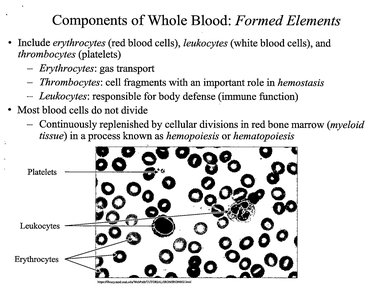
Components of Whole Blood: Formed Elements
Erythrocytes (RBCs): Gas transport.
Leukocytes (WBCs): Immune defense.
Thrombocytes (Platelets): Hemostasis (clotting).
Formed elements are replenished by cell division in red bone marrow (myeloid tissue) through hemopoiesis or hematopoiesis.
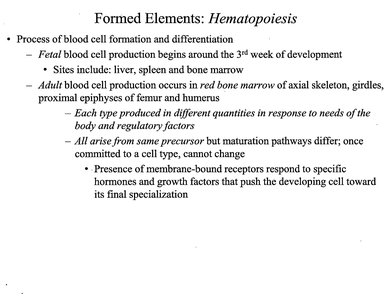
Formed Elements: Hematopoiesis
Hematopoiesis is the process of blood cell formation and differentiation. In the fetus, it begins around the third week of development in the liver, spleen, and bone marrow. In adults, it occurs in red bone marrow of the axial skeleton, girdles, and proximal epiphyses of femur and humerus.
Each blood cell type is produced in different quantities based on body needs and regulatory factors.
All blood cells arise from the same precursor, but once committed, cannot change type.
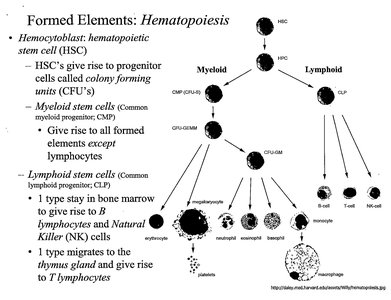
Hematopoietic Stem Cells and Lineages
Hemocytoblast (HSC): The hematopoietic stem cell gives rise to progenitor cells called colony forming units (CFUs).
Myeloid stem cells: Give rise to all formed elements except lymphocytes.
Lymphoid stem cells: Give rise to B lymphocytes, Natural Killer (NK) cells, and T lymphocytes (after migration to the thymus).
Formed Elements: Erythrocytes
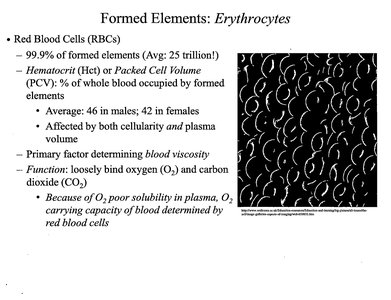
Red blood cells (RBCs) make up 99.9% of formed elements (average: 25 trillion in the body).
Hematocrit (Het) or Packed Cell Volume (PCV): Percentage of whole blood occupied by formed elements (average: 46% in males, 42% in females).
Primary determinant of blood viscosity.
Function: Loosely bind and transport O2 and CO2.
Erythrocyte Structure
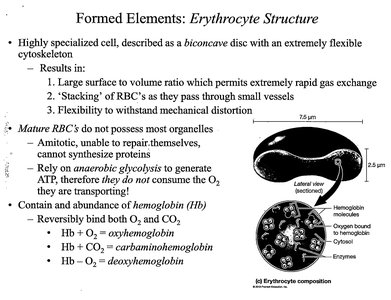
Biconcave disc shape with a flexible cytoskeleton.
Large surface area to volume ratio for rapid gas exchange.
Ability to stack and pass through small vessels.
Flexibility to withstand mechanical distortion.
Mature RBCs lack most organelles, are amitotic, and rely on anaerobic glycolysis for energy (do not consume the O2 they transport).
Contain abundant hemoglobin (Hb), which binds O2 and CO2 reversibly.
Hemoglobin reactions:
Hemoglobin Structure
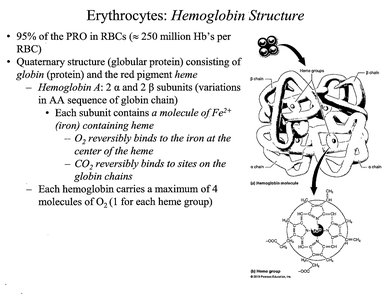
95% of RBC protein is hemoglobin (about 250 million Hb molecules per RBC).
Quaternary structure: 2 alpha and 2 beta subunits (Hemoglobin A).
Each subunit contains a heme group with Fe2+ (iron) at its center.
O2 binds reversibly to iron; CO2 binds to globin chains.
Each hemoglobin can carry up to 4 O2 molecules (one per heme group).
Gas Exchange Basics
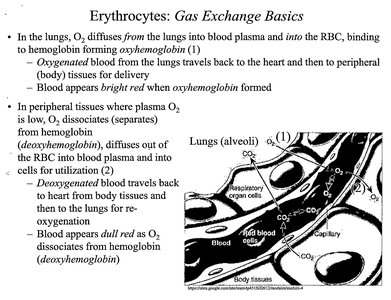
O2 diffuses from lungs into blood plasma and RBCs, binding to hemoglobin to form oxyhemoglobin (bright red).
In tissues, O2 dissociates from hemoglobin (deoxyhemoglobin) and diffuses into cells (dull red).
CO2 is transported from tissues to lungs for exhalation.
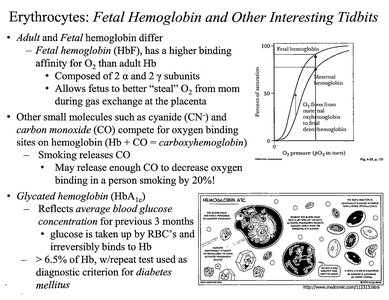
Fetal Hemoglobin and Other Interesting Tidbits
Fetal hemoglobin (HbF): Higher affinity for O2 than adult hemoglobin, allowing efficient O2 transfer from mother to fetus.
Composed of 2 alpha and 2 gamma subunits.
Other molecules (e.g., cyanide, carbon monoxide) can compete for hemoglobin binding, reducing O2 transport.
Glycated hemoglobin (HbA1c): Reflects average blood glucose over 3 months; used as a diagnostic criterion for diabetes mellitus (≥6.5%).
Erythrocyte Formation: Erythropoiesis
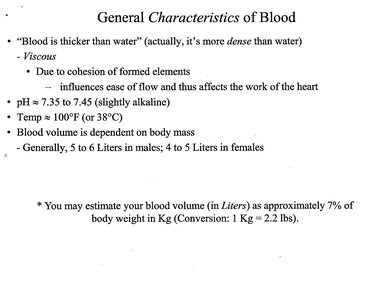
Occurs continuously in myeloid tissue (red bone marrow).
Requires amino acids, iron, vitamin B12, and folic acid.
Stages: HSC → CMP → erythrocyte-CFU → proerythroblast → erythroblast → reticulocyte → mature RBC.
Reticulocytes enter circulation after 5–7 days and mature in about 1 day.
New RBCs enter circulation at a rate of 2–3 million per second to balance loss.
Reticulocyte count (0.5–1.5% of RBCs) is used to measure erythropoiesis.