 Back
Chapter 2: Basic Chemistry for Anatomy & Physiology
Study Guide - Smart Notes
 Tailored notes based on your materials, expanded with key definitions, examples, and context.
Basic Chemistry in Human Anatomy and Physiology
Introduction to Chemistry in Anatomy & Physiology
Chemistry forms the foundation of anatomy and physiology, as all anatomical structures are composed of chemicals and all physiological processes are driven by chemical reactions. Understanding the chemical basis of life is essential for comprehending how the human body functions at every level of organization.
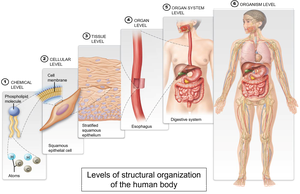
Levels of Structural Organization
Chemical Level: Atoms and molecules form the simplest level of organization.
Cellular Level: Molecules combine to form cells, the basic units of life.
Tissue Level: Similar cells group together to form tissues.
Organ Level: Different tissues combine to form organs.
Organ System Level: Organs work together in organ systems.
Organism Level: All organ systems function together in the human body.
Elements and Atoms
Elements in the Human Body
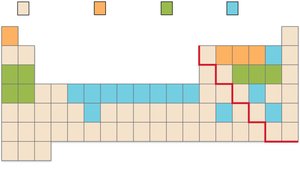
Elements are pure substances that cannot be broken down by ordinary chemical means. The human body is primarily composed of four major elements: oxygen, carbon, hydrogen, and nitrogen, which account for about 96% of body mass. Other elements, such as calcium, phosphorus, potassium, and sulfur, are present in smaller amounts and are essential for various physiological functions.
Atomic Structure
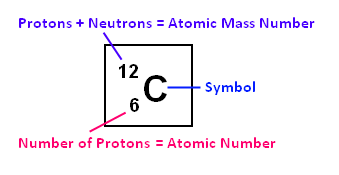
An atom consists of a nucleus containing protons (positively charged) and neutrons (no charge), surrounded by electrons (negatively charged) in electron shells. The atomic number is the number of protons, which defines the element, while the atomic mass number is the sum of protons and neutrons.
Protons: Positive charge, found in the nucleus.
Neutrons: No charge, found in the nucleus.
Electrons: Negative charge, found in electron shells around the nucleus.
Electron Shells and Valence Electrons
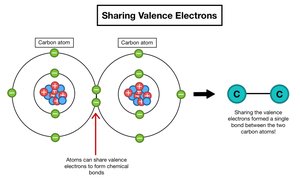
Electrons occupy shells around the nucleus. The outermost shell, called the valence shell, determines the chemical reactivity of the atom. Atoms are most stable when their valence shell is full. Atoms with incomplete valence shells are reactive and tend to form chemical bonds to achieve stability.
Ions and Isotopes
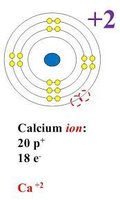
Ions: Atoms that have gained or lost electrons, resulting in a net charge. Cations are positively charged (lost electrons), and anions are negatively charged (gained electrons).
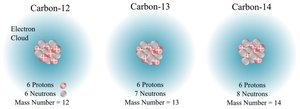
Isotopes: Atoms of the same element with different numbers of neutrons. Some isotopes are radioactive and decay over time, releasing energy.
Types of Chemical Bonds
Chemical Bonds Overview
Chemical bonds are forces that hold atoms together in compounds. The main types of bonds in biological molecules are ionic, covalent (nonpolar and polar), and hydrogen bonds.
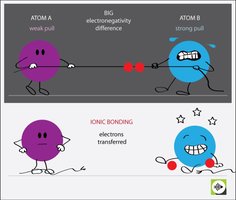
Ionic Bonds
Formed when electrons are transferred from one atom to another, resulting in the formation of oppositely charged ions that attract each other. Example: Sodium chloride (NaCl).
Covalent Bonds
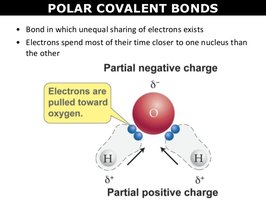
Formed when two atoms share one or more pairs of electrons. If electrons are shared equally, the bond is nonpolar; if shared unequally, the bond is polar.
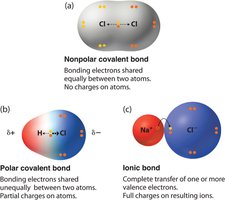
Nonpolar Covalent Bond: Electrons are shared equally (e.g., methane, CH4).
Polar Covalent Bond: Electrons are shared unequally, creating partial charges (e.g., water, H2O).
Hydrogen Bonds
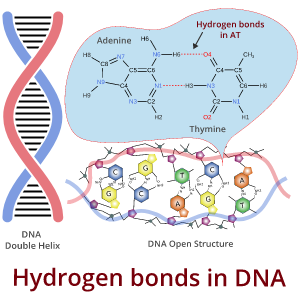
Weak attractions between the partial positive charge of hydrogen in one molecule and the partial negative charge of another atom (often oxygen or nitrogen) in a different molecule. Hydrogen bonds are crucial for the properties of water, the structure of DNA, and protein folding.
Chemical Reactions in Physiology
Types of Chemical Reactions
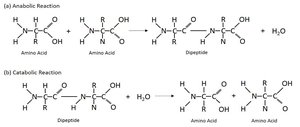
Synthesis (Anabolic) Reactions: Two or more atoms/molecules combine to form a larger molecule. Requires energy input. Example: Formation of proteins from amino acids.
Decomposition (Catabolic) Reactions: A large molecule is broken down into smaller molecules. Releases energy. Example: Breakdown of glycogen to glucose.
Exchange Reactions: Atoms are exchanged between molecules; involves both synthesis and decomposition. Example: ATP transferring a phosphate group to glucose.
Energy in Chemical Reactions
Kinetic Energy: Energy of motion, used to perform work such as forming chemical bonds.
Potential Energy: Stored energy, such as that in chemical bonds.
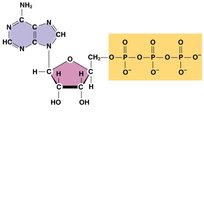
ATP (Adenosine Triphosphate): The main energy currency of the cell. Energy is released when ATP is hydrolyzed to ADP and inorganic phosphate.
Enzymes and Reaction Rates
Enzymes are biological catalysts that speed up chemical reactions by lowering the activation energy required. They are not consumed in the reaction and are essential for maintaining homeostasis.
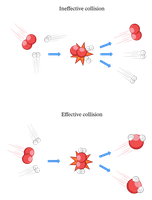
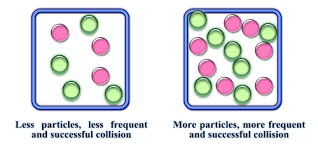
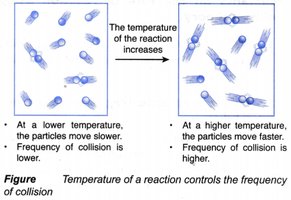
Factors Affecting Reaction Rates: Concentration of reactants, temperature, and presence of enzymes.
Inorganic and Organic Compounds
Inorganic Compounds
Water: The most abundant inorganic molecule in the body, acts as a solvent, and is essential for chemical reactions.
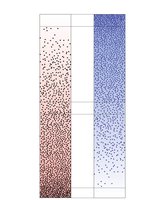
Acids, Bases, and Salts: Acids donate hydrogen ions (H+), bases accept H+, and salts dissociate into ions in water. The pH scale measures the concentration of H+ in a solution (0 = most acidic, 14 = most basic, 7 = neutral).
Electrolytes: Ions that conduct electricity in solution, essential for nerve and muscle function.
Organic Compounds
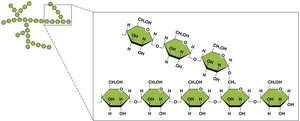
Carbohydrates: Main source of energy; include monosaccharides (glucose), disaccharides (sucrose), and polysaccharides (glycogen).
Lipids: Include triglycerides (energy storage), phospholipids (membranes), and steroids (hormones, membrane structure).
Proteins: Made of amino acids; serve as enzymes, structural components, and signaling molecules.
Nucleic Acids: DNA and RNA, which store and transmit genetic information.
Carbohydrates
Monosaccharides: Simple sugars (e.g., glucose, fructose).
Disaccharides: Two monosaccharides joined (e.g., sucrose).
Polysaccharides: Long chains of monosaccharides (e.g., glycogen).
Lipids
Triglycerides: Three fatty acids bonded to glycerol; energy storage.
Phospholipids: Glycerol, two fatty acids, and a phosphate group; form cell membranes.
Steroids: Four-ring structure; includes cholesterol and hormones.
Proteins
Amino Acids: Building blocks of proteins; 20 types, 9 essential in the diet.
Peptide Bonds: Covalent bonds joining amino acids.
Protein Structure: Primary (sequence), secondary (alpha helix, beta sheet), tertiary (3D shape), quaternary (multiple polypeptides).
Nucleic Acids
Nucleotides: Monomers of nucleic acids, composed of a nitrogenous base, a pentose sugar, and phosphate group(s).
DNA: Double helix, stores genetic information.
RNA: Single strand, helps in protein synthesis.
ATP: Nucleotide that stores and transfers energy in cells.
Summary Table: Types of Chemical Bonds
Bond Type | How Formed | Example | Polarity |
|---|---|---|---|
Ionic | Electron transfer | NaCl | Polar |
Nonpolar Covalent | Equal electron sharing | CH4 | Nonpolar |
Polar Covalent | Unequal electron sharing | H2O | Polar |
Hydrogen Bond | Attraction between partial charges | Between water molecules, DNA strands | Polar |
Key Equations
pH Calculation:
ATP Hydrolysis:
Additional info: This guide expands on the essentials of chemistry as they relate to human anatomy and physiology, providing foundational knowledge for further study in biological sciences.
