 Back
Chapter 2: Chemical Level of Organization – Study Notes
Study Guide - Smart Notes
 Tailored notes based on your materials, expanded with key definitions, examples, and context.
Chapter 2: Chemical Level of Organization
Introduction
This chapter explores the chemical foundations of anatomy and physiology, focusing on the structure of atoms, molecules, and compounds, and their roles in the human body. Understanding these concepts is essential for grasping how physiological processes occur at the molecular level.
Atoms, Molecules, and Compounds
Atoms: The Basic Particles of Matter
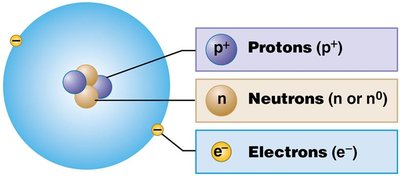
Atoms are the smallest stable units of matter and are composed of subatomic particles: protons, neutrons, and electrons.
Protons (p+): Positively charged particles found in the nucleus.
Neutrons (n or n0): Electrically neutral particles also located in the nucleus.
Electrons (e−): Negatively charged particles that orbit the nucleus in an electron cloud.
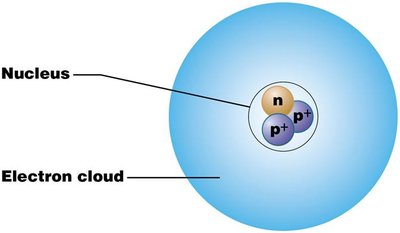
The nucleus contains protons and neutrons, while electrons move around the nucleus in the electron cloud.
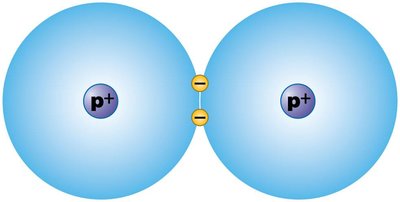
Atoms interact via their electrons to form more complex structures such as molecules and compounds.
Atomic Structure and Elements
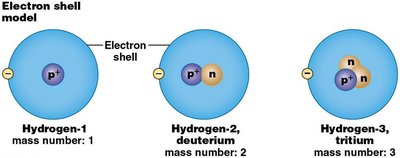
Atomic Number: Number of protons in an atom, defining the element.
Mass Number: Total number of protons and neutrons in the nucleus.
Isotopes: Atoms of the same element with different numbers of neutrons, thus different mass numbers but identical chemical properties.
Atomic Mass is measured in atomic mass units (amu), and atomic weight is the average mass of all isotopes of an element.
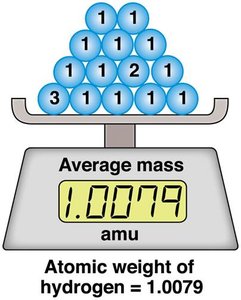
Principal Elements of the Human Body
The human body is primarily composed of oxygen, carbon, hydrogen, and nitrogen, with other elements present in smaller amounts. These elements are essential for physiological processes.
Element | % Body Weight | Significance |
|---|---|---|
Oxygen (O) | 65 | Component of water, essential for respiration |
Carbon (C) | 18.6 | Found in all organic compounds |
Hydrogen (H) | 9.7 | Component of water and most compounds |
Nitrogen (N) | 3.2 | Found in proteins, nucleic acids |
Calcium (Ca) | 1.8 | Bones, teeth, muscle contraction |
Phosphorus (P) | 1.0 | Bones, teeth, nucleic acids |
Potassium (K) | 0.4 | Nerve impulses, muscle contraction |
Sodium (Na) | 0.2 | Blood volume, nerve impulses |
Chlorine (Cl) | 0.2 | Blood volume, water absorption |
Magnesium (Mg) | 0.06 | Cofactor for enzymes |
Sulfur (S) | 0.04 | Proteins |
Iron (Fe) | 0.007 | Oxygen transport |
Iodine (I) | 0.0002 | Thyroid hormones |
Electrons and Energy Levels
Electron Shells and Reactivity
Electrons occupy energy levels (shells) around the nucleus. The arrangement of electrons determines an atom’s chemical properties.
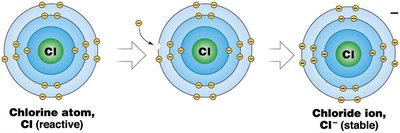
Valence Shell: Outermost energy level; atoms with unfilled valence shells are reactive.
Atoms with filled valence shells are inert (noble gases) and do not react easily.
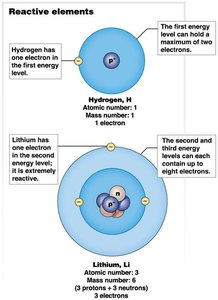
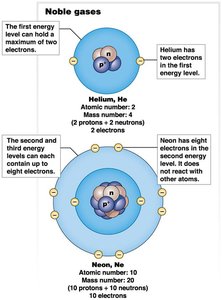
Ions: Cations and Anions
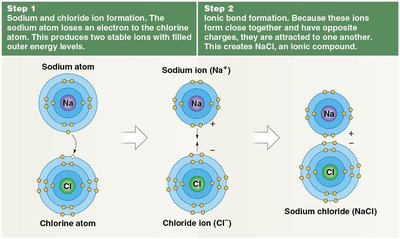
Cation: Atom that loses electrons, becoming positively charged.
Anion: Atom that gains electrons, becoming negatively charged.
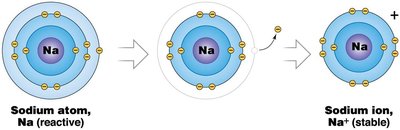
Chemical Bonds: Ionic and Covalent
Ionic Bonds
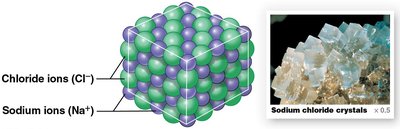
Ionic bonds are formed by the electrical attraction between cations and anions, typically involving the transfer of electrons from one atom to another.
Covalent Bonds
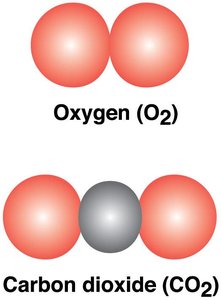
Covalent bonds involve the sharing of electrons between atoms. They can be single, double, or triple bonds depending on the number of shared electron pairs.
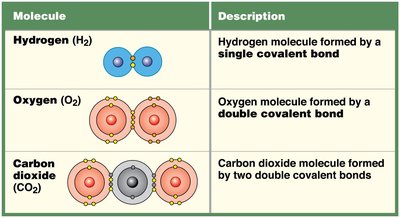
Nonpolar Covalent Bonds: Electrons are shared equally; no charge difference across the molecule.
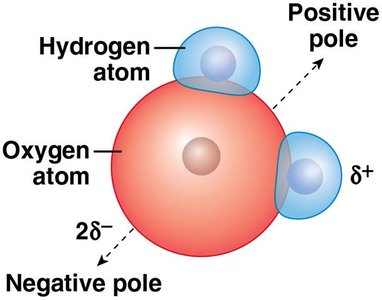
Polar Covalent Bonds: Electrons are shared unequally, creating partial charges (e.g., water molecule).
States of Matter and Hydrogen Bonds
Three States of Matter
Solid: Definite shape and volume; particles held tightly together.
Liquid: Definite volume, shape determined by container; particles less tightly held.
Gas: No definite shape or volume; particles move independently.




Hydrogen Bonds
Hydrogen bonds are weak attractions between the positive charge on a hydrogen atom and the negative charge on another polar molecule. They are crucial for the properties of water.
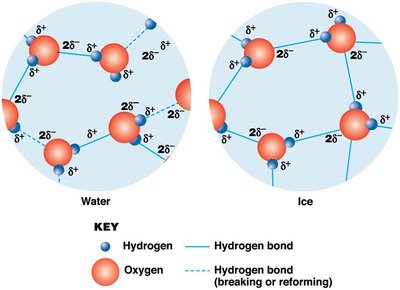
Responsible for water’s surface tension and its ability to dissolve substances.
Hydrogen bonds are constantly forming and breaking in liquid water, lock in place in ice, and are broken in vapor.

Chemical Reactions and Energy
Metabolism and Energy Types
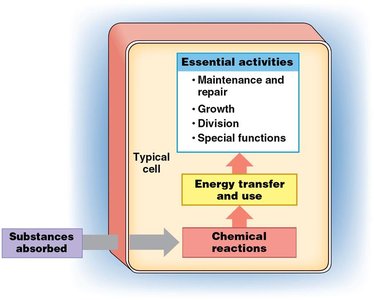
Metabolism is the sum of all chemical reactions in the body. These reactions involve the formation and breaking of chemical bonds.
Kinetic Energy: Energy of motion.
Potential Energy: Stored energy.
Work: Movement or change in the physical structure of matter.
Chemical Notation
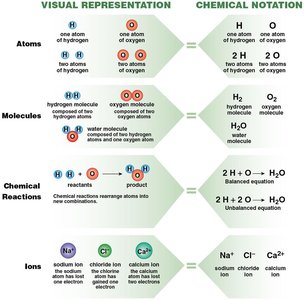
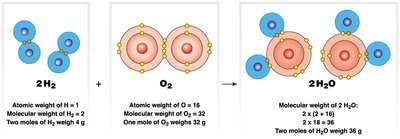
Chemical notation is a concise way to represent atoms, molecules, and reactions. For example, the reaction for water formation is:
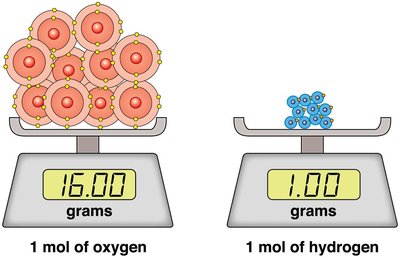
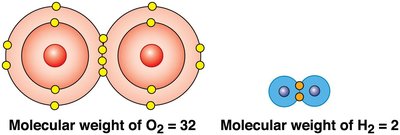
The mole (mol) is a quantity with a weight in grams equal to an element’s atomic weight. Molecular weight is the sum of atomic weights in a molecule.
Types of Chemical Reactions
Decomposition Reactions
Decomposition reactions break molecules into smaller fragments. Hydrolysis is a specific type involving water.


Catabolism refers to all decomposition reactions in the body, releasing energy.

Synthesis Reactions
Synthesis reactions assemble smaller molecules into larger ones, forming new chemical bonds. Dehydration synthesis removes water to form bonds.


Exchange Reactions
Exchange reactions involve the shuffling of parts between molecules, combining decomposition and synthesis.
Enzymes and Metabolism
Role of Enzymes
Enzymes are proteins that lower the activation energy required for chemical reactions, allowing them to proceed under physiological conditions. They act as catalysts and are not consumed in the reaction.
Metabolic Pathways: Series of enzyme-controlled reactions.
Exergonic Reactions: Release energy.
Endergonic Reactions: Absorb energy.
Metabolites are substances processed by enzymatic reactions, while nutrients are essential metabolites obtained from the diet.
Macromolecules are large molecules made of repeating monomers. Dehydration synthesis forms polymers; hydrolysis breaks them down.
Water in the Body
Properties of Water
Lubrication: Reduces friction between surfaces.
Chemical Reactant: Participates in many reactions (e.g., hydrolysis, dehydration synthesis).
High Heat Capacity: Absorbs and retains heat, stabilizing body temperature.
Solvent: Dissolves many inorganic and organic molecules, forming solutions.
Solubility and Electrolytes
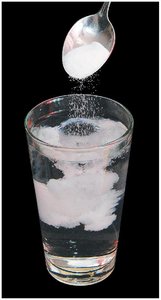
Water’s polarity allows it to dissolve ionic compounds (electrolytes) and polar molecules (hydrophilic). Nonpolar molecules (hydrophobic) do not dissolve in water.
pH and Buffers
pH Scale
pH measures the concentration of hydrogen ions (H+) in a solution. The scale ranges from 0 (acidic) to 14 (basic), with 7 being neutral. Normal blood pH is 7.35–7.45.
Acids: Release H+ ions (proton donors).
Bases: Remove H+ ions (proton acceptors).
Salts: Compounds that dissociate into cations and anions other than H+ and OH−.
Buffers: Compounds that stabilize pH by removing or replacing H+ ions.
Organic Compounds
Common Elements and Functional Groups
Organic compounds always contain carbon and hydrogen, often with oxygen. Functional groups are specific groupings of atoms that influence the properties and reactivity of organic molecules.
Carbohydrates
Carbohydrates are organic molecules with a 1:2:1 ratio of carbon, hydrogen, and oxygen. They are classified as:
Monosaccharides: Simple sugars (e.g., glucose).
Disaccharides: Two monosaccharides joined (e.g., sucrose).
Polysaccharides: Many monosaccharides linked (e.g., glycogen, starch).
Lipids
Lipids are hydrophobic molecules with a high ratio of carbon and hydrogen to oxygen. Types include fatty acids, glycerides, eicosanoids, steroids, phospholipids, and glycolipids. They serve as energy reserves, structural components, and chemical messengers.
Proteins
Proteins are polymers of amino acids, containing carbon, hydrogen, oxygen, nitrogen, and sometimes sulfur or phosphorus. Their structure determines their function and includes four levels: primary, secondary, tertiary, and quaternary. Denaturation disrupts protein structure and function.
Nucleic Acids
Nucleic acids (DNA and RNA) store and transfer genetic information. They are composed of nucleotides, each containing a phosphate group, a five-carbon sugar, and a nitrogenous base. DNA is double-stranded; RNA is single-stranded.
Additional info: This summary covers the foundational chemical concepts necessary for understanding anatomy and physiology, including atomic structure, chemical bonding, states of matter, chemical reactions, the role of water, pH regulation, and the major classes of organic compounds.
