 Back
Chapter 2: Chemistry Comes Alive – Foundations for Anatomy & Physiology
Study Guide - Smart Notes
 Tailored notes based on your materials, expanded with key definitions, examples, and context.
Chapter Overview: Chemistry Comes Alive
This chapter introduces the essential chemical principles that underlie all physiological processes in the human body. Understanding chemistry is crucial for interpreting how the body functions at the molecular level, including fluid balance, metabolism, and cellular structure.
Part 1: Basic Chemistry
2.1 Matter and Energy
Matter and energy are the foundational concepts of chemistry, both of which are essential for physiological processes.
Matter: Anything that has mass and occupies space. Exists in three states: solid (definite shape and volume), liquid (definite volume, changeable shape), and gas (changeable shape and volume).
Energy: The capacity to do work or put matter into motion. Exists as kinetic (energy in action) or potential (stored energy).
Forms of Energy: Chemical (stored in bonds), electrical (movement of charged particles), mechanical (movement of matter), and radiant/electromagnetic (travels in waves, e.g., light).
Energy Conversion: Energy can be transformed from one form to another, but some is always lost as heat.
2.2 Atoms and Elements
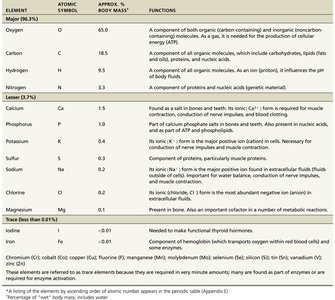
All matter is composed of elements, which are substances that cannot be broken down by ordinary chemical means. The human body is primarily composed of four elements: carbon, oxygen, hydrogen, and nitrogen.
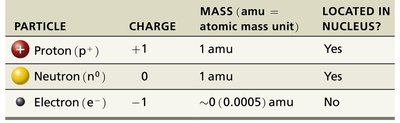
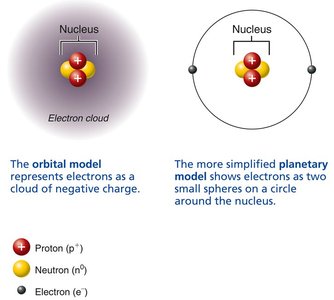
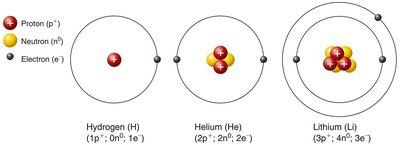
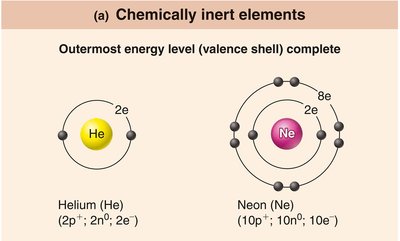
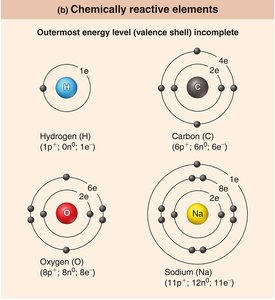
Atoms: The smallest units of elements, consisting of protons (+), neutrons (0), and electrons (–).
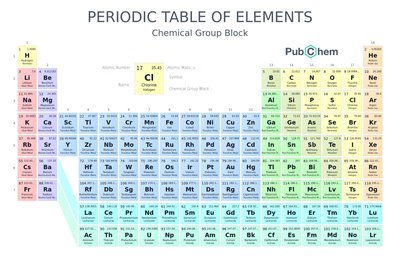
Atomic Number: Number of protons in the nucleus.
Mass Number: Total number of protons and neutrons.
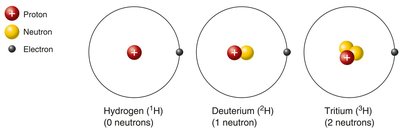
Isotopes: Atoms of the same element with different numbers of neutrons.
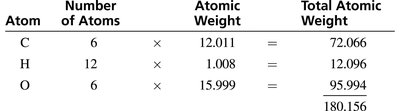
Atomic Weight: Average of mass numbers of all isotopes.
2.3 Molecules, Compounds, and Mixtures
Atoms combine to form molecules and compounds, which are essential for biological structure and function. Most matter exists as mixtures.
Molecule: Two or more atoms bonded together (e.g., O2).
Compound: Molecule with two or more different atoms (e.g., H2O).
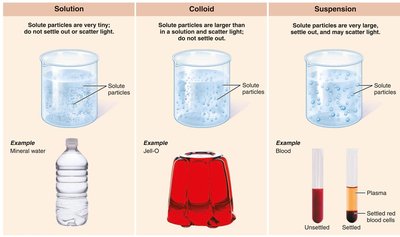
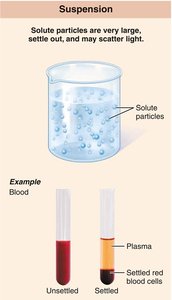
Mixtures: Physical combinations of substances. Types include solutions (homogeneous), colloids (heterogeneous, do not settle), and suspensions (heterogeneous, particles settle).
Concentration of Solutions
Percent (%): Parts per 100 parts of solution.
Milligrams per deciliter (mg/dL): Mass of solute per 100 mL of solution.
Molarity (M): Moles of solute per liter of solution. 1 mole = 6.02 × 10²³ molecules (Avogadro’s number).
Differences Between Mixtures and Compounds
Mixtures do not involve chemical bonding and can be separated physically; compounds require chemical reactions to separate.
2.4 Chemical Bonds
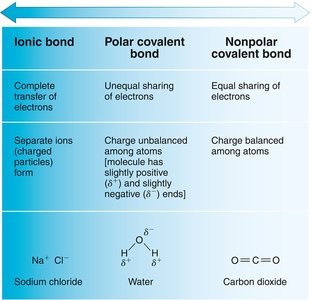
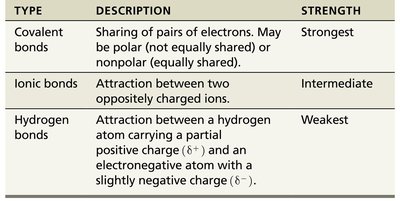
Chemical bonds are energy relationships between electrons of reacting atoms. The main types are ionic, covalent, and hydrogen bonds.
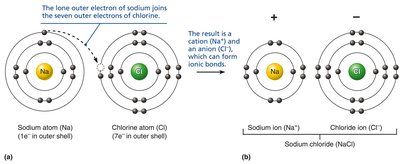
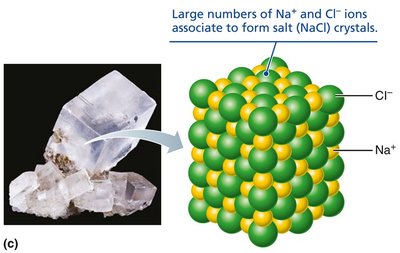
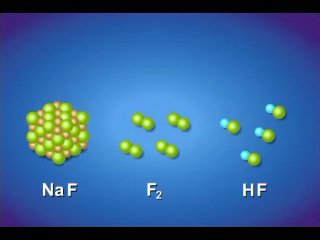
Ionic Bonds: Transfer of electrons from one atom to another, forming ions (cations and anions). Example: NaCl.
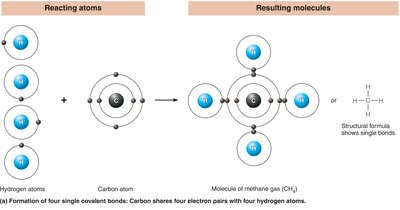
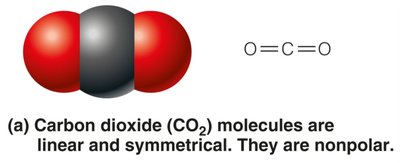
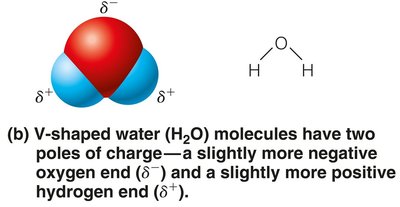
Covalent Bonds: Sharing of electrons between atoms. Can be single, double, or triple bonds. May be nonpolar (equal sharing) or polar (unequal sharing).
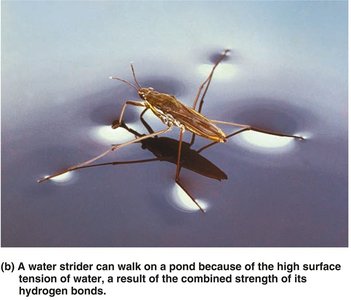
Hydrogen Bonds: Weak attractions between a hydrogen atom and an electronegative atom (e.g., between water molecules).
Part 2: Biochemistry
2.5 Chemical Reactions
Chemical reactions involve the formation, rearrangement, or breaking of chemical bonds. They are represented by chemical equations.
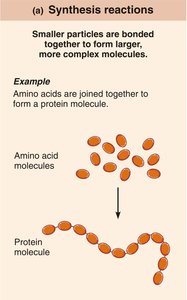
Synthesis (Combination): Atoms or molecules combine to form larger molecules (A + B → AB). Anabolic process.
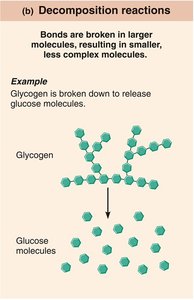
Decomposition: Molecules are broken down into smaller components (AB → A + B). Catabolic process.
Exchange (Displacement): Bonds are both made and broken (AB + C → AC + B).
Redox (Oxidation-Reduction): Involves transfer of electrons; important in metabolism.
Energy Flow in Chemical Reactions
Exergonic: Release energy (products have less potential energy).
Endergonic: Absorb energy (products have more potential energy).
Factors Affecting Reaction Rates
Temperature, concentration, particle size, and catalysts (enzymes).
2.6 Inorganic Compounds
Inorganic compounds include water, salts, acids, and bases. They are essential for physiological processes but do not contain carbon (with few exceptions).
Water: Most abundant inorganic compound; high heat capacity, solvent properties, reactivity, and cushioning.
Salts: Ionic compounds that dissociate in water to form electrolytes (e.g., Na+, K+, Ca2+).
Acids and Bases: Acids release H+; bases accept H+. pH scale measures hydrogen ion concentration.
Buffers: Resist changes in pH; important for homeostasis (e.g., bicarbonate buffer system).
2.7 Organic Compounds: Synthesis and Hydrolysis
Organic molecules contain carbon and are unique to living systems. Major classes include carbohydrates, lipids, proteins, and nucleic acids.
Polymers: Chains of monomers formed by dehydration synthesis and broken by hydrolysis.

2.8 Carbohydrates
Carbohydrates are sugars and starches, serving as a major energy source. They contain carbon, hydrogen, and oxygen in a 1:2:1 ratio.
Monosaccharides: Simple sugars (e.g., glucose, fructose, ribose).
Disaccharides: Two monosaccharides joined (e.g., sucrose, lactose).
Polysaccharides: Long chains of monosaccharides (e.g., starch in plants, glycogen in animals).
2.9 Lipids
Lipids are hydrophobic molecules including fats, oils, phospholipids, steroids, and eicosanoids. They are important for energy storage, membrane structure, and signaling.
Triglycerides: Glycerol + 3 fatty acids; energy storage.
Phospholipids: Glycerol + 2 fatty acids + phosphate group; major component of cell membranes.
Steroids: Four fused rings; cholesterol is a precursor for steroid hormones.
Eicosanoids: Derived from arachidonic acid; involved in inflammation and signaling.
2.10 Proteins
Proteins are polymers of amino acids and perform a vast array of functions, including structural support, catalysis (enzymes), transport, and signaling.
Levels of Structure: Primary (sequence), secondary (α-helix, β-sheet), tertiary (3D folding), quaternary (multiple polypeptides).
Denaturation: Loss of structure and function due to pH or temperature changes.
Enzymes: Biological catalysts that lower activation energy and increase reaction rates.
2.11 Nucleic Acids
Nucleic acids (DNA and RNA) store and transmit genetic information. They are polymers of nucleotides (sugar, phosphate, nitrogenous base).
DNA: Double helix, stores genetic blueprint.
RNA: Single-stranded, involved in protein synthesis (mRNA, tRNA, rRNA).
2.12 ATP (Adenosine Triphosphate)
ATP is the primary energy currency of the cell. It stores energy in high-energy phosphate bonds and releases it to power cellular work.
Structure: Adenine, ribose, and three phosphate groups.
ATP → ADP + Pi: Releases energy for cellular processes.
Additional info: This summary integrates and expands upon the provided lecture slides and tables, ensuring a comprehensive, self-contained study guide for ANP college students. All images included are directly relevant to the adjacent content and reinforce key concepts.
