 Back
Chapter 2: Chemistry Comes Alive – Study Notes
Study Guide - Smart Notes
 Tailored notes based on your materials, expanded with key definitions, examples, and context.
Chapter 2: Chemistry Comes Alive
Introduction
Chemistry forms the foundation for understanding physiological processes in the human body. This chapter explores the basic principles of chemistry and biochemistry, focusing on matter, energy, atomic structure, chemical bonds, and the types of chemical reactions essential for life.
2.1 Matter and Energy
Matter
Matter is anything that has mass and occupies space. It can be seen, smelled, or felt.
States of matter:
Solid: Definite shape and volume.
Liquid: Changeable shape, definite volume.
Gas: Changeable shape and volume.
Energy
Energy is the capacity to do work or put matter into motion.
Exists in two forms:
Kinetic energy: Energy in action.
Potential energy: Stored energy.
Forms of energy:
Chemical energy: Stored in bonds of chemical substances.
Electrical energy: Movement of charged particles.
Mechanical energy: Directly involved in moving matter.
Radiant (electromagnetic) energy: Travels in waves (e.g., light, X-rays).
Energy conversions are inefficient; some energy is lost as heat.
2.2 Atoms and Elements
Elements
Elements are substances that cannot be broken down into simpler substances by ordinary chemical methods.
Four elements make up 96% of the human body: carbon, oxygen, hydrogen, and nitrogen.
Each element is represented by a one- or two-letter atomic symbol (e.g., O for oxygen).
Atoms
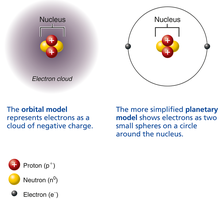
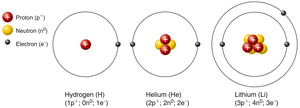
Atoms are the smallest units of an element that retain the properties of that element.
Composed of three subatomic particles:
Protons (p+): Positive charge, 1 atomic mass unit (amu).
Neutrons (n0): No charge, 1 amu.
Electrons (e-): Negative charge, virtually no mass.
Isotopes and Atomic Structure
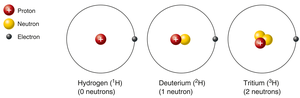
Isotopes are atoms of the same element with different numbers of neutrons.
Atomic number: Number of protons in the nucleus.
Mass number: Total number of protons and neutrons.
Atomic weight: Average of mass numbers of all isotopes.
2.3 Combining Matter
Molecules and Compounds
Molecule: Two or more atoms bonded together.
Compound: Molecule with two or more different kinds of atoms.
Mixtures
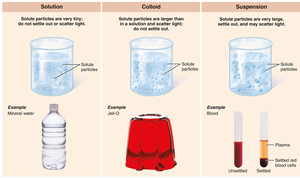
Most matter exists as mixtures: two or more components physically intermixed.
Three basic types:
Solutions: Homogeneous mixtures; solute particles are tiny and do not settle out.
Colloids: Heterogeneous mixtures; larger particles that do not settle out.
Suspensions: Heterogeneous mixtures with large particles that settle out.
2.4 Chemical Bonds
Role of Electrons in Chemical Bonding
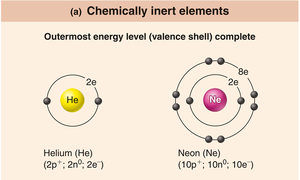
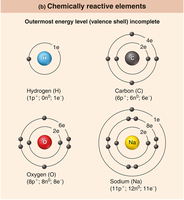
Electrons occupy electron shells (energy levels) around the nucleus.
The valence shell is the outermost shell and determines chemical reactivity.
Octet rule: Atoms tend to gain, lose, or share electrons to achieve 8 electrons in their valence shell (except H and He).
Types of Chemical Bonds
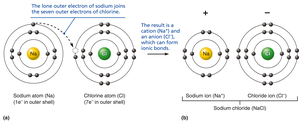
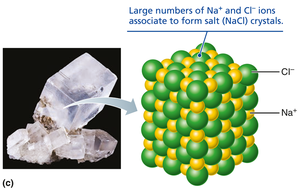
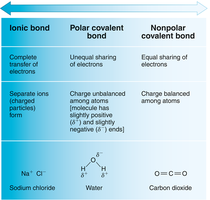
Ionic bonds: Transfer of electrons from one atom to another, forming ions (cations and anions).
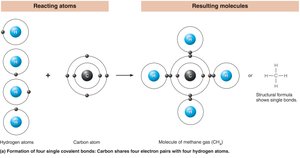
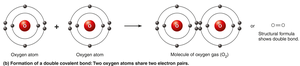
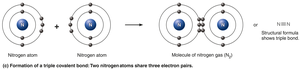
Covalent bonds: Sharing of electrons between atoms. Can be single, double, or triple bonds.
Hydrogen bonds: Weak attraction between a hydrogen atom and an electronegative atom (e.g., O or N).
Polar and Nonpolar Covalent Bonds
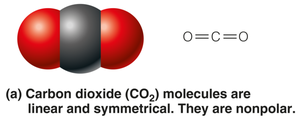
Nonpolar covalent bonds: Equal sharing of electrons (e.g., O2, CO2).
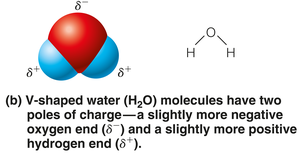
Polar covalent bonds: Unequal sharing of electrons, resulting in partial charges (e.g., H2O).
2.5 Chemical Reactions
Chemical Equations
Chemical reactions involve the formation, rearrangement, or breaking of chemical bonds.
Written as chemical equations: Reactants → Products.
Types of Chemical Reactions
Synthesis (combination): Atoms or molecules combine to form a larger molecule. Example:
Decomposition: Molecule is broken down into smaller molecules or atoms. Example:
Exchange (displacement): Bonds are both made and broken. Example:
Redox reactions: Involve electron transfer; oxidation is loss, reduction is gain of electrons.
Energy Flow in Chemical Reactions
Exergonic reactions: Release energy (products have less potential energy than reactants).
Endergonic reactions: Absorb energy (products have more potential energy than reactants).
Factors Affecting Reaction Rate
Temperature (higher increases rate)
Concentration (higher increases rate)
Particle size (smaller increases rate)
Catalysts (e.g., enzymes) increase reaction rate without being consumed.
2.6 Inorganic Compounds
Water
Most abundant inorganic compound in the body (60–80% of cell volume).
Properties:
High heat capacity and vaporization
Polar solvent properties
Reactivity (hydrolysis and dehydration synthesis)
Cushioning (protects organs)
Salts
Ionic compounds that dissociate in water to form electrolytes (conduct electrical currents).
Examples: NaCl, KCl, calcium phosphates.
Ionic balance is vital for homeostasis.
Acids and Bases
Acids: Proton donors; release H+ ions.
Bases: Proton acceptors; release OH- ions.
pH scale: Measures H+ concentration (0–14); lower pH is more acidic, higher is more basic.
Buffers: Resist changes in pH by releasing or binding H+ ions.
2.7 Organic Compounds
General Features
Contain carbon (except CO2 and CO, which are inorganic).
Major classes: carbohydrates, lipids, proteins, nucleic acids.
Many are polymers built from monomers by dehydration synthesis and broken down by hydrolysis.
2.8 Carbohydrates
Include sugars and starches; contain C, H, O in a 1:2:1 ratio.
Three classes:
Monosaccharides: Simple sugars (e.g., glucose, ribose).
Disaccharides: Two monosaccharides joined (e.g., sucrose, lactose).
Polysaccharides: Long chains (e.g., starch in plants, glycogen in animals).
2.9 Lipids
Contain C, H, O (less O than carbohydrates), sometimes P; insoluble in water.
Main types:
Triglycerides: Energy storage, insulation, protection.
Phospholipids: Major component of cell membranes.
Steroids: Four interlocking rings (e.g., cholesterol).
Eicosanoids: Derived from arachidonic acid; involved in inflammation and other functions.
2.10 Proteins
Comprise 10–30% of cell mass; contain C, H, O, N, sometimes S and P.
Functions: structural, enzymatic, contractile, transport, and more.
Polymers of amino acids joined by peptide bonds.
Four structural levels: primary, secondary, tertiary, quaternary.
Denaturation: loss of structure and function due to pH or temperature changes.
Enzymes: biological catalysts that lower activation energy and speed up reactions.
2.11 Nucleic Acids
Composed of C, H, O, N, P; largest molecules in the body.
Monomers: nucleotides (nitrogen base, pentose sugar, phosphate group).
Two types:
DNA: Double helix, genetic blueprint, found in nucleus.
RNA: Single-stranded, involved in protein synthesis.
2.12 ATP (Adenosine Triphosphate)
ATP is the energy currency of the cell.
Structure: adenine-containing RNA nucleotide with two additional phosphate groups.
Energy is released when phosphate bonds are broken; used to power cellular work.
Additional info: This summary covers the essential chemical principles underlying human physiology, as presented in Chapter 2 of Marieb's Human Anatomy & Physiology. The included images directly support explanations of atomic structure, types of mixtures, and chemical bonding.
