 Back
Chapter 2: The Chemical Level of Organization – Study Notes
Study Guide - Smart Notes
 Tailored notes based on your materials, expanded with key definitions, examples, and context.
Chapter 2: The Chemical Level of Organization
Atoms and Atomic Structure
The atom is the smallest stable unit of matter, composed of subatomic particles: protons (positively charged), neutrons (neutral), and electrons (negatively charged). Protons and neutrons are similar in size and mass and are located within the nucleus, while electrons are much lighter and orbit the nucleus in an electron cloud.
Atomic number: The number of protons in an atom, unique for each element.
Atoms typically have equal numbers of protons and electrons, making them electrically neutral (except for ions).
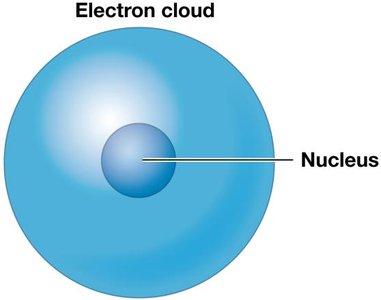
Electron cloud: The region around the nucleus where electrons are likely to be found. Electron shell: A two-dimensional representation of the electron cloud, where electrons are held by the attraction to the positively charged nucleus.
Elements and Isotopes
An element is a pure substance composed of atoms with the same number of protons. Each element has a unique atomic number and a chemical symbol (e.g., O for oxygen, Na for sodium). The human body is primarily composed of a few principal elements, each with specific biological roles.
Element | % Body Weight | Significance |
|---|---|---|
Oxygen (O) | 65 | Component of water, essential for respiration |
Carbon (C) | 18.6 | Found in all organic molecules |
Hydrogen (H) | 9.7 | Component of water and most compounds |
Nitrogen (N) | 3.2 | Found in proteins, nucleic acids |
Calcium (Ca) | 1.8 | Bones, teeth, nerve impulses, muscle contraction |
Phosphorus (P) | 1.0 | Bones, teeth, nucleic acids |
Potassium (K) | 0.4 | Membrane function, nerve impulses |
Sodium (Na) | 0.2 | Blood volume, nerve impulses |
Chlorine (Cl) | 0.2 | Blood volume, water absorption |
Magnesium (Mg) | 0.06 | Cofactor for enzymes |
Sulfur (S) | 0.04 | Found in proteins |
Iron (Fe) | 0.007 | Oxygen transport |
Iodine (I) | 0.0002 | Thyroid hormones |
Isotopes are forms of the same element with different numbers of neutrons. They have nearly identical chemical properties but differ in mass. The mass number is the sum of protons and neutrons.
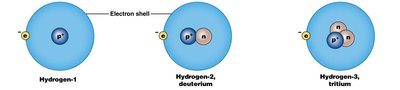
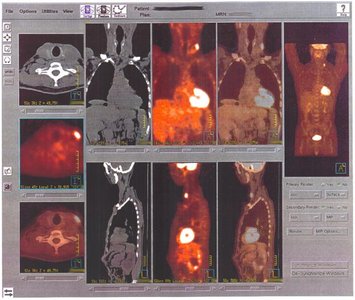
Radioisotopes have unstable nuclei and emit radiation as they decay. The half-life is the time required for half of a radioactive isotope to decay. Radioisotopes are used in diagnostic procedures, such as PET scans.
Electrons and Energy Levels
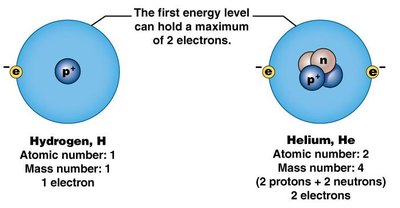
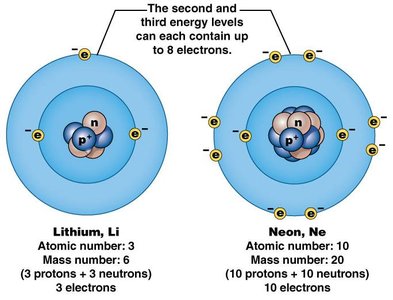
Atoms are electrically neutral when they have equal numbers of protons and electrons. Electrons occupy energy levels (shells) around the nucleus:
The first shell (closest to the nucleus) holds up to 2 electrons.
The second and third shells can each hold up to 8 electrons.
The valence shell is the outermost shell and determines chemical reactivity.
Atoms with unfilled valence shells are reactive; those with filled shells are stable (inert).
Molecules and Compounds
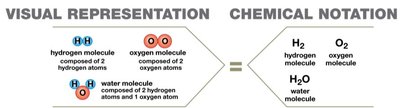
Molecules are two or more atoms held together by shared electrons. Compounds are chemical substances composed of atoms of two or more different elements. Not all molecules are compounds (e.g., H2), and not all compounds are molecules (e.g., NaCl, which is held together by ionic bonds).
Ions and Ionic Bonds
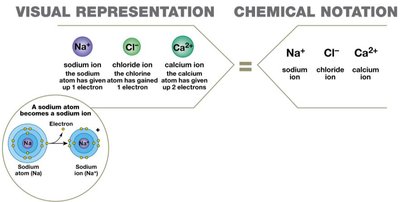
An ion is an atom or group of atoms with an electrical charge. Cations are positively charged (loss of electrons), and anions are negatively charged (gain of electrons). Ionic bonds are formed by the attraction between cations and anions, such as in sodium chloride (NaCl).
Covalent Bonds
Covalent bonds are formed when atoms share electrons. These bonds can be single, double, or triple, depending on the number of shared electron pairs. Nonpolar covalent bonds involve equal sharing, while polar covalent bonds involve unequal sharing, resulting in partial charges (e.g., water is a polar molecule).
Hydrogen Bonds
Hydrogen bonds are weak attractions between the partial positive charge of a hydrogen atom in a polar covalent bond and the partial negative charge of another atom (O, N, or F) in a different polar covalent bond. These bonds are important in water, proteins, and nucleic acids.
Chemical Reactions
Chemical reactions involve the formation or breaking of bonds between atoms. They are represented by chemical equations, with reactants on the left and products on the right. Types of reactions include:
Decomposition: AB → A + B
Hydrolysis: AB + H2O → AH + BOH
Synthesis: A + B → AB
Dehydration synthesis: AH + BOH → AB + H2O
Exchange: AB + CD → AD + CB
Reversible: A + B ↔ AB
pH and Homeostasis
pH measures the concentration of hydrogen ions (H+) in a solution. A pH of 7 is neutral; below 7 is acidic, and above 7 is basic (alkaline). The pH of blood is tightly regulated (7.35–7.45). Deviations can cause acidosis (pH < 7.35) or alkalosis (pH > 7.45), which can be life-threatening.
Macromolecules
Macromolecules are large, complex molecules essential for life. There are four main types:
Carbohydrates: Energy sources; monomer is the monosaccharide (e.g., glucose).
Lipids: Energy storage, insulation, and membrane structure; include fatty acids, triglycerides, steroids, and phospholipids.
Proteins: Structure, movement, transport, enzymes, and defense; monomer is the amino acid.
Nucleic acids: Store and process genetic information; monomer is the nucleotide (DNA and RNA).
Carbohydrates
Monosaccharides: Simple sugars (e.g., glucose, fructose).
Disaccharides: Two monosaccharides joined (e.g., sucrose).
Polysaccharides: Many monosaccharides joined (e.g., starch, glycogen, cellulose).
Lipids
Fatty acids: Saturated (no double bonds) or unsaturated (one or more double bonds).
Glycerides: Fatty acids attached to glycerol (mono-, di-, triglycerides).
Steroids: Four-ring structure (e.g., cholesterol, hormones).
Phospholipids: Major component of cell membranes.
Proteins
Composed of 20 different amino acids linked by peptide bonds.
Four levels of structure: primary, secondary (alpha helix, beta sheet), tertiary, quaternary (e.g., hemoglobin).
Enzymes are proteins that catalyze biochemical reactions by lowering activation energy.
Nucleic Acids
DNA: Double-stranded, stores genetic information; bases are A, T, C, G.
RNA: Single-stranded, involved in protein synthesis; bases are A, U, C, G.
Nucleotides consist of a pentose sugar, phosphate group, and nitrogenous base.
High-Energy Compounds
Cells use high-energy compounds, such as ATP (adenosine triphosphate), to store and transfer energy. ATP is generated from ADP (adenosine diphosphate) and a phosphate group. The enzyme ATPase catalyzes the breakdown of ATP, releasing energy for cellular processes.
Key equation:
