 Back
BackChapter 2: The Chemical Level of Organization – Study Notes for Anatomy & Physiology I
Study Guide - Smart Notes
 Tailored notes based on your materials, expanded with key definitions, examples, and context.
Chemical Level of Organization
Introduction to Chemistry in Anatomy & Physiology
The study of living material in anatomy and physiology is fundamentally dependent on understanding chemistry, as all biological processes are governed by chemical interactions. The human body is composed of principal elements and compounds that interact at the molecular and atomic levels.
Subatomic Particles: Protons (positive), Neutrons (neutral), Electrons (negative)
Atoms: Smallest stable units of matter, made up of subatomic particles
Molecules: Formed when atoms combine via chemical bonds
Atomic Structure and Isotopes
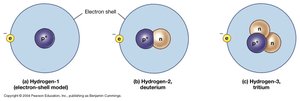
Atoms consist of a nucleus (protons and neutrons) and electron shells. The atomic number is the number of protons, while the mass number is the sum of protons and neutrons. Isotopes are variants of elements with the same number of protons but different numbers of neutrons.
Atomic Weight: Expressed in Daltons
Isotopes: Example: Hydrogen (0 neutrons), Deuterium (1 neutron), Tritium (2 neutrons)
Electron Shells and Stability
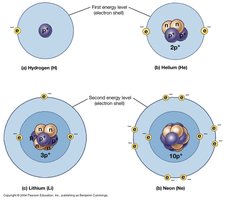
Electrons orbit the nucleus in shells, each with a specific capacity. Atoms are most stable when their outermost shell is full.
1st shell: max 2 electrons
2nd shell: max 8 electrons
3rd shell: max 8 electrons
Atoms with full outer shells (e.g., Helium, Neon) are inert; those with incomplete shells are reactive.
Chemical Bonds
Types of Chemical Bonds
Chemical bonds are the forces that hold atoms together.
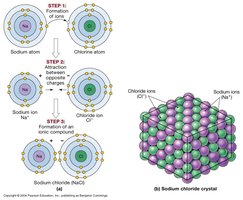
Ionic Bonds: Formed by transfer of electrons (3-5 kcal/mol)
Covalent Bonds: Formed by sharing electrons (50 kcal/mol)
Hydrogen Bonds: Weak attractions between δ+ hydrogen and δ- atoms (3-5 kcal/mol)
Ionic Bonds
Ionic bonds occur when one atom donates an electron (becoming a cation) and another accepts it (becoming an anion). Example: Sodium chloride (NaCl).
Cation: Positively charged ion
Anion: Negatively charged ion
Covalent Bonds
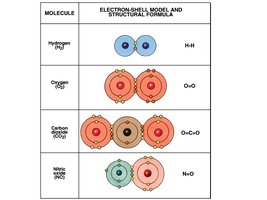
Covalent bonds involve the sharing of electrons.
Single Covalent Bond: Two atoms share one pair of electrons (e.g., H-H)
Double Covalent Bond: Two atoms share two pairs of electrons (e.g., O=O)
Polar and Non-Polar Covalent Bonds
Non-polar: Equal sharing of electrons
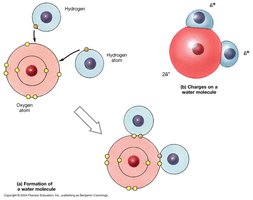
Polar: Unequal sharing, resulting in partial charges (δ+ and δ-)
Hydrogen Bonds
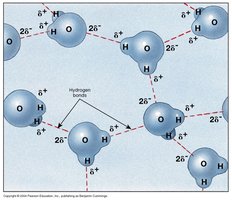
Hydrogen bonds are weak attractions between the δ+ hydrogen of one molecule and the δ- atom of another. They are important for water properties and biological molecules.
Reduce evaporation
Create surface tension
Properties of Water
Water and Solutions
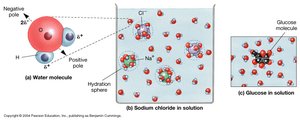
Water is a polar molecule, making it an excellent solvent. It dissolves ionic compounds (e.g., NaCl) and forms hydration spheres.
Hydrophilic: Water-loving substances
Hydrophobic: Water-repelling substances
pH and Acids, Bases, Salts
pH Scale
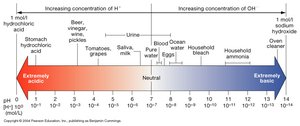
The pH scale measures hydrogen ion concentration, ranging from 0 (acidic) to 14 (basic).
Neutral: pH = 7
Acidic: pH < 7
Basic: pH > 7
Blood pH: 7.35–7.45
Organic Compounds
Carbohydrates
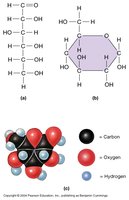
Carbohydrates are organic molecules containing carbon, hydrogen, and oxygen in a 1:2:1 ratio.
Monosaccharides: Simple sugars (e.g., glucose)
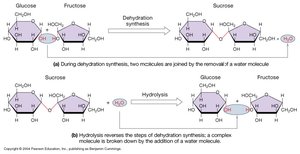
Disaccharides: Two monosaccharides joined (e.g., sucrose)
Polysaccharides: Many monosaccharides (e.g., starch, cellulose)
Lipids
Lipids are hydrophobic molecules with less oxygen than carbohydrates.
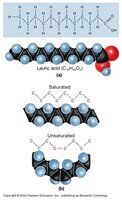
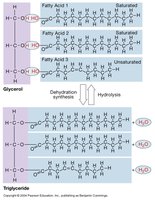
Fatty Acids: Saturated (single bonds), Unsaturated (double bonds)
Eicosanoids: Derived from arachidonic acid (prostaglandins, leukotrienes)
Glycerides: Glycerol + fatty acids (mono-, di-, triglycerides)
Steroids: Cholesterol, estrogen, testosterone
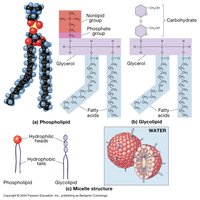
Phospholipids & Glycolipids: Key components of cell membranes
Proteins
Proteins are the most abundant organic compounds, composed of amino acids.
Functions: Support, movement, transport, buffering, metabolic regulation, coordination, defense
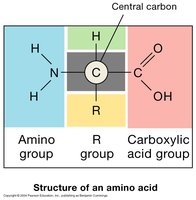
Amino Acid Structure: Central carbon, amino group, carboxyl group, hydrogen, R group
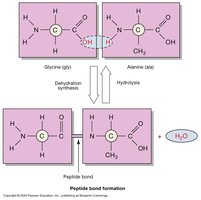
Peptide Bonds: Formed by dehydration synthesis
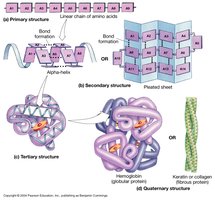
Protein Structure: Primary, secondary, tertiary, quaternary
Nucleic Acids
Nucleic acids are large molecules made of nucleotides.
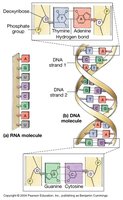
DNA: Double-stranded, contains A, T, C, G
RNA: Single-stranded, contains A, U, C, G
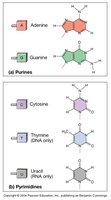
Nucleotide Structure: 5-carbon sugar, phosphate group, base (purine or pyrimidine)
High Energy Compounds
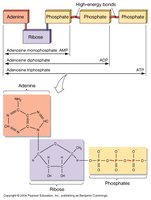
Cells store energy in molecules like ATP, ADP, and AMP. Energy is released by breaking phosphate bonds.
Phosphorylation: Addition of phosphate group
ATP: Adenosine triphosphate, main energy carrier
Summary Table: Key Terms and Concepts
Term | Definition |
|---|---|
Atom | Smallest unit of matter |
Isotope | Element with same protons, different neutrons |
Ionic Bond | Transfer of electrons |
Covalent Bond | Sharing of electrons |
Hydrogen Bond | Weak attraction between molecules |
pH | Measure of hydrogen ion concentration |
Carbohydrate | Organic molecule, energy source |
Lipid | Hydrophobic molecule, energy storage |
Protein | Organic molecule, structural and functional roles |
Nucleic Acid | DNA/RNA, genetic information |
ATP | Energy carrier molecule |
Equations and Formulas
Atomic Weight:
pH Calculation:
Dehydration Synthesis:
Hydrolysis:
ATP Hydrolysis:
Additional info:
All content expanded and clarified for academic completeness.
Images included only where directly relevant to the explanation.
