 Back
Chapter 2: The Chemistry of Life – Structured Study Notes for Anatomy & Physiology
Study Guide - Smart Notes
 Tailored notes based on your materials, expanded with key definitions, examples, and context.
Chapter 2: The Chemistry of Life
Module 2.1: Atoms and Elements
This module introduces the foundational concepts of matter, atoms, and elements, which are essential for understanding biological processes in anatomy and physiology.
Matter: Anything that has mass and occupies space; exists as solids, liquids, or gases.
Chemistry: The study of matter and its interactions.
Atom: The smallest unit of matter retaining its properties; composed of subatomic particles:
Protons: Positively charged, located in the nucleus.
Neutrons: No charge, slightly larger than protons, located in the nucleus.
Electrons: Negatively charged, orbit outside the nucleus.
Atoms are electrically neutral when protons and electrons are equal.
Electron shells: Regions around the nucleus where electrons reside; each shell holds a specific number of electrons (1st: 2, 2nd: 8, 3rd: 18).
Element: Substance that cannot be broken down by chemical means; defined by atomic number (number of protons).
The human body is primarily composed of four elements: hydrogen, oxygen, carbon, and nitrogen, plus mineral and trace elements.
Isotopes and Radioactivity
Isotopes and radioactivity are important in medical diagnostics and treatments.
Mass number: Sum of protons and neutrons.
Isotope: Same atomic number, different mass number.
Radioisotopes: Unstable isotopes that release energy/radiation during decay.
Nuclear medicine: Uses radioisotopes for cancer therapy, radiotracers, and thyroid disorder treatments.
Module 2.2: Matter Combined – Mixtures and Chemical Bonds
This module explains how matter combines physically and chemically, forming mixtures and chemical bonds.
Mixtures: Physical combinations of atoms; three types:
Suspensions: Large, uneven particles; settle out.
Colloids: Small, evenly distributed particles; do not settle out.
Solutions: Extremely small, evenly distributed particles; solute dissolved in solvent; do not settle out.
Chemical bonds: Attractive forces between atoms; not physical structures.
Molecule: Two or more atoms of the same element bonded.
Compound: Two or more atoms of different elements bonded.
Valence electrons: Outermost shell electrons; determine bonding behavior.
Octet rule: Atoms are most stable with 8 valence electrons.
Duet rule: Atoms with ≤5 electrons are stable with 2 valence electrons.
Ionic Bonds
Ionic bonds form when electrons are transferred between metal and nonmetal atoms, resulting in ions.
Cation: Positively charged ion (metal loses electrons).
Anion: Negatively charged ion (nonmetal gains electrons).
Opposite charges attract, forming salts.
Covalent Bonds
Covalent bonds are the strongest chemical bonds, formed by sharing electrons between nonmetals.
Single, double, or triple bonds (sharing one, two, or three pairs of electrons).
Electronegativity: Ability of an atom to attract electrons; increases across the periodic table.
Bond Type | Electron Sharing |
|---|---|
Single | 1 pair |
Double | 2 pairs |
Triple | 3 pairs |
Nonpolar covalent bonds: Equal sharing of electrons between atoms with similar electronegativities.
Polar covalent bonds: Unequal sharing; one atom is partially negative, the other partially positive.
Hydrogen Bonds
Hydrogen bonds are weak attractions between dipoles, crucial for water's properties and biological molecules.
Responsible for surface tension in water.
Module 2.3: Chemical Reactions
Chemical reactions involve the formation, breaking, or rearrangement of chemical bonds.
Chemical notation: Reactants (left), products (right).
Reversible reactions: Proceed in both directions.
Irreversible reactions: Proceed in one direction.
Energy in Chemical Reactions
Potential energy: Stored energy.
Kinetic energy: Energy in motion.
Three forms in the body: chemical, electrical, mechanical.
Endergonic reactions: Require energy input; products have more energy.
Exergonic reactions: Release energy; products have less energy.
Types of Chemical Reactions
Catabolic (decomposition): Break down large molecules; usually exergonic.
Exchange: Atoms are exchanged between reactants.
Redox (oxidation-reduction): Electrons and energy are exchanged; oxidized loses electrons, reduced gains electrons.
Anabolic (synthesis): Build large molecules from small subunits; endergonic.
Reaction Rates and Enzymes
Reaction rates depend on activation energy, concentration, temperature, particle size, and catalysts.
Activation energy (): Minimum energy required for a reaction.
Catalyst: Lowers activation energy; not consumed.
Enzyme: Biological catalyst; highly specific, speeds up reactions, not permanently altered.
Induced-fit mechanism: Substrate binding changes enzyme shape, facilitating reaction.
Enzyme Deficiencies
Tay-Sachs Disease: Deficiency of hexosaminidase; fatal neurodegeneration.
SCIDs: Adenosine deaminase deficiency; severe immune deficiency.
Phenylketonuria: Deficiency of phenylalanine hydroxylase; can cause mental retardation if untreated.
Module 2.4: Inorganic Compounds – Water, Acids, Bases, and Salts
Inorganic compounds are essential for physiological processes; water, acids, bases, and salts are key examples.
Water: Makes up 60–80% of body mass; high heat capacity, solvent, lubricant, and cushion.
Water dissolves hydrophilic (charged/polar) solutes; does not dissolve hydrophobic (nonpolar) solutes.
Acids: Proton donors; increase hydrogen ion concentration.
Bases: Proton acceptors; decrease hydrogen ion concentration.
pH scale: Measures hydrogen ion concentration;
pH 7 is neutral; <7 is acidic; >7 is basic.
Buffer: Resists changes in pH; major buffer is carbonic acid–bicarbonate system.
Salts: Ionic compounds; dissociate into electrolytes in water.
Module 2.5: Organic Compounds – Carbohydrates, Lipids, Proteins, and Nucleotides
Organic compounds are built from monomers and polymers, and are vital for structure and function in the body.
Monomers: Single subunits; combine via dehydration synthesis to form polymers.
Hydrolysis: Catabolic reaction; breaks polymers into monomers using water.
Carbohydrates
Carbohydrates are composed of carbon, hydrogen, and oxygen; serve as fuel and have structural roles.
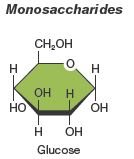
Monosaccharides: Simple sugars (glucose, fructose, galactose, ribose, deoxyribose).
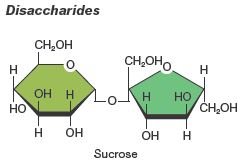
Disaccharides: Two monosaccharides joined by dehydration synthesis (e.g., sucrose).
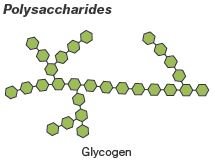
Polysaccharides: Many monosaccharides joined; glycogen is the storage form in humans.
Glycoproteins and glycolipids: Polysaccharides covalently bound to proteins or lipids.
Lipids
Lipids are hydrophobic molecules, including fats, oils, phospholipids, and steroids.
Fatty acids: Lipid monomers; saturated (no double bonds), monounsaturated (one double bond), polyunsaturated (multiple double bonds).
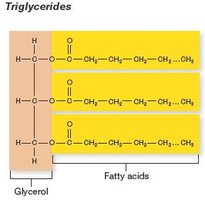
Triglycerides: Three fatty acids linked to glycerol; energy storage.
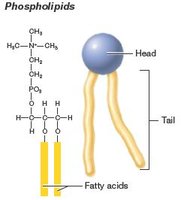
Phospholipids: Glycerol backbone, two fatty acid tails, one phosphate head; amphiphilic; key in cell membranes.
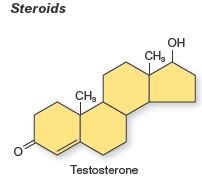
Steroids: Four-ring structure; cholesterol forms basis for other steroids.
Proteins
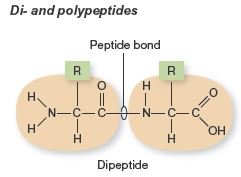
Proteins are polymers of amino acids; essential for structure, function, and regulation in the body.
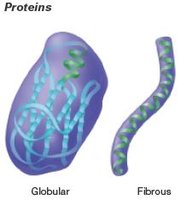
Fibrous proteins: Rope-like, nonpolar, provide strength.
Globular proteins: Spherical, polar, function as enzymes and messengers.
Four levels of structure:
Primary: Amino acid sequence.
Secondary: Alpha helix or beta-pleated sheet (hydrogen bonds).
Tertiary: 3D shape, stabilized by hydrogen bonds.
Quaternary: Multiple polypeptide chains linked.
Denaturation: Loss of structure and function due to heat, pH, or chemicals.
Nucleotides and Nucleic Acids
Nucleotides are the monomers of nucleic acids, which store and transmit genetic information.
Nucleotide structure: Nitrogenous base, pentose sugar (ribose or deoxyribose), phosphate group.
ATP: Adenosine triphosphate; main energy carrier in cells.
DNA: Double helix; stores genetic information; complementary base pairing (A-T, G-C).
RNA: Single strand; involved in protein synthesis; uracil replaces thymine.
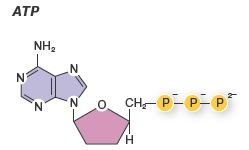
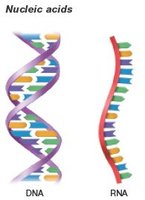
Table: Organic Molecules
Type | Monomer | Polymer | Main Function |
|---|---|---|---|
Carbohydrate | Monosaccharide | Polysaccharide | Fuel, structure |
Lipid | Fatty acid | Triglyceride, phospholipid, steroid | Energy storage, membrane structure, hormones |
Protein | Amino acid | Polypeptide/protein | Structure, enzymes, signaling |
Nucleic acid | Nucleotide | DNA, RNA | Genetic information, protein synthesis |
Additional info: These notes expand on the original slides with academic context, definitions, and examples to ensure completeness and clarity for exam preparation.
