 Back
Chapter 2: The Chemistry of Life – Study Notes for Anatomy & Physiology
Study Guide - Smart Notes
 Tailored notes based on your materials, expanded with key definitions, examples, and context.
The Chemistry of Life
Introduction
Chemistry forms the foundation of human anatomy and physiology. All structures and functions of the body are based on chemical principles, from the composition of bones to the transmission of nerve impulses. Understanding chemistry is essential for grasping how the body works at the molecular and cellular levels.
Atoms and Elements
Basic Definitions
Matter: Anything that has mass and occupies space.
Chemistry: The study of matter and its interactions.
Atom: The smallest unit of matter that retains the properties of an element.
Element: A substance composed of one type of atom; cannot be broken down by chemical means.
Atomic Structure
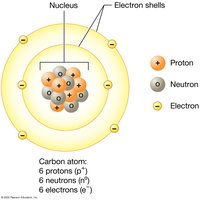
Protons: Positively charged particles in the atomic nucleus.
Neutrons: Uncharged particles, slightly larger than protons, also in the nucleus.
Electrons: Negatively charged particles that orbit the nucleus in electron shells.
Atoms are electrically neutral when the number of protons equals the number of electrons.
Electron shells: 1st shell holds 2 electrons, 2nd holds 8, 3rd holds up to 18 (satisfied with 8).
Elements in the Human Body
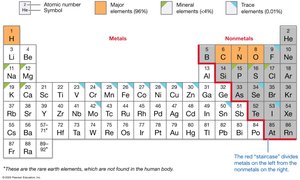
Defined by atomic number (number of protons).
Major elements (96% of body mass): Oxygen (O), Carbon (C), Hydrogen (H), Nitrogen (N).
Mineral elements (less than 4%): Sodium, Potassium, Calcium, Chlorine, Magnesium, Phosphorus, Sulfur.
Trace elements (0.01%): Iron, Copper, Iodine, Zinc, etc.
Isotopes and Radioactivity
Isotope: Atoms of the same element with different numbers of neutrons.
Radioisotopes: Unstable isotopes that emit radiation; used in nuclear medicine (e.g., cancer therapy, thyroid treatment).

Matter Combined: Mixtures and Chemical Bonds
Mixtures
Mixture: Physical combination of atoms; can be separated physically.
Molecule: Chemical combination of atoms; can only be separated by chemical means.
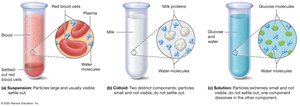
Suspensions: Large particles, settle out (e.g., blood).
Colloids: Small particles, do not settle, opaque (e.g., milk).
Solutions: Solute dissolves in solvent, clear (e.g., glucose in water).
Chemical Bonds
Chemical Bond: Energy relationship between atoms due to interactions of valence electrons.
Valence Electrons: Electrons in the outermost shell; involved in bonding.
Octet Rule: Atoms are most stable with 8 electrons in their valence shell (2 for small atoms).
Ionic Bonds
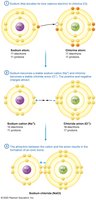
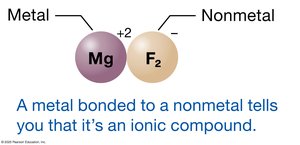
Formed by transfer of electrons from a metal to a nonmetal.
Cation: Positively charged ion (lost electron).
Anion: Negatively charged ion (gained electron).
Resulting compounds are called salts.
Covalent Bonds
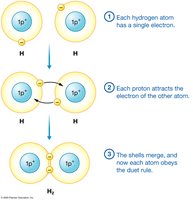
Formed by sharing electrons between nonmetals.
Single, double, or triple bonds possible.
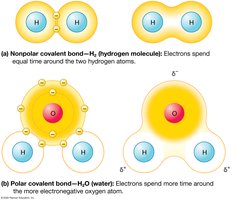
Nonpolar Covalent Bond: Electrons shared equally (e.g., O2, N2).
Polar Covalent Bond: Electrons shared unequally, creating dipoles (e.g., H2O).
Hydrogen Bonds
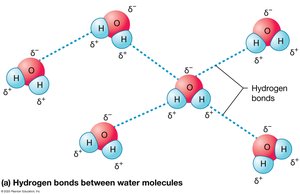
Weak attractions between partially positive hydrogen and partially negative atoms in polar molecules.
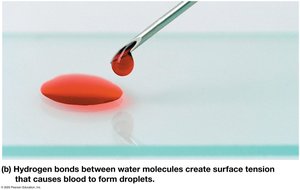
Responsible for surface tension in water.
Determining Bond Types
Ionic: Metal + nonmetal.
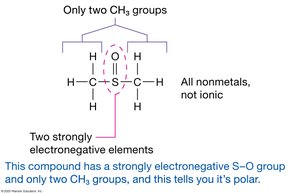
Nonpolar: Identical nonmetals, or mostly C and H.
Polar: Nonmetals with different electronegativities.
Chemical Notation and Reactions
Chemical Equations
Reactants: Substances that undergo change (left side).
Products: Substances produced (right side).
Reversible reactions:
Irreversible reactions:
Energy in Chemical Reactions
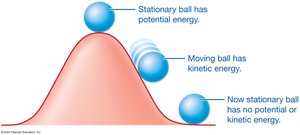
Energy: Capacity to do work.
Potential Energy: Stored energy.
Kinetic Energy: Energy of motion.
Chemical Energy: Energy stored in bonds.
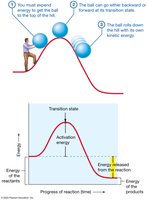
Endergonic Reactions: Require energy input; products have more energy than reactants.
Exergonic Reactions: Release energy; products have less energy than reactants.
Types of Chemical Reactions
Catabolic (Decomposition): Break down large molecules; generally exergonic.
Anabolic (Synthesis): Build new molecules; generally endergonic.
Exchange: Atoms or electrons are exchanged between reactants.
Redox (Oxidation-Reduction): Involve electron transfer; one reactant is oxidized, the other reduced.
Reaction Rates and Enzymes
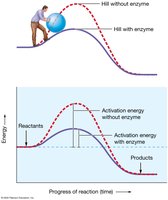
Activation Energy: Minimum energy required for a reaction to occur.
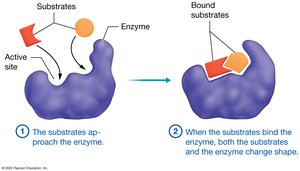
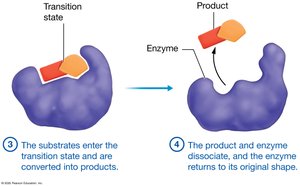
Catalyst: Substance that lowers activation energy; in biology, these are enzymes.
Enzymes: Biological catalysts, highly specific, not consumed in reactions, speed up reactions dramatically.
Enzyme Deficiencies
Tay-Sachs Disease: Deficiency of hexosaminidase; leads to fatal accumulation of lipids in brain cells.
SCIDS: Deficiency of adenosine deaminase; severe immune deficiency.
Phenylketonuria: Deficiency of phenylalanine hydroxylase; can cause mental retardation if untreated.

Inorganic Compounds: Water, Acids, Bases, and Salts
Water
Makes up 50-65% of body mass.
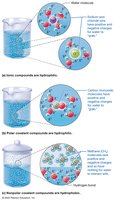
Absorbs and carries heat, cushions, lubricates, and is the primary solvent in the body.
Hydrophilic: Substances that dissolve in water (polar or charged).
Hydrophobic: Substances that do not dissolve in water (nonpolar).
Acids and Bases
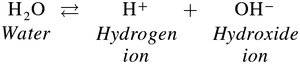
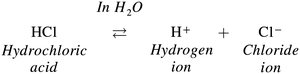
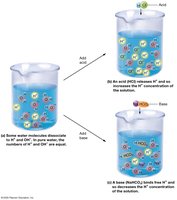
Acid: Proton (H+) donor; increases H+ in solution.
Base: Proton acceptor; decreases H+ in solution.
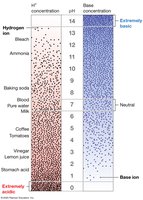
pH Scale: Measures hydrogen ion concentration; 7 is neutral, below 7 is acidic, above 7 is basic.
Each pH unit represents a tenfold change in H+ concentration.
Buffers
Resist changes in pH; consist of a weak acid and its anion.
Major buffer in blood: carbonic acid–bicarbonate system.
Blood pH must remain between 7.35 and 7.45; deviations cause acidosis or alkalosis.

Salts and Electrolytes
Salt: Compound of a metal cation and nonmetal anion held by ionic bonds.
Electrolytes: Ions in solution that conduct electricity; essential for nerve and muscle function.
Organic Compounds
Hydrocarbons
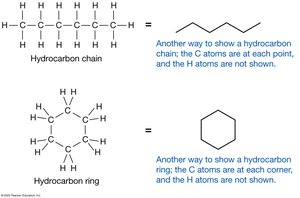
Organic compounds containing only carbon and hydrogen; form chains and rings.
Monomers and Polymers
Four main types: Carbohydrates, Lipids, Proteins, Nucleic Acids.
Monomer: Single subunit.
Polymer: Many monomers linked together.
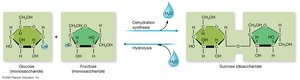
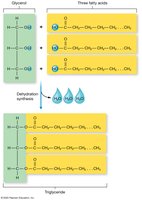
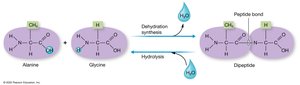
Dehydration Synthesis: Links monomers by removing water.
Hydrolysis: Breaks polymers by adding water.
Carbohydrates
Composed of C, H, O (1:2:1 ratio); polar and hydrophilic.
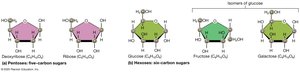
Monosaccharides: Simple sugars (glucose, fructose, galactose, ribose, deoxyribose).
Disaccharides: Two monosaccharides (sucrose, lactose).
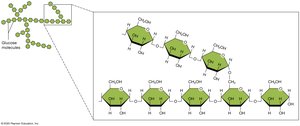
Polysaccharides: Long chains (starch in plants, glycogen in animals).
Glycoproteins and glycolipids: Carbohydrates attached to proteins/lipids for cell recognition.
Lipids
Composed of C, H, and some O; nonpolar and hydrophobic.
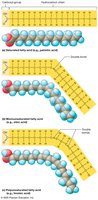
Fatty Acids: Hydrocarbon chains with carboxylic acid group; can be saturated, monounsaturated, or polyunsaturated.
Triglycerides: Three fatty acids linked to glycerol; energy storage.
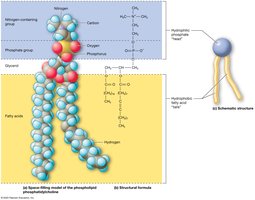
Phospholipids: Glycerol, two fatty acids, and a phosphate group; main component of cell membranes; amphiphilic.
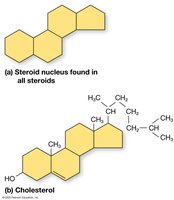
Steroids: Four-ring structure; includes cholesterol, bile acids, and hormones.
Proteins
Composed of C, H, O, N, and sometimes S; may be polar or nonpolar.
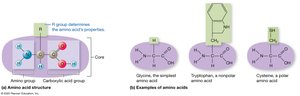
Amino Acids: 21 types; central carbon, amino group, carboxyl group, R group.
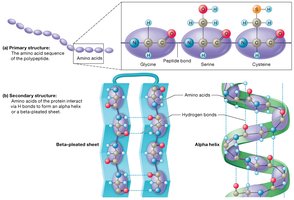
Peptides: Chains of amino acids linked by peptide bonds.
Protein Structure: Primary (sequence), Secondary (alpha helix, beta sheet), Tertiary (3D folding), Quaternary (multiple chains).
Denaturation: Loss of structure and function due to heat, pH, or chemicals.
Nucleotides and Nucleic Acids
Composed of C, H, O, N, P; include DNA and RNA.
Nucleotide: Nitrogenous base, five-carbon sugar, phosphate group.
ATP: Main energy carrier; formed from ADP and phosphate.
DNA: Double helix, deoxyribose sugar, bases A, T, G, C; stores genetic code.
RNA: Single strand, ribose sugar, bases A, U, G, C; involved in protein synthesis.
Additional info: For a comprehensive review, students should create flashcards, concept maps, and practice quiz questions to reinforce these foundational chemistry concepts as they relate to anatomy and physiology.
