 Back
BackChapter 21: The Respiratory System – Structure, Function, and Gas Exchange
Study Guide - Smart Notes
 Tailored notes based on your materials, expanded with key definitions, examples, and context.
Overview of the Respiratory System
Major Organs and Anatomical Divisions
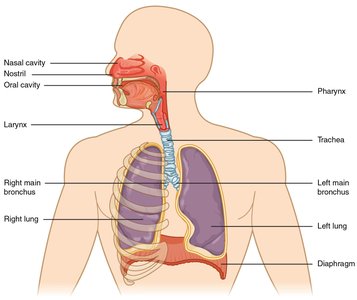
The respiratory system is responsible for the exchange of oxygen and carbon dioxide between the body and the environment. It consists of organs located in the head, neck, and thoracic cavity, including the nasal cavity, pharynx, larynx, trachea, bronchial tree, and lungs. The system is divided into the upper and lower respiratory tracts, as well as conducting and respiratory zones.
Upper Respiratory Tract: Passageways from the nasal cavity to the larynx.
Lower Respiratory Tract: Passageways from the trachea to the alveoli, including the lungs.
Conducting Zone: Tubes that transport air into and out of the body, where air is filtered, warmed, and moistened.
Respiratory Zone: Structures containing alveoli where gas exchange occurs.
Basic Functions of the Respiratory System
Pulmonary Ventilation: Movement of air in and out of the lungs.
Pulmonary Gas Exchange: Exchange of gases between alveoli and blood.
Gas Transport: Movement of gases through the blood.
Tissue Gas Exchange: Exchange of gases between blood and tissues.
Other Functions: Speech, olfaction, blood pH regulation, blood pressure regulation (angiotensin-II), and assisting in venous return and abdominal pressure changes.
Pulmonary Ventilation
Mechanics of Breathing
Pulmonary ventilation consists of two phases: inspiration (inhalation) and expiration (exhalation). The movement of air is driven by pressure gradients created by changes in lung volume, as described by Boyle's Law.
Boyle’s Law: At constant temperature, the pressure of a gas is inversely proportional to its volume:
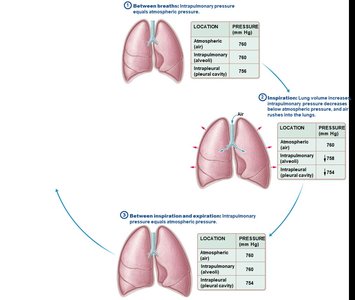
As lung volume increases, intrapulmonary pressure decreases, drawing air in. As lung volume decreases, intrapulmonary pressure increases, pushing air out.


Pressure Relationships in the Thoracic Cavity
Three main pressures influence pulmonary ventilation:
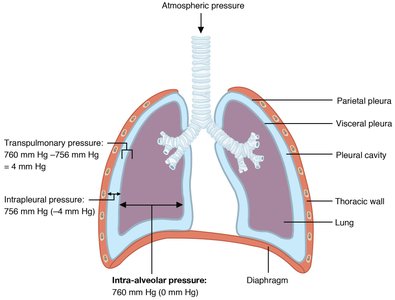
Atmospheric Pressure: Pressure exerted by air outside the body (typically 760 mm Hg at sea level).
Intrapulmonary (Alveolar) Pressure: Pressure within the alveoli; equalizes with atmospheric pressure between breaths.
Intrapleural Pressure: Pressure within the pleural cavity; always slightly less than intrapulmonary pressure, creating a suction effect that keeps the lungs inflated.
Pressure Changes During Breathing
During quiet breathing, the following sequence occurs:
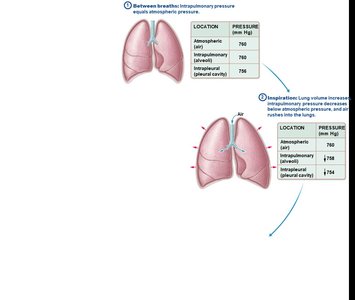
Between Breaths: Intrapulmonary pressure equals atmospheric pressure; no air movement.
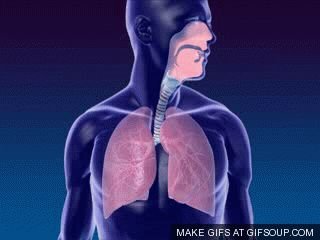
Inspiration: Diaphragm and external intercostals contract, increasing thoracic volume and decreasing intrapulmonary pressure below atmospheric, causing air to flow in.
Between Inspiration and Expiration: Pressures equalize; no air movement.
Expiration: Muscles relax, thoracic volume decreases, intrapulmonary pressure rises above atmospheric, and air flows out.
Pathological Changes: Pneumothorax
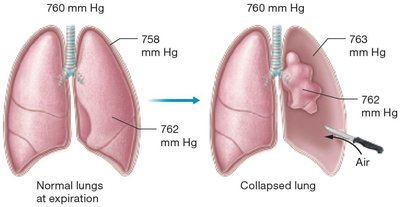
If intrapleural pressure rises to atmospheric or above, the suction effect is lost, and the lung collapses. Causes include trauma, pleural effusion, pneumothorax (air), or hemothorax (blood).
Physical Factors Influencing Ventilation
Airway Resistance
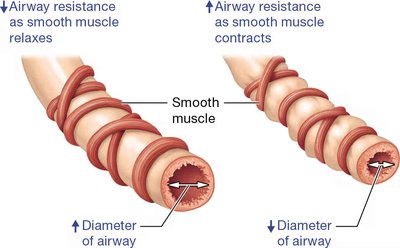
Airway resistance is anything that impedes airflow through the respiratory tract. It is primarily influenced by the diameter of the bronchioles: larger diameter means less resistance, and smaller diameter means more resistance.
Alveolar Surface Tension
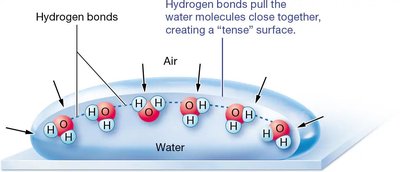
Alveoli are lined with a thin film of water, creating surface tension that can cause alveoli to collapse. Pulmonary surfactant reduces this surface tension, allowing alveoli to remain inflated and facilitating gas exchange.
Pulmonary Compliance
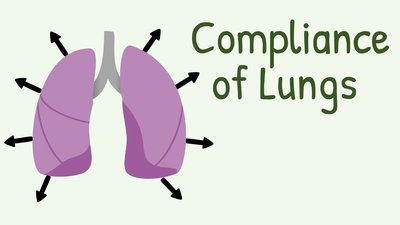
Pulmonary compliance refers to the ability of the lungs and chest wall to stretch and expand. It depends on alveolar surface tension, the distensibility of the chest wall, and the ability of respiratory muscles to move the chest wall.
Pulmonary Volumes and Capacities
Measuring Pulmonary Function
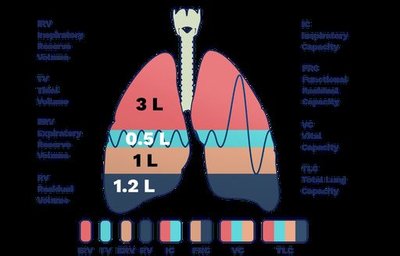
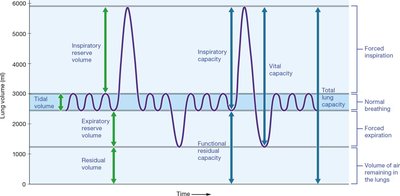
Pulmonary volumes are measured using a spirogram and include:
Tidal Volume (TV): Air exchanged during quiet breathing (~500 mL).
Inspiratory Reserve Volume (IRV): Maximum air forcibly inhaled after normal inhalation.
Expiratory Reserve Volume (ERV): Maximum air forcibly exhaled after normal exhalation.
Residual Volume (RV): Air remaining in lungs after forced exhalation.
Pulmonary capacities are combinations of these volumes:
Inspiratory Capacity (IC):
Functional Residual Capacity (FRC):
Vital Capacity (VC):
Total Lung Capacity (TLC):
Types of Lung Diseases
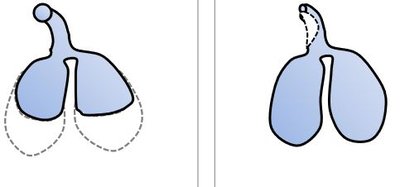
Restrictive Diseases: Reduced lung expansion (e.g., pulmonary fibrosis).
Obstructive Diseases: Blocked airways, difficulty exhaling (e.g., asthma, emphysema).
Gas Exchange and Transport
Gas Laws and Exchange Mechanisms
Gas exchange in the lungs and tissues is governed by Dalton’s Law and Henry’s Law:
Dalton’s Law: Total pressure of a gas mixture is the sum of the partial pressures of each gas.
Henry’s Law: The amount of gas dissolved in a liquid is proportional to its partial pressure and solubility.
Pulmonary Gas Exchange (External Respiration)
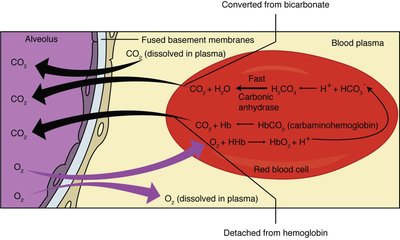
Oxygen diffuses from alveoli (high PO2) to blood (low PO2), while carbon dioxide diffuses from blood (high PCO2) to alveoli (low PCO2).
Tissue Gas Exchange (Internal Respiration)
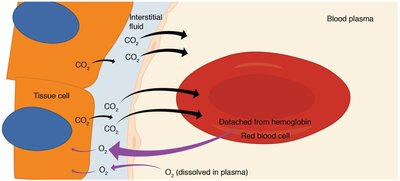
Oxygen diffuses from blood to tissues, and carbon dioxide diffuses from tissues to blood, driven by partial pressure gradients.
Gas Transport in the Blood
Oxygen Transport
Oxygen is poorly soluble in plasma; most is transported bound to hemoglobin (Hb) in red blood cells. Each Hb molecule can carry four oxygen molecules.
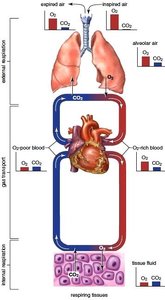
Loading: Oxygen binds to Hb in the lungs (forming oxyhemoglobin).
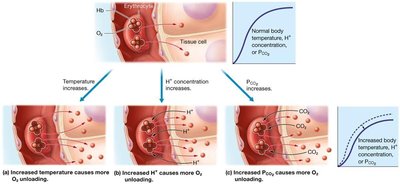
Unloading: Oxygen is released from Hb in tissues (forming deoxyhemoglobin).
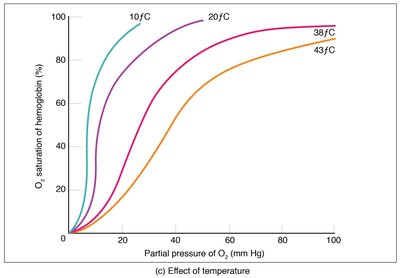
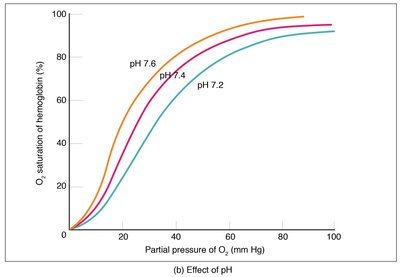
The oxygen-hemoglobin dissociation curve shows how Hb saturation varies with PO2. Factors such as temperature, pH, and PCO2 shift the curve and affect oxygen unloading.
Carbon Dioxide Transport
Carbon dioxide is transported in three forms:
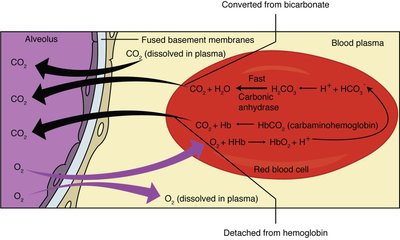
Dissolved in plasma (7-10%)
Bound to hemoglobin as carbaminohemoglobin (20%)
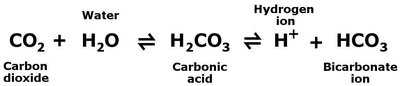
As bicarbonate ions (HCO3-) in plasma (70%)
The bicarbonate buffer system is crucial for maintaining blood pH:
Effect of Ventilation on Blood pH
Normal Ventilation: Maintains stable pH.
Hyperventilation: Excess CO2 exhaled, pH rises (alkalosis).
Hypoventilation: CO2 retained, pH drops (acidosis).
Summary of Respiratory Processes
Pulmonary Ventilation: Air moves between atmosphere and alveoli.
Pulmonary Gas Exchange: O2 enters blood, CO2 exits at alveoli.
Gas Transport: O2 and CO2 carried by blood (O2 by Hb, CO2 as bicarbonate).
Tissue Gas Exchange: O2 delivered to tissues, CO2 picked up from tissues.
