 Back
BackChapter 22: The Immune System – Structure, Function, and Defense Mechanisms
Study Guide - Smart Notes
 Tailored notes based on your materials, expanded with key definitions, examples, and context.
Immune System Overview
Introduction to the Immune System
The immune system is a complex network of cells, tissues, and organs that work together to defend the body against infectious agents and disease. It is divided into two main branches: the innate immune system and the adaptive immune system. These systems collaborate to identify, target, and eliminate pathogens while maintaining tolerance to self-antigens.
Host defense system: Protects against infectious agents (pathogens) and disease.
Pathogens: Organisms that cause damage or death to the host. Major types include bacteria, viruses, fungi, protozoans, and multicellular parasites.
Types of Infectious Agents
Bacteria, Viruses, Fungi, Protozoans, and Multicellular Parasites
Pathogens are classified based on their structure and life cycle. Understanding their differences is crucial for targeted immune responses and treatments.
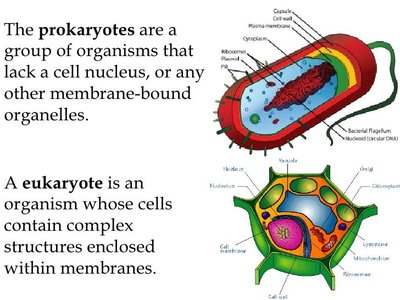
Bacteria: Single-celled prokaryotes with cell walls. Easily targeted by antibiotics due to differences from human cells.
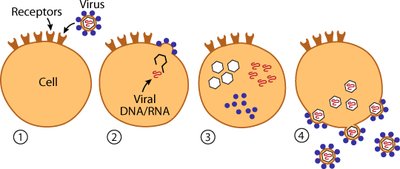
Viruses: Acellular entities that require host cells to replicate. They hijack cellular machinery, often killing the host cell upon exit.
Fungi: Eukaryotic organisms that can cause superficial or systemic infections.
Protozoans: Single-celled eukaryotes, often causing diseases like malaria.
Multicellular parasites: Complex organisms such as worms that live and feed on hosts.

Examples of Diseases Caused by Infectious Agents
Bacterial: Strep throat, tuberculosis, tetanus, salmonella
Viral: Influenza, common cold, HIV/AIDS, coronavirus, mononucleosis
Fungal: Ringworm, athlete’s foot, yeast infections
Protozoan: Malaria, amoebic dysentery
Parasitic: Hookworms, tapeworms, pinworms
Immune System Organization
Distribution of Immune Cells
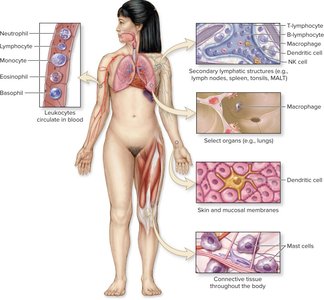
Immune cells are distributed throughout the body, residing in blood, secondary lymphatic structures, connective tissues, and organs exposed to the environment (e.g., lungs, skin, mucosal membranes).
Innate Immune System
First Line of Defense: Physical and Chemical Barriers
The first line of defense prevents entry of pathogens through physical and chemical barriers.
Skin: Acts as a physical barrier; secretes antimicrobial substances (proteins, enzymes, sebum).
Mucous membranes: Line body openings, produce mucus, and secrete antimicrobial enzymes and IgA.
Normal flora: Nonpathogenic microorganisms that outcompete pathogens for resources.
Second Line of Defense: Cellular and Chemical Responses
If pathogens bypass the first line, the second line of defense involves various immune cells and chemicals.
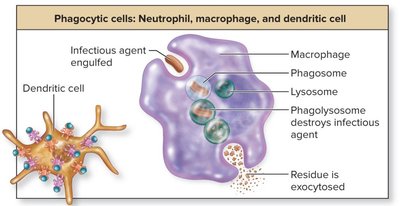
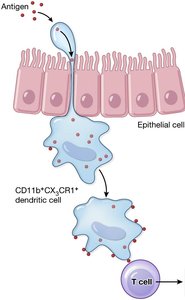
Phagocytic cells: Neutrophils, macrophages, and dendritic cells engulf and destroy pathogens.
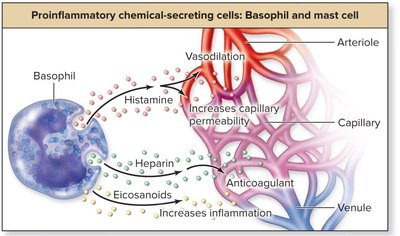
Proinflammatory cells: Basophils and mast cells release chemicals (histamine, heparin, eicosanoids) to promote inflammation.
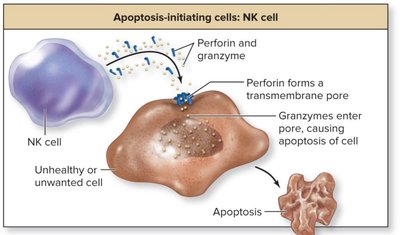
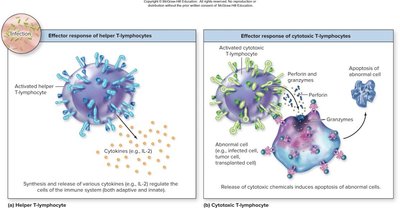
Apoptosis-inducing cells: Natural killer (NK) cells induce apoptosis in infected or abnormal cells using perforin and granzymes.
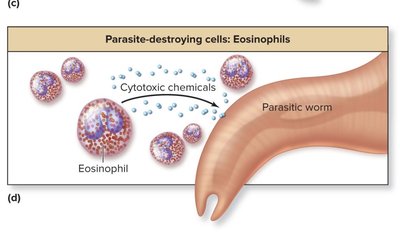
Parasite-destroying cells: Eosinophils release cytotoxic chemicals to kill parasites.
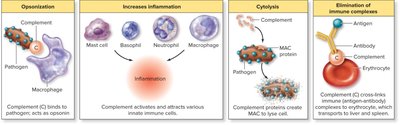
Complement system: Plasma proteins that opsonize pathogens, recruit immune cells, induce cytolysis, and link antibodies to red blood cells for clearance.
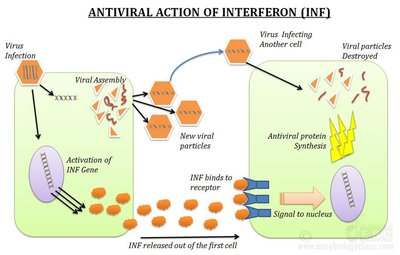
Interferons: Proteins that inhibit viral replication and recruit NK cells.
Fever: Increases metabolic rate and tissue repair, but high fevers can be dangerous.
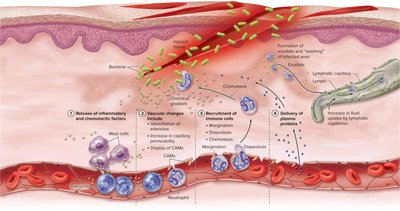
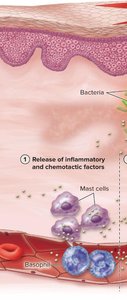
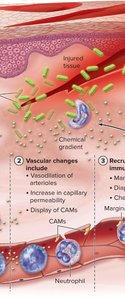
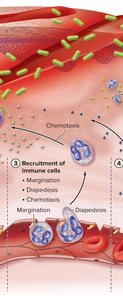
Inflammation: Localized response characterized by redness, heat, swelling, and pain. Involves four steps: release of factors, vascular changes, recruitment of immune cells, and delivery of plasma proteins.
Adaptive Immune System
Overview and Key Features
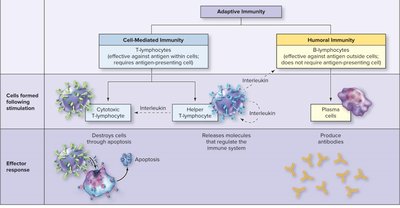
The adaptive immune system provides a specific response to pathogens, developing memory for faster responses upon re-exposure. It consists of two main branches: cell-mediated immunity (T-cells) and humoral immunity (B-cells and antibodies).
Antigens and Lymphocyte Receptors
Antigen: A molecule capable of inducing an immune response. Pathogens have unique antigens, often proteins or polysaccharides.
Epitope: The specific part of an antigen recognized by a lymphocyte receptor.
Immunogen: An antigen that elicits an immune response.
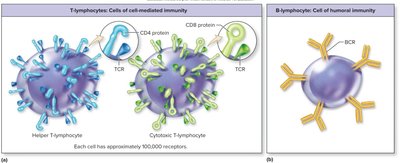
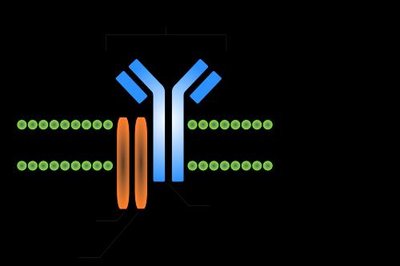
T-cell Receptor (TCR): Found on T-cells, recognizes antigen fragments presented by MHC molecules.
B-cell Receptor (BCR): Found on B-cells, binds directly to antigens.
Lymphocyte Diversity and Clonal Selection
Random DNA rearrangement in developing lymphocytes creates a vast pool of unique TCRs and BCRs, enabling recognition of diverse antigens. Upon activation by a specific antigen, lymphocytes undergo clonal selection and proliferation.
T-Cells: Helper and Cytotoxic Subtypes
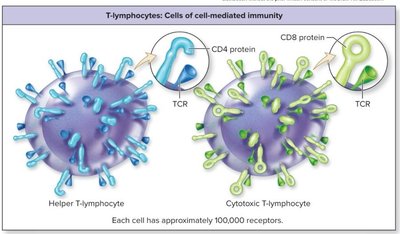
Helper T-cells (CD4+): Activate B-cells, cytotoxic T-cells, and innate immune cells by secreting interleukins.
Cytotoxic T-cells (CD8+): Kill virus-infected and cancer cells by releasing perforin and granzymes.
Antigen Presentation and MHC Molecules
Antigen-presenting cells (APCs): Dendritic cells, macrophages, and B-cells present antigens to T-cells using MHC molecules.
MHC Class I: Found on all nucleated cells; presents to CD8+ T-cells.
MHC Class II: Found on APCs; presents to CD4+ T-cells.
B-Cells and Antibody Production
B-cells recognize antigens, present them to helper T-cells, and differentiate into plasma cells that secrete antibodies. Antibodies neutralize pathogens, opsonize for phagocytosis, and activate complement.
Plasma cells: Specialized B-cells that produce large quantities of antibodies.
Memory B-cells: Remain in the body for rapid response upon re-exposure to the antigen.
Classes of Antibodies (Immunoglobulins)
IgG: Most abundant, crosses placenta, found in blood and body fluids.
IgM: First antibody produced, found in blood and breast milk.
IgA: Found in external secretions (tears, saliva, breast milk).
IgD: Functions as a B-cell receptor.
IgE: Involved in allergic reactions and defense against parasites.
Immunological Memory and Vaccination
Memory B-cells and T-cells enable a faster and stronger response upon subsequent exposure to the same pathogen. Vaccines exploit this principle to provide long-term protection.
Types of Immunity
Active immunity: Results from direct exposure to antigen (infection or vaccination); long-lasting.
Passive immunity: Results from transfer of antibodies (e.g., maternal antibodies, antivenom); short-term.
T-Cell Maturation and Selection
Positive selection: T-cells that bind to MHC molecules survive.
Negative selection: T-cells that do not react to self-antigens survive, preventing autoimmunity.
Only about 2% of T-cells survive both selection processes.
Clinical Correlations
Anaphylaxis: Severe allergic reaction treated with antihistamines, steroids, and epinephrine.
HIV/AIDS: HIV infects and destroys T-cells, leading to immunodeficiency.
Cancer Immunotherapy: PD-1/PD-L1 pathway manipulation allows T-cells to target cancer cells more effectively.
