 Back
Chapter 24: Nutrition, Metabolism, and Energy Balance – Study Notes
Study Guide - Smart Notes
 Tailored notes based on your materials, expanded with key definitions, examples, and context.
Nutrition, Metabolism, and Energy Balance
Overview
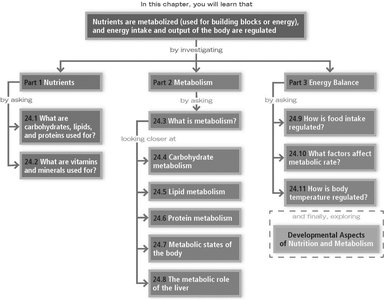
This chapter explores how nutrients are metabolized for building blocks or energy, and how energy intake and output are regulated in the human body. The content is divided into three main parts: Nutrients, Metabolism, and Energy Balance.
Part 1: Nutrients
Definition and Categories of Nutrients
Nutrients are substances used by the body to promote normal growth, development, and maintenance. Essential nutrients cannot be synthesized in adequate amounts by the body and must be obtained from the diet. Calories represent food energy, with 1 calorie (C) equivalent to 1 kilocalorie, the energy required to raise the temperature of water by 1°C.
Major Nutrients: Carbohydrates, lipids, proteins
Micronutrients: Vitamins and minerals
Caloric Values: Carbohydrates and proteins yield 4 calories/gram; lipids yield 9 calories/gram
Example: According to USDA's MyPlate, a healthy diet includes roughly half fruits and vegetables, half grains and proteins, and dairy as a glass of milk.
Carbohydrates
Simple Carbohydrates: Monosaccharides and disaccharides from fruits, sugarcane, honey, milk
Complex Carbohydrates: Polysaccharides from grains, fruits, vegetables
Glucose: Primary fuel for ATP synthesis; essential for neurons and red blood cells
Dietary Fiber: Provided by insoluble cellulose and soluble polysaccharides
Lipids
Triglycerides: Most abundant dietary lipids; can be saturated (animal sources, coconut oil, trans fats) or unsaturated (plant sources)
Essential Fatty Acids: Linoleic and linolenic acids must be consumed
Cholesterol: Found in animal products; most synthesized by the liver
Functions: Absorption of fat-soluble vitamins, cellular fuel, myelin sheath and cell membrane formation, adipose tissue, regulatory molecules
Proteins
Complete Proteins: Contain all essential amino acids (eggs, milk, fish, meats)
Incomplete Proteins: Lacking one or more essential amino acids (legumes, nuts, cereals)
Functions: Structural and functional molecules, synthesis of new molecules, energy source
Nitrogen Balance: Positive (protein synthesis exceeds breakdown), Negative (breakdown exceeds synthesis)
Vitamins and Minerals
Vitamins: Mostly act as coenzymes; fat-soluble (A, D, E, K) absorbed with lipids; water-soluble (B-complex, C) absorbed with water
Minerals: Work with other molecules, incorporated into tissues, ionized in fluids, or bound to organic compounds
Part 2: Metabolism
Metabolic Processes
Metabolism is the sum of all biochemical reactions in the body. It includes:
Anabolism: Synthesis of larger molecules from smaller ones
Catabolism: Breakdown of large molecules into simpler ones
Cellular respiration is a catabolic process where food molecules are broken down to release energy for ATP synthesis.
Oxidation-Reduction Reactions
Oxidation: Loss of electrons
Reduction: Gain of electrons
Importance: Transfer of energy between molecules; enzyme-catalyzed reactions require coenzymes (e.g., NAD+, FAD)
ATP Synthesis Mechanisms
Substrate-Level Phosphorylation: Direct transfer of phosphate groups to ADP
Oxidative Phosphorylation: Energy from food fuels creates a proton gradient used to attach phosphates to ADP
Carbohydrate Metabolism
Glycolysis: Anaerobic process in cytosol; converts glucose to pyruvic acid, NADH, and ATP
Citric Acid Cycle: Aerobic process in mitochondria; produces CO2, NADH, FADH2, ATP
Electron Transport Chain: Oxygen-requiring; produces water and ATP
Net Energy Gain: 30 ATP per glucose molecule
Glucose Handling
Glycogenesis: Formation of glycogen from glucose
Glycogenolysis: Breakdown of glycogen to glucose
Gluconeogenesis: Formation of glucose from non-glucose molecules
Lipid Metabolism
Oxidation: Glycerol enters glycolysis; fatty acids undergo beta oxidation to acetyl CoA
Lipogenesis: Formation of triglycerides for storage
Lipolysis: Breakdown of triglycerides for energy
Ketogenesis: Formation of ketone bodies from acetyl CoA
Structural Materials: Phospholipids for membranes, cholesterol for hormones
Protein Metabolism
Transamination: Transfer of amine group to α-ketoglutaric acid
Deamination: Removal of amine group as ammonia, converted to urea
Protein Synthesis: Amino acids used for structural and functional proteins
Metabolic States of the Body
Absorptive State: Anabolism exceeds catabolism; insulin directs nutrient storage
Postabsorptive State: Catabolism exceeds anabolism; glucagon and sympathetic nervous system mobilize energy reserves
Metabolic Role of the Liver
Functions: Metabolism of carbohydrates, fats, proteins; storage of vitamins and minerals; detoxification
Lipoproteins: VLDL (triglyceride transport), LDL (cholesterol transport), HDL (cholesterol removal)
Cholesterol Regulation: Negative feedback, dietary influence, saturated/unsaturated/trans fats
Part 3: Energy Balance
Body Energy Balance
Energy Intake: Energy produced during food oxidation
Energy Output: Energy lost as heat, used for work, or stored
Stable Weight: When intake equals output
Regulation of Food Intake
Obesity: BMI > 30; increases risk for several diseases
BMI Formula:
Hypothalamic Control: Peptides regulate hunger and satiety
Short-Term Regulation: Neural signals, nutrient levels, GI hormones
Long-Term Regulation: Leptin from adipose cells suppresses hunger
Factors Affecting Metabolic Rate
Basal Metabolic Rate (BMR): Energy for essential activities; influenced by age, sex, temperature, thyroxine
Total Metabolic Rate (TMR): Energy for all activities; increases with muscle activity and food intake
Body Temperature Regulation
Core vs. Shell Temperature: Core (internal organs) is highest; shell (skin) is lowest
Heat Exchange Mechanisms: Radiation, conduction, convection, evaporation
Hypothalamic Regulation: Heat-loss and heat-promoting centers
Heat-Promoting Mechanisms: Vasoconstriction, shivering, increased metabolism, thyroxine release
Heat-Loss Mechanisms: Vasodilation, sweating, behavioral changes
Fever: Pyrogens reset hypothalamic temperature
Developmental Aspects of Nutrition and Metabolism
Early Nutrition: Critical for brain, muscle, and bone development
Genetic Disorders: Affect metabolism (e.g., cystic fibrosis, phenylketonuria)
Type II Diabetes: Significant in middle age
Metabolic Syndrome: Visceral fat increases risk for heart disease and stroke
Metabolic Rate Decline: Affects digestion and absorption with age
Additional info:
Cross-references to other chapters: Chemical bonding, membrane transport, hypothalamus, hormones, blood flow, chylomicrons, bile, ketone bodies
Recent discoveries: Body weight sensing, metabolism without enzymes, lipolysis in white fat for temperature regulation
Library research topics: Nutritional guidelines, popular diets, metabolic disorders, vitamin/mineral supplements, effects of inability to sweat
