 Back
Chapter 3: Cells – The Living Units (Mini-Textbook Study Notes)
Study Guide - Smart Notes
 Tailored notes based on your materials, expanded with key definitions, examples, and context.
Cells: The Living Units
Cell Theory and Cell Diversity
Cells are the fundamental structural and functional units of all living organisms. The human body contains trillions of cells, each specialized for distinct functions. Cell theory states that:
All living things are composed of cells.
Cells are the simplest units of life.
Cells arise only from pre-existing cells.
Cell activities determine organism structure and function.
There are over 250 types of human cells, differing in size, shape, and internal components, which result in diverse functions.
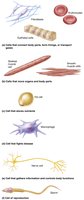
Basic Processes of Cells
All cells perform essential processes to maintain life:
Cell metabolism: Sum of all chemical reactions in the cell. Includes anabolic (building) and catabolic (breaking down) reactions, as well as oxidation-reduction reactions that generate ATP.
Transport: Movement of substances produced or ingested by the cell to various destinations.
Communication: Cells communicate with themselves, their environment, and other cells via chemical and electrical signals.
Cell reproduction: Division for growth, development, and replacement of damaged cells.
Structure of the Generalized Cell
Major Components
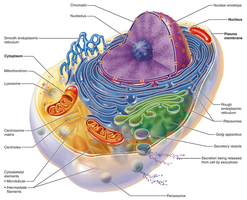
Human cells share three basic structural parts:
Plasma membrane: Flexible boundary separating the cell from its environment.
Cytoplasm: Intracellular fluid containing organelles.
Nucleus: Control center containing DNA.
Plasma Membrane
Fluid Mosaic Model
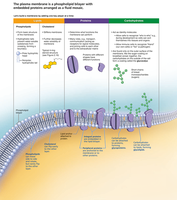
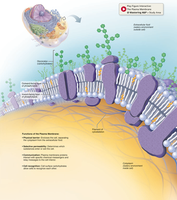
The plasma membrane is a dynamic, selectively permeable barrier composed of a phospholipid bilayer with embedded proteins and surface carbohydrates (glycocalyx). It separates intracellular fluid (ICF) from extracellular fluid (ECF) and regulates what enters and leaves the cell.
Membrane Lipids
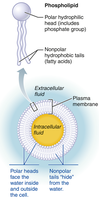
Phospholipids: Form the bilayer; polar heads are hydrophilic, nonpolar tails are hydrophobic.
Cholesterol: Interspersed among phospholipids, increases membrane stiffness.
Membrane Proteins
Membrane proteins are crucial for cell communication and function. They are classified as:
Integral proteins: Span the membrane; function as transporters, receptors, and enzymes.
Peripheral proteins: Loosely attached; function as enzymes, motor proteins, and in cell-to-cell connections.
Functions of Membrane Proteins
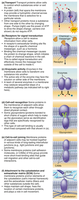
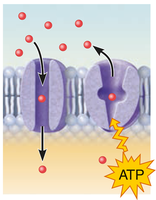
Transport: Channels and carriers move substances across the membrane.
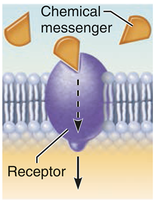
Receptors: Bind chemical messengers and initiate signal transduction.
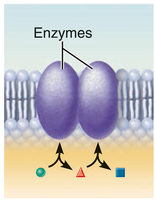
Enzymatic activity: Catalyze reactions on either side of the membrane.
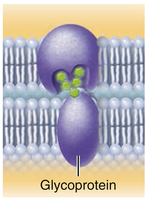
Cell-cell recognition: Glycoproteins serve as identification tags.
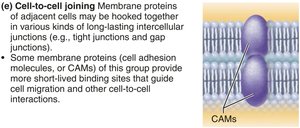
Cell-to-cell joining: Form intercellular junctions for adhesion and communication.
Attachment: Anchor cytoskeleton and extracellular matrix.
Summary Table: Membrane Protein Functions
Function | Description |
|---|---|
Transport | Move substances across membrane |
Receptors | Receive and transmit signals |
Enzymatic activity | Catalyze reactions |
Cell-cell recognition | Identify cells |
Cell-to-cell joining | Form junctions |
Attachment | Anchor cytoskeleton/ECM |
Additional info:
These notes expand on the original content by providing definitions, examples, and a summary table for membrane protein functions. Images included are directly relevant to the structure and function of cells and their membranes, reinforcing key concepts for ANP college students
