 Back
Chapter 3: The Cell – Structure, Function, and Membrane Transport
Study Guide - Smart Notes
 Tailored notes based on your materials, expanded with key definitions, examples, and context.
The Cell: Structure and Function
Introduction to Cell Metabolism
Cells are the fundamental units of life, carrying out essential chemical reactions to maintain homeostasis. These reactions include building and breaking down macromolecules, energy conversion, transport, communication, and reproduction.
Anabolic Reactions: Synthesize macromolecules such as polysaccharides, lipids, proteins, and nucleic acids.
Catabolic Reactions: Break down macromolecules and nutrients, providing energy and removing worn-out components.
Oxidation-Reduction Reactions: Convert nutrient energy (e.g., from glucose) into ATP, the cell’s main energy currency.
Substance Transport: Movement of compounds within and outside the cell is vital for function and survival.
Communication: Cells interact with their environment and other cells via signaling mechanisms.
Cell Reproduction: Most cells reproduce through cell division, ensuring tissue growth and repair.
Overview of Cell Structure
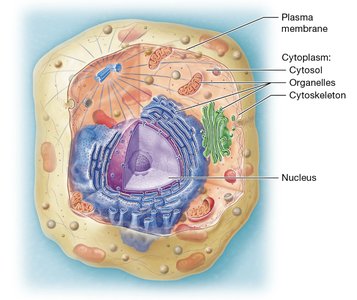
Cells share common structural features, including the plasma membrane, cytoplasm, and nucleus. Each component plays a specific role in maintaining cellular integrity and function.
Plasma Membrane: Acts as a selective barrier, providing structural support, communication, regulation of transport, and cell identification.
Cytoplasm: Contains cytosol (intracellular fluid), organelles, and the cytoskeleton.
Nucleus: Surrounded by a double membrane (nuclear envelope), it houses DNA and is the site of RNA synthesis and ribosome assembly.
Cell Size and Diversity
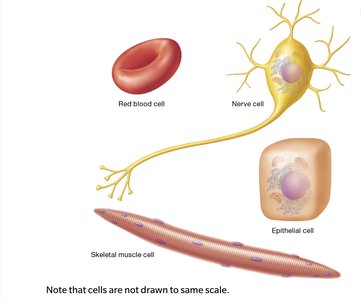
Cells vary greatly in size, shape, and function, reflecting their specialized roles in the body. Examples include red blood cells, nerve cells, epithelial cells, and skeletal muscle cells.
Plasma Membrane Structure
Phospholipid Bilayer and Fluid Mosaic Model
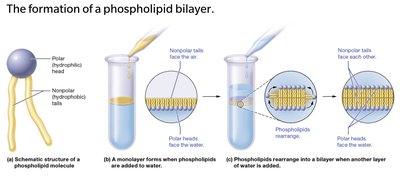
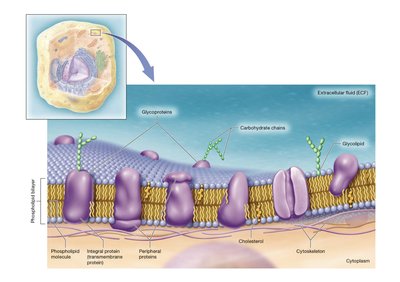
The plasma membrane is primarily composed of a phospholipid bilayer, which forms a dynamic, semi-permeable barrier between the cell and its environment. The fluid mosaic model describes the membrane as a flexible structure with proteins and other molecules embedded within the lipid bilayer.
Phospholipid Bilayer: Consists of hydrophilic (polar) heads facing outward and hydrophobic (nonpolar) tails facing inward, creating a selective barrier.
Membrane Proteins: Integral (transmembrane) proteins span the membrane, while peripheral proteins are attached to one side. These proteins serve as channels, carriers, receptors, enzymes, structural supports, and cell linkers.
Other Components: Cholesterol stabilizes membrane fluidity; glycolipids and glycoproteins are involved in cell recognition and signaling.
Membrane Transport Mechanisms
Passive Transport
Passive transport moves substances across the membrane without energy expenditure, relying on concentration gradients.
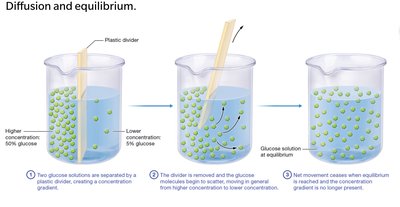
Diffusion: Movement of solute molecules from high to low concentration until equilibrium is reached.
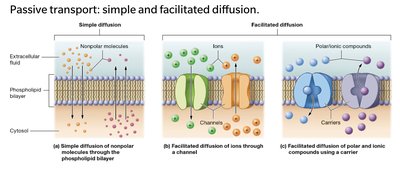
Simple Diffusion: Nonpolar molecules (e.g., O2, CO2) pass directly through the lipid bilayer.
Facilitated Diffusion: Polar or charged solutes cross the membrane with the help of channel or carrier proteins.
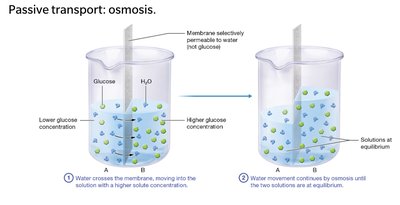
Osmosis: Movement of water across a selectively permeable membrane from low to high solute concentration.
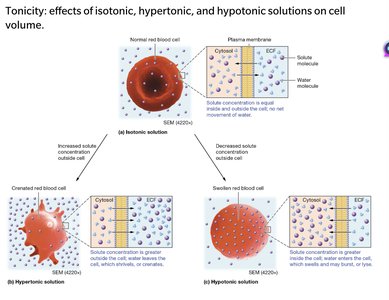
Tonicity: Describes the effect of extracellular solutions on cell volume:
Isotonic: No net water movement; cell volume remains stable.
Hypertonic: Cell loses water and shrinks (crenation).
Hypotonic: Cell gains water and may burst (lysis).
Summary Table: Types of Membrane Transport
Type of Transport | Definition | Examples |
|---|---|---|
Simple Diffusion | Movement of solute from high to low concentration directly through the membrane | O2, CO2, lipids |
Facilitated Diffusion | Movement of solute down its gradient via a membrane protein | Ions, glucose, amino acids |
Osmosis | Movement of water toward higher solute concentration | Water movement between ECF and ICF |
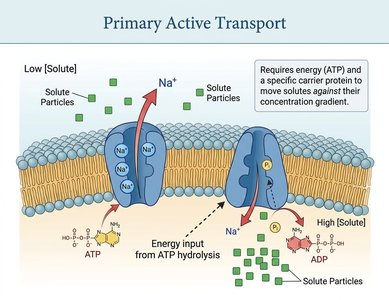
Primary Active Transport | Direct use of ATP to move solutes against their gradient | Na+/K+ pump |
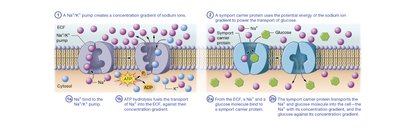
Secondary Active Transport | Uses gradient established by primary active transport to move another substance | Sodium-glucose cotransport |
Active Transport
Active transport requires energy (usually ATP) to move substances against their concentration gradients.
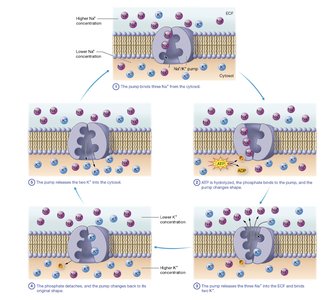
Primary Active Transport: Directly uses ATP to pump ions (e.g., Na+/K+ ATPase moves 3 Na+ out and 2 K+ in).
Secondary Active Transport: Uses the energy from the gradient created by primary active transport to move other substances (e.g., sodium-glucose cotransporter).
Membrane Potential
Resting Membrane Potential (RMP)
The membrane potential is the electrical potential difference across the plasma membrane, typically around -80 mV in resting cells. This potential is crucial for the function of excitable cells such as neurons and muscle cells.
Vesicular Transport
Endocytosis and Exocytosis
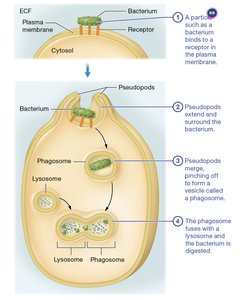
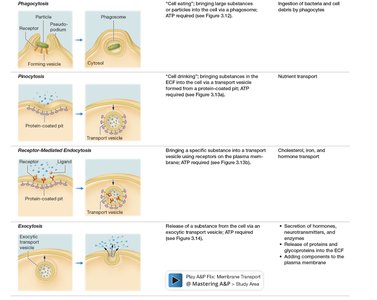
Vesicular transport moves large particles and macromolecules across the plasma membrane via vesicles, requiring energy from ATP.
Endocytosis: Imports substances into the cell. Includes phagocytosis ("cell eating") and pinocytosis ("cell drinking").
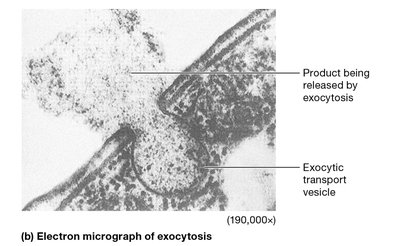
Exocytosis: Exports substances out of the cell by fusing vesicles with the plasma membrane.
Transcytosis
Transcytosis is the process by which substances are transported across the interior of a cell, combining endocytosis and exocytosis. It is important in transporting large molecules across endothelial and epithelial barriers.
Summary Table: Organelle Structure and Function
Organelle | Structure | Function |
|---|---|---|
Mitochondrion | Double membrane, inner folds (cristae) | ATP synthesis |
Peroxisome | Membrane-enclosed, contains enzymes | Detoxification, lipid metabolism |
Ribosome | Two subunits, protein and rRNA | Protein synthesis |
Rough ER | Membrane sacs with ribosomes | Protein folding/modification |
Smooth ER | Membrane sacs without ribosomes | Lipid synthesis, detoxification |
Golgi Apparatus | Stack of flattened membranes | Sorts, modifies, packages proteins |
Lysosome | Membrane sac with digestive enzymes | Digests damaged organelles, debris |
Key Concepts and Applications
Membrane Structure: The fluid mosaic model explains the dynamic and complex nature of the plasma membrane.
Transport Mechanisms: Passive and active transport processes regulate the movement of substances, maintaining cellular homeostasis.
Vesicular Transport: Essential for bulk movement of macromolecules and communication between cells and their environment.
Membrane Potential: Critical for nerve impulse transmission and muscle contraction.
