 Back
Chapter 4: Tissue – The Living Fabric (ANP College Study Notes)
Study Guide - Smart Notes
 Tailored notes based on your materials, expanded with key definitions, examples, and context.
Tissue: The Living Fabric
Introduction to Tissues
Tissues are groups of cells with similar structure and function, working together to maintain homeostasis in the body. The study of tissues is known as histology. There are four basic tissue types: epithelial, connective, muscle, and nervous tissue.
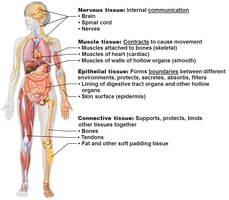
Epithelial tissue: Covers surfaces, forms boundaries, and is involved in protection, absorption, filtration, excretion, secretion, and sensory reception.
Connective tissue: Supports, protects, binds other tissues together; includes bone, tendons, fat, and other soft padding tissue.
Muscle tissue: Contracts to cause movement; includes skeletal, cardiac, and smooth muscle.
Nervous tissue: Internal communication; found in the brain, spinal cord, and nerves.
Epithelial Tissue
Characteristics of Epithelial Tissue
Epithelial tissue consists of sheets of cells covering body surfaces or lining cavities. It is classified by its function and location, such as covering/lining epithelia (skin, internal surfaces) and glandular epithelia (secretory tissue in glands).
Polarity: Cells have an apical (top) and basal (bottom) surface. The apical surface may have microvilli for increased absorption.
Specialized contacts: Cells are tightly joined by junctions (tight junctions, desmosomes).
Supported by connective tissue: The basement membrane (basal and reticular lamina) reinforces the sheet.
Avascular but innervated: No blood vessels; nourished by diffusion; supplied by nerve fibers.
Regeneration: High capacity for renewal, especially in areas exposed to friction or hostile environments.
Classification of Epithelia
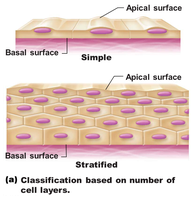
Epithelial tissues are classified by the number of cell layers and cell shape.
Simple epithelia: Single layer; involved in absorption, secretion, filtration.
Stratified epithelia: Two or more layers; protection is the major role.
Cell shapes include:
Squamous: Flattened, scale-like
Cuboidal: Box-like, cube-shaped
Columnar: Tall, column-shaped
Types of Epithelial Tissue
Simple Epithelia
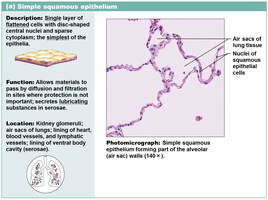
Simple squamous epithelium: Single layer of flat cells; allows diffusion and filtration; found in kidney glomeruli, air sacs of lungs, lining of heart, blood vessels, and serosae.
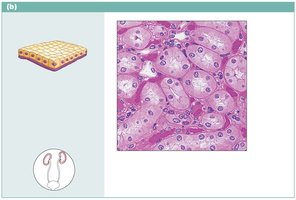
Simple cuboidal epithelium: Single layer of cube-shaped cells; functions in secretion and absorption; found in kidney tubules, ducts, and secretory portions of small glands, ovary surface.
Simple columnar epithelium: Single layer of tall cells; absorption and secretion of mucus, enzymes; ciliated type propels mucus; found in digestive tract, gallbladder, excretory ducts, small bronchi, uterine tubes.
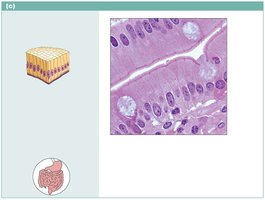
Pseudostratified columnar epithelium: Single layer of cells of varying heights; nuclei at different levels; may contain mucus-secreting cells and cilia; found in sperm-carrying ducts, large glands, trachea, upper respiratory tract.
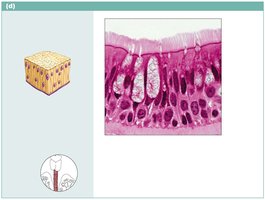
Stratified Epithelia
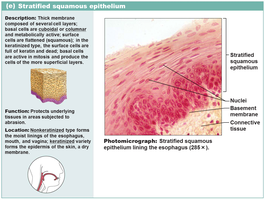
Stratified squamous epithelium: Several layers; protects underlying tissues; forms the lining of the esophagus, mouth, vagina, and the epidermis of skin.
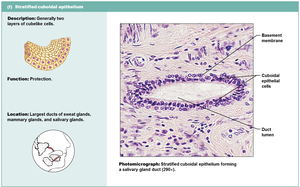
Stratified cuboidal epithelium: Generally two layers of cube-like cells; protection; found in ducts of sweat, mammary, and salivary glands.
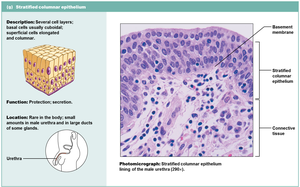
Stratified columnar epithelium: Several cell layers; protection and secretion; rare, found in male urethra and large ducts of some glands.
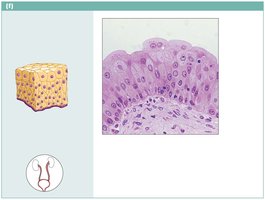
Transitional epithelium: Resembles both stratified squamous and cuboidal; stretches readily; lines ureters, bladder, and part of urethra.
Glandular Epithelia
A gland is one or more cells that makes and secretes an aqueous fluid. Glands are classified by site of product release (endocrine or exocrine) and number of cells (unicellular or multicellular).
Endocrine glands: Internally secreting (hormones); secretions released into interstitial fluid and picked up by circulatory system.
Exocrine glands: Externally secreting (sweat, oil, saliva); secretions released onto body surfaces or into cavities.
Unicellular exocrine glands: Mucous and goblet cells; produce mucus.
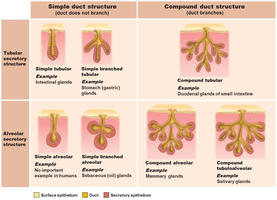
Multicellular exocrine glands: Composed of a duct and secretory unit; classified by duct structure (simple or compound) and secretory unit shape (tubular, alveolar, tubuloalveolar).
Modes of secretion:
Merocrine: Secrete by exocytosis (sweat, pancreas).
Holocrine: Accumulate products and rupture (sebaceous glands).
Apocrine: Accumulate products, only apex ruptures (mammary glands).
Connective Tissue
Characteristics and Functions
Connective tissue is the most abundant and widely distributed tissue. It binds, supports, protects, insulates, stores fuel, and transports substances. All connective tissues arise from mesenchyme, have varying vascularity, and are embedded in an extracellular matrix (ECM).
Ground substance: Gel-like material; medium for solute diffusion; contains interstitial fluid, cell adhesion proteins, proteoglycans, and water.
Fibers: Collagen (strongest), elastic (stretch and recoil), reticular (branched, supportive networks).
Cells: Immature "blast" cells (fibroblasts, chondroblasts, osteoblasts, hematopoietic stem cells); mature "cyte" cells; fat cells; white blood cells; mast cells; macrophages.
Types of Connective Tissue
Connective tissue proper: Loose (areolar, adipose, reticular) and dense (regular, irregular, elastic).
Cartilage: Hyaline, elastic, fibrocartilage; tough, flexible, avascular.
Bone (osseous tissue): Hard, calcified matrix; supports, protects, stores minerals, site of blood cell formation.
Blood: Fluid matrix (plasma); transports nutrients, wastes, gases.
Muscle Tissue
Types and Functions
Muscle tissue is highly vascularized and responsible for movement. There are three types:
Skeletal muscle: Voluntary movement; attached to bones.
Cardiac muscle: Involuntary; found in heart; propels blood.
Smooth muscle: Involuntary; found in walls of hollow organs; propels substances.
Nervous Tissue
Structure and Function
Nervous tissue consists of neurons and supporting cells. Neurons transmit electrical signals; supporting cells protect and nourish neurons. Found in the brain, spinal cord, and nerves.
Covering and Lining Membranes
Types of Membranes
Cutaneous membrane: Skin; keratinized stratified squamous epithelium attached to connective tissue; dry membrane.
Mucous membrane: Lines body cavities open to exterior; moist; may secrete mucus.
Serous membrane: Lines closed ventral body cavities; simple squamous epithelium (mesothelium) on areolar connective tissue; parietal and visceral layers.
Tissue Repair
Repair Mechanisms
When tissues are damaged, repair occurs via inflammation and immune responses. Repair can be:
Regeneration: Same kind of tissue replaces destroyed tissue; function restored.
Fibrosis: Connective tissue replaces destroyed tissue; function lost.
Tissues with high regenerative capacity: epithelial, bone, areolar, dense irregular, blood-forming tissue. Moderate: smooth muscle, dense regular. Low: cardiac muscle, nervous tissue.
