 Back
BackChapter 4: Tissue—The Living Fabric (Epithelial and Connective Tissues)
Study Guide - Smart Notes
 Tailored notes based on your materials, expanded with key definitions, examples, and context.
Tissue: The Living Fabric
Introduction to Tissues
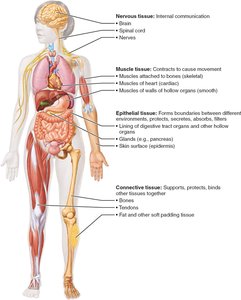
Tissues are groups of cells similar in structure that perform common or related functions. The study of tissues is called histology. The human body is composed of four primary tissue types: epithelial, connective, muscle, and nervous tissue.
Epithelial tissue: Covers surfaces, lines cavities, and forms glands.
Connective tissue: Supports, protects, and binds other tissues together.
Muscle tissue: Contracts to produce movement.
Nervous tissue: Initiates and transmits electrical impulses for communication.
Epithelial Tissue
General Characteristics
Epithelial tissue is a sheet of cells that covers body surfaces or lines body cavities. It has two main forms:
Covering and lining epithelium: Forms the outer layer of the skin and lines open cavities and organs.
Glandular epithelium: Forms the glands of the body (e.g., salivary glands).
Main functions include protection, absorption, filtration, excretion, secretion, and sensory reception.
Special Characteristics of Epithelial Tissue
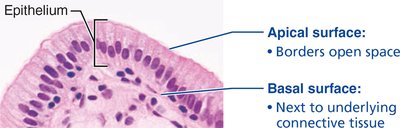
Polarity: Cells have an apical (top) surface and a basal (bottom) surface.
Specialized contacts: Cells are tightly joined by junctions (tight junctions and desmosomes).
Supported by connective tissue: The basement membrane anchors epithelium to underlying connective tissue.
Avascular but innervated: Contains no blood vessels but is supplied by nerve fibers; nutrients diffuse from underlying tissues.
Regeneration: High capacity for renewal, especially in areas exposed to friction.
Classification of Epithelial Tissue
Epithelial tissues are classified by the number of cell layers and the shape of the cells in the apical layer.
Number of layers:
Simple epithelium: Single cell layer (for absorption, secretion, filtration).
Stratified epithelium: Two or more layers (for protection).
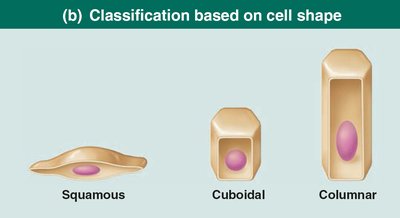
Cell shape:
Squamous: Flat and scale-like.
Cuboidal: Box-like, as tall as they are wide.
Columnar: Tall and column-shaped.

Types of Epithelial Tissue
Simple Squamous Epithelium: Single layer of flat cells; allows diffusion and filtration. Location: Air sacs of lungs, lining of heart, blood vessels, lymphatic vessels, serosae.

Simple Cuboidal Epithelium: Single layer of cube-like cells; functions in secretion and absorption. Location: Kidney tubules, ducts, and secretory portions of small glands, ovary surface.

Simple Columnar Epithelium: Single layer of tall cells; may have microvilli or cilia, and goblet cells. Functions in absorption and secretion of mucus and enzymes. Location: Non-ciliated: digestive tract; ciliated: small bronchi, uterine tubes.

Pseudostratified Columnar Epithelium: Appears multi-layered but is a single layer; often ciliated. Secretes and moves mucus. Location: Trachea, upper respiratory tract.

Stratified Squamous Epithelium: Several layers; protects underlying tissues. Location: Non-keratinized: moist linings (esophagus, mouth, vagina); keratinized: skin.

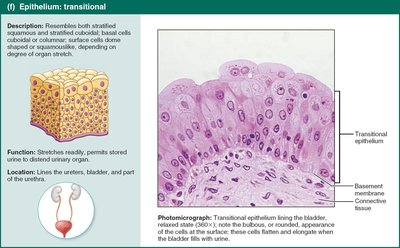
Transitional Epithelium: Resembles both stratified squamous and cuboidal; stretches readily. Location: Lines ureters, bladder, part of urethra.
Glandular Epithelia
A gland consists of one or more cells that make and secrete an aqueous fluid called a secretion. Glands are classified by:
Site of product release: Endocrine (ductless, secrete hormones into blood) or Exocrine (secrete via ducts onto surfaces or into cavities).
Number of cells: Unicellular (e.g., goblet cells) or multicellular (e.g., salivary glands).
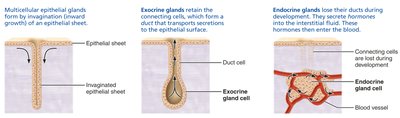
Types of Multicellular Exocrine Glands
Multicellular exocrine glands are classified by structure (simple or compound ducts; tubular or alveolar secretory units) and mode of secretion:
Merocrine: Secrete by exocytosis (e.g., sweat, pancreas, salivary glands).
Holocrine: Accumulate products until cell ruptures (e.g., sebaceous glands).
Apocrine: Apex of cell pinches off (e.g., mammary glands).

Connective Tissue
General Features
Connective tissue is the most abundant and widely distributed tissue type. Its major functions include binding and support, protection, insulation, energy storage, and transportation of substances (e.g., blood).
Four main classes: Connective tissue proper, cartilage, bone, blood.
Common Characteristics
Extracellular matrix: Nonliving material (ground substance and fibers) separates cells, allowing tissue to bear weight and withstand tension.
Common origin: All connective tissues arise from embryonic mesenchyme.
Structural Elements
Ground substance: Unstructured material that fills space between cells; contains interstitial fluid, cell adhesion proteins, and proteoglycans (e.g., chondroitin sulfate, hyaluronic acid).
Fibers:
Collagen: Strongest, provides tensile strength.
Elastic: Stretch and recoil.
Reticular: Short, fine, branched; support soft tissues.
Cells: Immature forms end in "-blast" (actively secrete matrix); mature forms end in "-cyte" (maintain matrix). Other cells include adipocytes, leukocytes, mast cells, and macrophages.
Types of Connective Tissue
Tissue Class | Subclasses | Cells | Matrix | General Features |
|---|---|---|---|---|
Connective Tissue Proper | Loose (areolar, adipose, reticular); Dense (regular, irregular, elastic) | Fibroblasts, fibrocytes, adipocytes, defense cells | Gel-like ground substance; collagen, reticular, elastic fibers | Binding, resisting tension, water/salt reservoir, energy storage |
Cartilage | Hyaline, elastic, fibrocartilage | Chondroblasts, chondrocytes | Gel-like ground substance; collagen, elastic fibers | Resists compression, supports, cushions, avascular |
Bone | Compact, spongy | Osteoblasts, osteocytes | Calcified ground substance; collagen fibers | Hard, supports, resists compression/tension, vascularized |
Blood | --- | RBCs, WBCs, platelets | Plasma (no fibers) | Fluid tissue, transports substances |
Muscle Tissue
Overview
Muscle tissue is highly vascularized and responsible for movement. Muscle cells contain myofilaments (actin and myosin) for contraction. There are three types:
Skeletal muscle: Voluntary, attached to bones, striated.
Cardiac muscle: Involuntary, found in heart, striated, intercalated discs for synchronized contraction.
Smooth muscle: Involuntary, found in walls of hollow organs, non-striated.
Nervous Tissue
Overview
Nervous tissue is the main component of the nervous system (brain, spinal cord, nerves). It regulates and controls body functions. Two main cell types:
Neurons: Respond to stimuli and transmit electrical signals via dendrites and axons.
Glial cells (neuroglia): Support, insulate, and protect neurons.
