 Back
BackChapter 5: The Integumentary System – Structured Study Notes
Study Guide - Smart Notes
 Tailored notes based on your materials, expanded with key definitions, examples, and context.
The Integumentary System
Overview and Functions
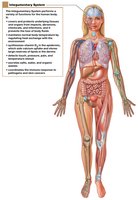
The integumentary system is the largest organ system in the human body, comprising about 16% of body weight and covering 1.5–2 square meters. It consists of the cutaneous membrane (skin), which includes the epidermis and dermis, as well as accessory structures such as hair, nails, and exocrine glands. The system also contains blood vessels and sensory receptors, and is separated from deeper tissues by the subcutaneous layer (hypodermis).
Protection: Shields underlying tissues from impact, abrasion, fluid loss, and chemical attack.
Excretion: Removes salts, water, and organic wastes via glands.
Temperature Regulation: Maintains body temperature through insulation and evaporative cooling.
Melanin Production: Protects against UV radiation.
Keratin Production: Provides toughness and water resistance.
Vitamin D Synthesis: Essential for calcium metabolism.
Lipid Storage: In dermis and subcutaneous layer.
Sensory Detection: Touch, pressure, pain, vibration, and temperature.
Immune Response: Coordinates defense against pathogens and cancers.
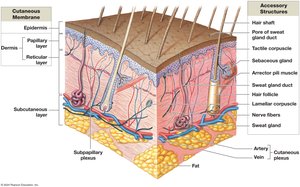
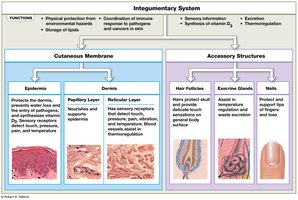
Epidermis
Structure and Function
The epidermis is the superficial layer of the skin, composed of stratified squamous epithelium. It is avascular, relying on diffusion from the dermis for nutrients and oxygen. The main cell type is the keratinocyte, which produces keratin, a tough, fibrous protein.
Thin skin: Covers most of the body; has four layers.
Thick skin: Covers palms and soles; has five layers.
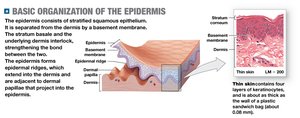
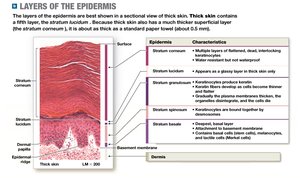
Layers of the Epidermis
The five strata of the epidermis, from deep to superficial, are:
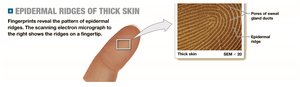
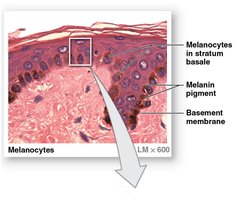
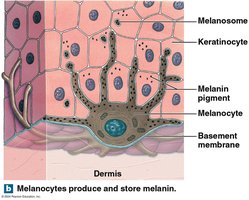
Stratum basale: Deepest layer; contains stem cells (basal cells), tactile (Merkel) cells, and melanocytes. Attached to basement membrane by hemidesmosomes. Forms epidermal ridges (fingerprints).
Stratum spinosum: 8–10 layers of keratinocytes bound by desmosomes; contains dendritic (Langerhans) cells for immune defense.
Stratum granulosum: 3–5 layers; cells stop dividing, fill with keratin and keratohyalin, become dehydrated and die.
Stratum lucidum: Only in thick skin; layer of dead keratinocytes.
Stratum corneum: 15–30 layers of keratinized cells; water-resistant but not waterproof; cells are shed after 2 weeks.
Water Loss and Epidermal Growth Factor
Insensible perspiration: Water loss by diffusion (about 500 mL/day).
Sensible perspiration: Water loss by sweat glands.
Epidermal Growth Factor (EGF): Promotes division of basal cells, keratin production, epidermal development and repair, and glandular secretion.
Dermis
Structure and Function
The dermis is the deeper layer of skin, anchoring accessory structures and containing blood vessels and nerves. It is divided into two layers:
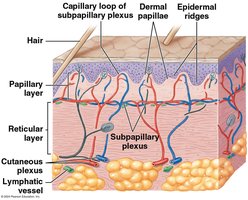
Papillary layer: Areolar tissue; contains capillaries, lymphatic vessels, and sensory neurons; forms dermal papillae.
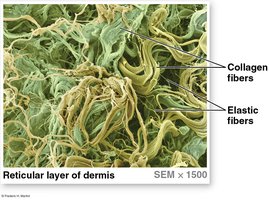
Reticular layer: Dense irregular connective tissue; rich in collagen and elastic fibers; provides strength and elasticity.
Dermal Strength, Elasticity, and Tension Lines
Collagen fibers: Strong, limit flexibility.
Elastic fibers: Allow stretching and recoil.
Skin turgor: Strength and flexibility due to water content.
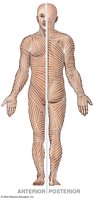
Tension lines: Parallel bundles of fibers; cuts parallel heal better.
Dermal Blood Supply and Innervation
Cutaneous plexus: Deep network of vessels.
Subpapillary plexus: Network in papillary layer.
Contusion: Bruise from damaged vessels.
Sensory receptors: Tactile (Meissner) corpuscles for light touch; Lamellar (Pacinian) corpuscles for deep pressure and vibration.
Subcutaneous Layer (Hypodermis)
Structure and Function
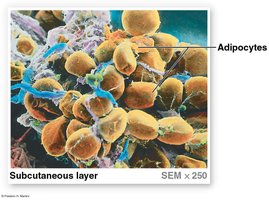
The subcutaneous layer stabilizes the skin and connects it to underlying tissues. It is not part of the skin but consists mainly of adipose tissue, providing energy storage, insulation, and padding. It contains large arteries and veins and is a site for subcutaneous injections.
Skin Color
Factors Affecting Skin Color
Skin color is determined by epidermal pigmentation and dermal circulation.
Carotene: Orange-yellow pigment from vegetables; accumulates in skin and can be converted to vitamin A.
Melanin: Red-yellow (pheomelanin) or brown-black (eumelanin) pigment produced by melanocytes; protects against UV radiation; synthesis increases with sun exposure.
Dermal circulation: Blood flow and oxygenation affect skin color; hemoglobin is bright red when oxygenated, dark red when deoxygenated (cyanosis).
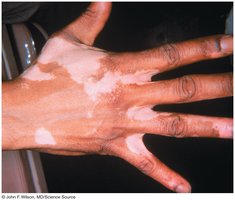
Disease-related changes: Jaundice (yellow), pituitary tumor/Addison’s disease (darkening), vitiligo (white patches).
Vitamin D3 Synthesis
Sunlight and Vitamin D3 Production
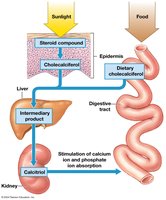
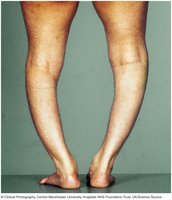
Vitamin D3 (cholecalciferol) is produced by epidermal cells in response to UV radiation. The liver and kidneys convert it to calcitriol, which is essential for calcium and phosphate absorption in the small intestine. Deficiency can cause rickets, leading to abnormal bone development.
Hair
Structure and Function
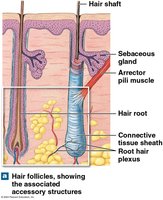
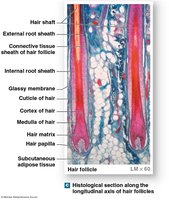
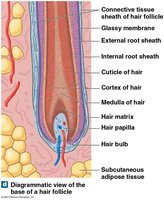
Hair is a nonliving accessory structure produced in hair follicles, originating in the dermis and projecting through the epidermis. It covers most of the body except certain areas.
Functions: Protection, cushioning, insulation, sensory reception, guarding openings.
Hair follicles: Deep in dermis, surrounded by connective tissue sheath and sensory nerves; arrector pili muscle causes "goose bumps".
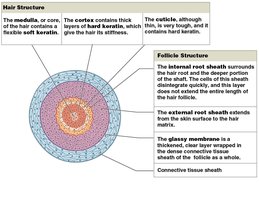
Hair structure: Three layers – medulla (core), cortex (intermediate), cuticle (surface).
Hair Growth and Types
Hair production: Begins at hair bulb; basal cells in hair matrix produce hair cells, which keratinize and die.
Growth cycle: Hair grows, becomes club hair when follicle is inactive, then shed as new cycle begins.
Types: Vellus (soft, fine), terminal (heavy, pigmented).
Hair color: Determined by melanocyte pigment production, genes, environment, and age.
Exocrine Glands of the Skin
Types and Functions
The skin contains several types of exocrine glands:
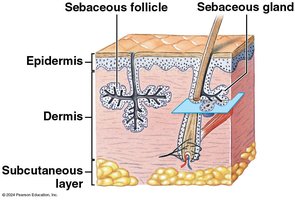
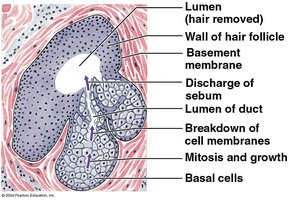
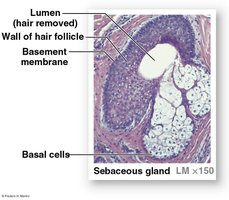
Sebaceous glands: Produce sebum (oil) into hair follicles; lubricates, protects, inhibits bacteria.
Sebaceous follicles: Discharge sebum directly onto skin surface.
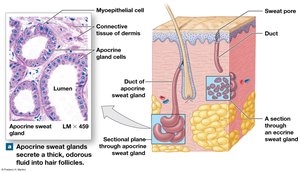
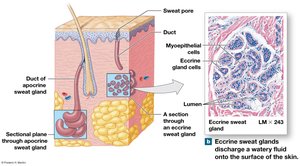
Sweat glands: Apocrine (secrete into hair follicles; sticky, odorous; found in armpits, nipples, pubic region) and eccrine (secrete directly onto skin; widely distributed; for cooling and excretion).
Other glands: Mammary (milk), ceruminous (earwax).
Nails
Structure and Formation
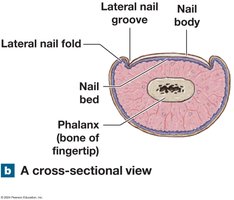
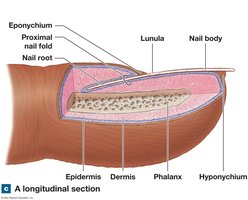
Nails are protective structures made of dead, keratinized epidermal cells. They protect the tips of fingers and toes.
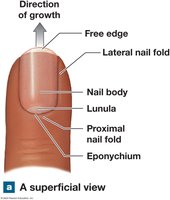
Nail body: Visible portion covering the nail bed.
Nail root: Site of nail production.
Eponychium (cuticle): Stratum corneum extending over nail root.
Lunula: Pale crescent near root.
Hyponychium: Thickened stratum corneum beneath free edge.
Injury Repair
Phases of Skin Injury Repair
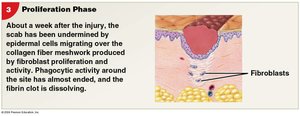
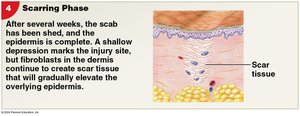
The skin repairs itself through four phases:
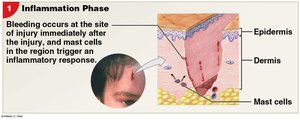
Inflammatory phase: Bleeding, swelling, pain; mast cells trigger inflammation.
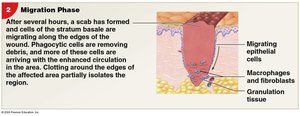
Migration phase: Scab forms; macrophages clean debris; cells migrate to repair epidermis and dermis.
Proliferation phase: Scab disintegrates; fibroblasts produce collagen meshwork; epidermal cells migrate.
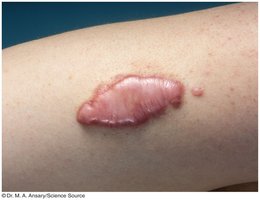
Scarring phase: Scar tissue forms; less flexible, more fibers, fewer blood vessels.
Effects of Aging on the Integumentary System
Changes with Age
Epidermis thins; connections with dermis weaken.
Dendritic cells decrease; increased infection risk.
Vitamin D production declines.
Melanocyte activity declines; increased risk of burns and cancers.
Glandular activity declines; reduced lubrication and cooling.
Blood supply to dermis reduced; decreased thermoregulation.
Hair follicle function declines; hair loss, graying.
Elastic fibers shrink; sagging and wrinkling.
Repair rate slows.
Clinical Notes
Skin Cancer
Basal cell carcinoma: Originates in stratum basale; most common; does not metastasize.
Squamous cell carcinoma: Affects squamous cells; does not metastasize.
Malignant melanoma: Aggressive; metastasis common; signs include asymmetry, irregular border, mottled color, size >6 mm, changing shape/color.
Burns and Grafts
First-degree: Damages only epidermis; minor pain.
Second-degree: Damages epidermis and some dermis; blistering, swelling, pain.
Third-degree: Destroys epidermis, dermis, and subcutaneous layer; requires skin grafts.
Rule of nines: Used to estimate burn surface area.
Burns cause: Fluid/electrolyte loss, thermoregulation issues, increased infection risk.
Layer | Main Features |
|---|---|
Epidermis | Stratified squamous epithelium, keratinocytes, avascular, five strata |
Dermis | Papillary (areolar tissue, capillaries), Reticular (dense irregular connective tissue, collagen/elastic fibers) |
Subcutaneous Layer | Adipose tissue, energy storage, insulation, blood reservoir |
Gland Type | Secretion | Function |
|---|---|---|
Sebaceous | Sebum | Lubricates, protects, inhibits bacteria |
Apocrine Sweat | Sticky, odorous sweat | Odor, nutrient for bacteria |
Eccrine Sweat | Watery sweat | Cooling, excretion, protection |
Mammary | Milk | Nourishment |
Ceruminous | Cerumen (earwax) | Protects ear canal |
