 Back
BackChapter 8: Joints (Articulations) – Structure, Function, and Movements
Study Guide - Smart Notes
 Tailored notes based on your materials, expanded with key definitions, examples, and context.
Joints (Articulations)
Introduction to Joints
Joints, or articulations, are sites where two or more bones meet. They play a crucial role in holding the skeleton together and providing mobility. Understanding the structure and function of joints is essential for diagnosing and treating joint injuries, such as ankle sprains.
Classification of Joints
Structural Classification
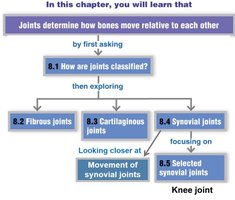
Joints are classified structurally based on the presence or absence of a joint cavity and the material binding the bones together:
Fibrous Joints: No joint cavity; bones connected by fibrous tissue.
Cartilaginous Joints: No joint cavity; bones connected by cartilage.
Synovial Joints: Joint cavity present; bones connected by a fluid-filled cavity.
Functional Classification
Joints are also classified by the amount of movement they allow:
Synarthroses: Immovable joints (most fibrous joints).
Amphiarthroses: Slightly movable joints (some cartilaginous joints).
Diarthroses: Freely movable joints (all synovial joints).
Fibrous Joints
General Features
Fibrous joints are mostly synarthrotic (immovable) and lack a joint cavity. Bones are connected by collagen fibers. There are three main types:
Gomphosis
Suture
Syndesmosis
Gomphosis
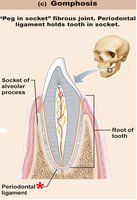
A peg-in-socket fibrous joint, found only in the teeth. The periodontal ligament holds the tooth in its socket.
Suture
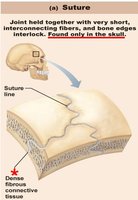
Sutures are joints held together with very short, interconnecting fibers, and bone edges interlock. They are found only in the skull. With age, sutures may ossify and become synostoses (bony junctions).
Syndesmosis
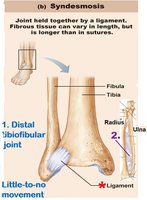
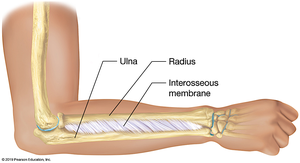
Bones are connected by a ligament. The amount of movement depends on the length of the ligament. Examples include the distal tibiofibular joint (little movement) and the interosseous membrane between the radius and ulna (more movement).
Cartilaginous Joints
General Features
Cartilaginous joints lack a joint cavity and unite bones with cartilage. They are either synarthrotic or amphiarthrotic. Two main types are:
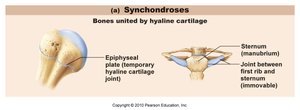
Synchondroses: Bones united by hyaline cartilage.
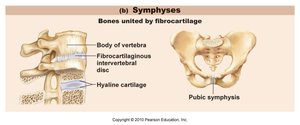
Symphyses: Bones united by fibrocartilage.
Synchondroses
These joints are united by hyaline cartilage and are typically immovable. Examples include the epiphyseal plates in growing bones and the joint between the first rib and the sternum.
Symphyses
Symphyses are strong, flexible, and amphiarthrotic joints where bones are united by fibrocartilage. Examples include the intervertebral discs and the pubic symphysis.
Synovial Joints
General Features
Synovial joints are characterized by a fluid-filled joint cavity and are all diarthrotic (freely movable). They are the most common type of joint in the limbs and body.
Six Distinguishing Features of Synovial Joints
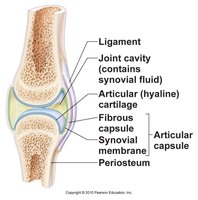
Articular cartilage: Hyaline cartilage covering bone surfaces.
Joint (articular) cavity: Space containing synovial fluid.
Synovial fluid: Slippery fluid that lubricates and nourishes the joint.
Articular (joint) capsule: Two-layered capsule enclosing the joint cavity (outer fibrous layer and inner synovial membrane).
Reinforcing ligaments: Capsular, extracapsular, and intracapsular ligaments strengthen the joint.
Blood vessels and nerves: Supply nutrients and monitor joint position and stretch.
Other Structural Features
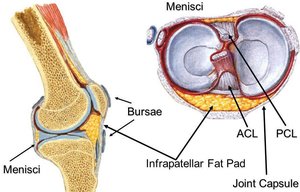
Fatty pads: Cushioning structures between the fibrous layer and bone or synovial membrane (e.g., knee and hip joints).
Articular discs (menisci): Fibrocartilage pads that improve the fit of bone ends, stabilize the joint, and reduce wear and tear.
Friction-Reducing Structures
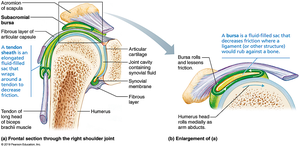
Bursae: Fluid-filled sacs that reduce friction where ligaments, muscles, skin, or tendons rub against bone.
Tendon sheaths: Elongated bursae that wrap around tendons to decrease friction.
Stability of Synovial Joints
Factors Influencing Stability
Shape of articular surfaces: Minor role in stability.
Ligament number and location: Limited role.
Muscle tone: Most important factor; keeps tendons taut and reinforces joints, especially in the shoulder, knee, and foot arches.
Movements Allowed by Synovial Joints
Attachment Points and Movement
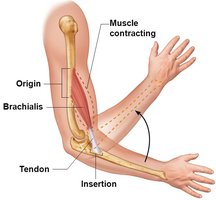
All muscles attach to bone at two points: the origin (immovable bone) and the insertion (movable bone). Muscle contraction moves the insertion toward the origin. Movements occur along transverse, frontal, or sagittal planes.
Range of Motion
Nonaxial: Slipping movements only.
Uniaxial: Movement in one plane.
Biaxial: Movement in two planes.
Multiaxial: Movement in or around all three planes.
Types of Movements
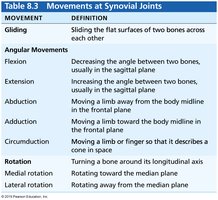
Gliding: Sliding flat surfaces of bones across each other.
Angular movements: Increase or decrease the angle between two bones (flexion, extension, hyperextension, abduction, adduction, circumduction).
Rotation: Turning a bone around its own long axis (medial and lateral rotation).
Movement | Definition |
|---|---|
Gliding | Sliding the flat surfaces of two bones across each other |
Flexion | Decreasing the angle between two bones, usually in the sagittal plane |
Extension | Increasing the angle between two bones, usually in the sagittal plane |
Abduction | Moving a limb away from the body midline in the frontal plane |
Adduction | Moving a limb toward the body midline in the frontal plane |
Circumduction | Moving a limb or finger so that it describes a cone in space |
Rotation | Turning a bone around its longitudinal axis |
Medial rotation | Rotating toward the median plane |
Lateral rotation | Rotating away from the median plane |
Types of Synovial Joints
Six Types of Synovial Joints
Plane joint: Nonaxial, gliding movements (e.g., intercarpal joints).
Hinge joint: Uniaxial, flexion and extension (e.g., elbow, knee).
Pivot joint: Uniaxial, rotation (e.g., proximal radioulnar joint, atlantoaxial joint).
Condylar joint: Biaxial, flexion/extension and abduction/adduction (e.g., knuckle joints).
Saddle joint: Biaxial, similar to condylar but with greater movement (e.g., thumb carpometacarpal joint).
Ball-and-socket joint: Multiaxial, movement in all axes (e.g., shoulder, hip).
Selected Synovial Joints: The Knee Joint
Structure and Function
The knee joint is the largest and most complex joint in the body, consisting of three joints in one cavity: the femoropatellar joint and the lateral and medial tibiofemoral joints. It is a modified hinge joint, allowing flexion, extension, and some rotation.
Ligaments and Stability
Capsular and extracapsular ligaments: Prevent hyperextension and provide stability (e.g., tibial and fibular collateral ligaments).
Intracapsular ligaments: Cruciate ligaments (ACL and PCL) prevent anterior-posterior displacement of the tibia and femur.
Menisci: Medial and lateral menisci improve fit, stabilize, and absorb shock.
Common Knee Injuries
The knee absorbs significant vertical force but is vulnerable to horizontal or lateral blows. Common injuries involve the three C's: collateral ligaments, cruciate ligaments, and cartilages (menisci).
Summary Table: Types of Synovial Joints and Movements
Joint Type | Movement | Example |
|---|---|---|
Plane | Nonaxial (gliding) | Intercarpal joints |
Hinge | Uniaxial (flexion/extension) | Elbow, knee |
Pivot | Uniaxial (rotation) | Proximal radioulnar joint |
Condylar | Biaxial (flexion/extension, abduction/adduction) | Knuckle joints |
Saddle | Biaxial (greater movement) | Thumb joint |
Ball-and-socket | Multiaxial (all movements) | Shoulder, hip |
