 Back
Chemical Classes of Hormones: Structure and Classification
Study Guide - Smart Notes
 Tailored notes based on your materials, expanded with key definitions, examples, and context.
The Endocrine System
Chemical Classes of Hormones
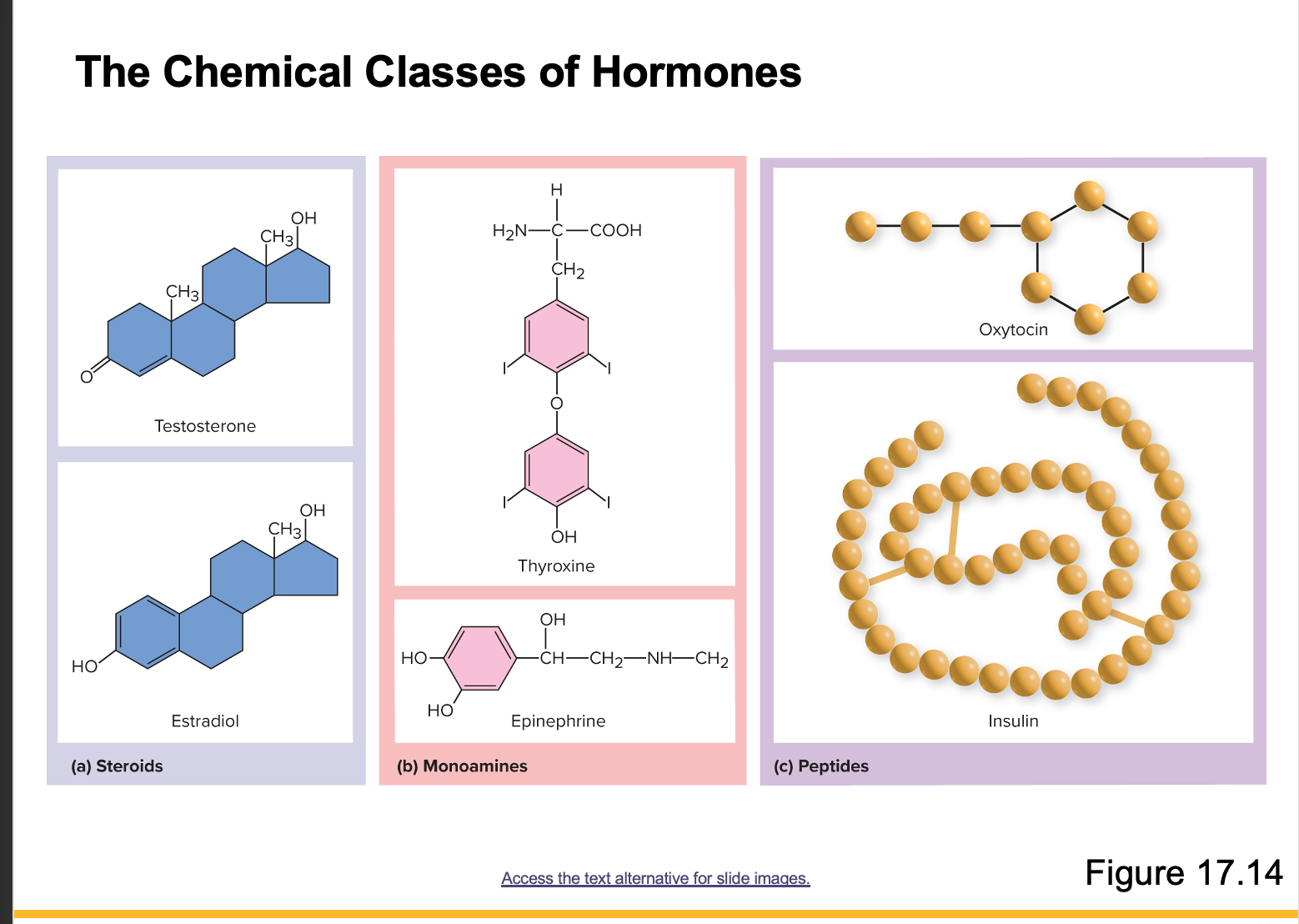
Hormones are signaling molecules produced by glands and transported by the bloodstream to target organs. They are classified based on their chemical structure, which influences their mechanism of action, solubility, and physiological effects. The three main classes are steroids, monoamines, and peptides.
Steroid Hormones
Steroid hormones are derived from cholesterol and are characterized by a four-ring carbon structure. They are lipid-soluble, allowing them to easily cross cell membranes and bind to intracellular receptors.
Testosterone: A primary male sex hormone involved in the development of male reproductive tissues and secondary sexual characteristics.
Estradiol: The main estrogen in females, essential for reproductive and sexual function.
Properties: Lipid-soluble, act on intracellular receptors, regulate gene expression.
Example: Steroid hormones regulate long-term processes such as growth, development, and reproduction.
Monoamine Hormones
Monoamines are hormones derived from amino acids such as tyrosine and tryptophan. They include catecholamines and thyroid hormones, which are generally water-soluble except for thyroid hormones.
Thyroxine (T4): A thyroid hormone that regulates metabolism, growth, and development.
Epinephrine: Also known as adrenaline, it is involved in the fight-or-flight response.
Properties: Water-soluble (except thyroid hormones), act on cell surface receptors, rapid effects.
Example: Epinephrine increases heart rate and blood pressure during stress.
Peptide Hormones
Peptide hormones are composed of chains of amino acids. They are water-soluble and act on cell surface receptors, triggering intracellular signaling cascades.
Oxytocin: A hormone involved in childbirth and lactation, as well as social bonding.
Insulin: Regulates blood glucose levels by facilitating cellular uptake of glucose.
Properties: Water-soluble, act on membrane receptors, rapid and short-lived effects.
Example: Insulin lowers blood glucose after a meal.
Comparison Table: Hormone Classes
Class | Structure | Solubility | Receptor Location | Examples |
|---|---|---|---|---|
Steroids | Four-ring carbon structure | Lipid-soluble | Intracellular | Testosterone, Estradiol |
Monoamines | Modified amino acids | Water-soluble (except thyroid hormones) | Cell surface (except thyroid hormones: intracellular) | Thyroxine, Epinephrine |
Peptides | Amino acid chains | Water-soluble | Cell surface | Oxytocin, Insulin |
Additional info: Hormone classification is fundamental to understanding endocrine system function and pharmacology. The solubility and receptor location determine how hormones are transported, their mechanism of action, and their physiological effects.
