Back
BackChemical Composition of the Body: Molecular Interactions and Organic Molecules
Study Guide - Smart Notes
 Tailored notes based on your materials, expanded with key definitions, examples, and context.
Chemical Composition of the Body
Atoms, Ions, and Chemical Bonds
Understanding the chemical principles underlying physiological processes is essential for studying human physiology. Atoms, ions, and chemical bonds form the foundation of molecular interactions in the body.
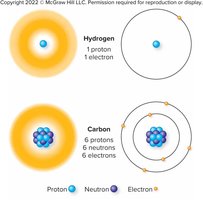
Atom: The smallest unit of an element, consisting of a nucleus (protons and neutrons) and orbiting electrons.
Atomic Mass: Equal to the number of protons plus neutrons.
Atomic Number: Equal to the number of protons.
Electron Orbitals: Energy levels (shells) surrounding the nucleus; electrons fill shells starting closest to the nucleus.
Valence Electrons: Electrons in the outermost shell; participate in chemical bonding.
Isotopes: Atoms of the same element with different numbers of neutrons; some are radioactive and used in medical testing.
Chemical Bonds
Chemical bonds are formed when electrons interact between atoms. The type of bond depends on how electrons are shared or transferred.
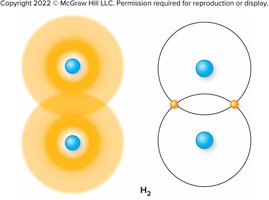
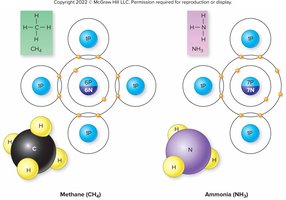
Covalent Bonds: Valence electrons are shared between atoms. If shared equally, the bond is nonpolar (e.g., H2); if shared unequally, the bond is polar (e.g., water).
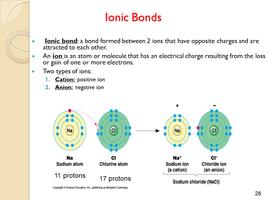
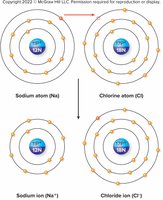
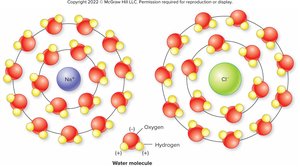
Ionic Bonds: One atom donates electrons to another, forming ions. The donor becomes a cation (positive), and the receiver becomes an anion (negative). Ionic compounds dissociate in water, forming hydration spheres.
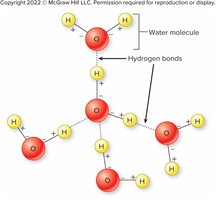
Hydrogen Bonds: Weak bonds between polar molecules, based on attraction between electropositive hydrogen and electronegative oxygen or nitrogen. Responsible for surface tension, capillarity, and protein/DNA structure.
Acids, Bases, and pH
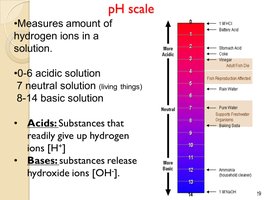
Acids and bases are defined by their ability to donate or accept protons (H+). The pH scale measures the concentration of hydrogen ions in a solution.
Acid: Proton donor; pH < 7.
Base: Proton acceptor; pH > 7.
Neutral Solution: Equal concentrations of H+ and OH-; pH = 7.
pH Scale: Ranges from 0 (strong acid) to 14 (strong base).
Buffer: Stabilizes pH; consists of a weak acid and a weak base. In blood, the bicarbonate/carbonic acid system prevents acidosis and alkalosis.

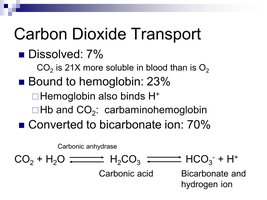
Buffer Equation:
Additional info: The lungs and kidneys also regulate blood pH by removing CO2 and adjusting bicarbonate levels.
Organic Molecules
Four Categories of Organic Molecules
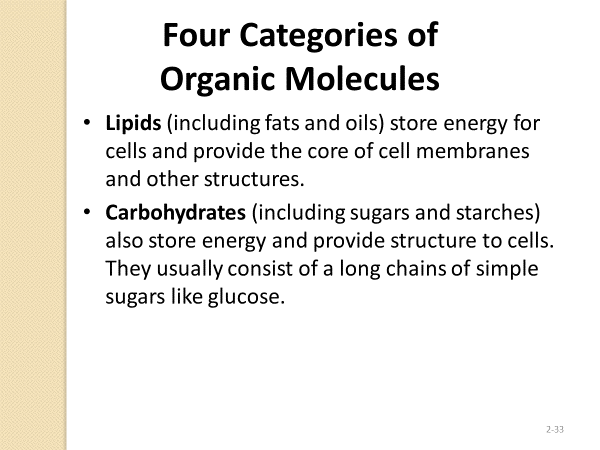
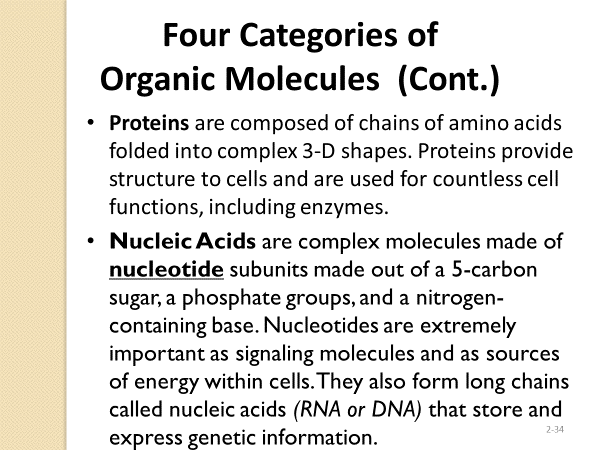
Organic molecules are essential for cellular structure and function. They are classified into four main groups:
Carbohydrates: Energy storage and structural support; composed of carbon, hydrogen, and oxygen in a 1:2:1 ratio.
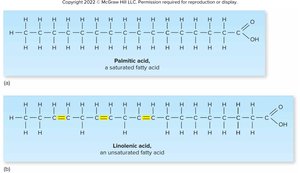
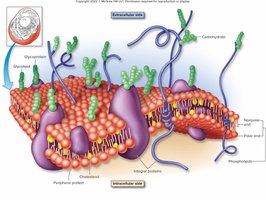
Lipids: Energy storage, membrane structure, and signaling; hydrophobic due to nonpolar hydrocarbon chains.
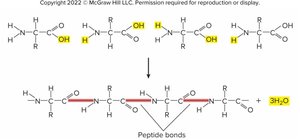
Proteins: Chains of amino acids; provide structure, catalyze reactions, and regulate cell functions.
Nucleic Acids: Chains of nucleotide subunits; store and express genetic information (DNA, RNA).
Carbohydrates
Carbohydrates are classified by the number of sugar units:
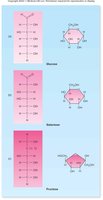
Monosaccharides: Simple sugars with one carbon ring (e.g., glucose, fructose, galactose).
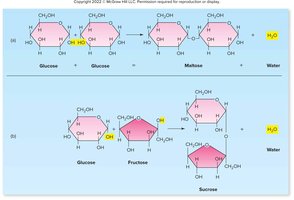
Disaccharides: Two monosaccharides joined by a covalent bond (e.g., sucrose, maltose, lactose).
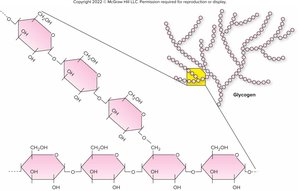
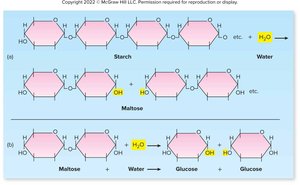
Polysaccharides: Chains of monosaccharides (e.g., starch, glycogen, cellulose, chitin).
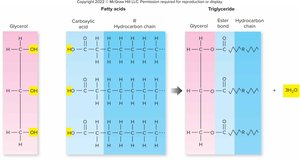
Dehydration Synthesis: Forms covalent bonds by removing water.
Hydrolysis: Breaks covalent bonds by adding water.
Lipids
Lipids are hydrophobic molecules with diverse functions:
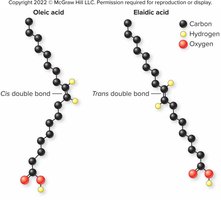
Triglycerides: Composed of glycerol and three fatty acids; can be saturated (no double bonds) or unsaturated (one or more double bonds).
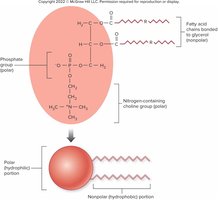
Phospholipids: Amphipathic molecules with a polar phosphate group and nonpolar fatty acid chains; major component of cell membranes.
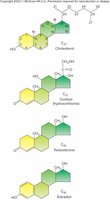
Steroids: Four-ring structure; includes cholesterol, steroid hormones, vitamin D, and bile salts.
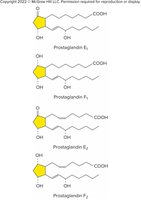
Prostaglandins: Regulatory molecules derived from fatty acids; involved in inflammation, blood clotting, and other functions.
Proteins
Proteins are polymers of amino acids, each with a unique sequence and structure:
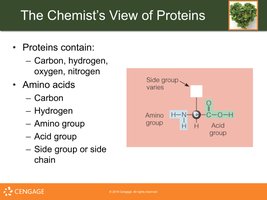
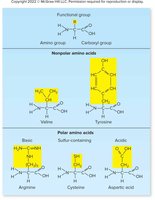
Amino Acids: Contain an amino group, carboxyl group, and variable R group; 20 types exist.
Primary Structure: Sequence of amino acids in a polypeptide chain.
Secondary Structure: Alpha helix or beta sheet formed by hydrogen bonds.
Tertiary Structure: 3D folding due to interactions between R groups; determines function.
Quaternary Structure: Multiple polypeptide chains bonded together (e.g., hemoglobin).
Conjugated Proteins: Proteins combined with other molecules (e.g., glycoproteins, lipoproteins).
Nucleic Acids
Nucleic acids are polymers of nucleotides, which consist of a five-carbon sugar, phosphate group, and nitrogenous base.
DNA: Double-stranded; contains deoxyribose sugar and four bases (adenine, thymine, cytosine, guanine). Follows the Law of Complementary Base Pairs.
RNA: Single-stranded; contains ribose sugar and uracil instead of thymine. Types include mRNA, tRNA, and rRNA.
Other Nucleotides: ATP and GTP (energy carriers), cAMP (regulation), NAD and FAD (co-enzymes).
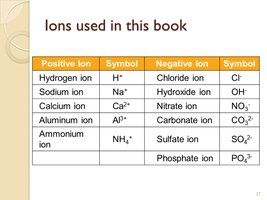
Summary Table: Common Biological Ions
Positive Ion | Symbol | Negative Ion | Symbol |
|---|---|---|---|
Hydrogen ion | H+ | Chloride ion | Cl- |
Sodium ion | Na+ | Hydroxide ion | OH- |
Calcium ion | Ca2+ | Nitrate ion | NO3- |
Aluminum ion | Al3+ | Carbonate ion | CO32- |
Ammonium ion | NH4+ | Sulfate ion | SO42- |
Phosphate ion | PO43- |
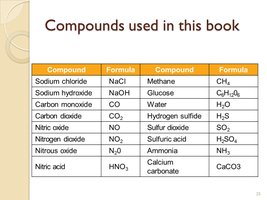
Summary Table: Common Biological Compounds
Compound | Formula | Compound | Formula |
|---|---|---|---|
Sodium chloride | NaCl | Methane | CH4 |
Sodium hydroxide | NaOH | Glucose | C6H12O6 |
Carbon monoxide | CO | Water | H2O |
Carbon dioxide | CO2 | Hydrogen sulfide | H2S |
Nitric oxide | NO | Sulfur dioxide | SO2 |
Nitrogen dioxide | NO2 | Ammonia | NH3 |
Nitrous oxide | N2O | Calcium carbonate | CaCO3 |
Nitric acid | HNO3 |