 Back
BackChemical Context of Life: Foundations for Anatomy & Physiology
Study Guide - Smart Notes
 Tailored notes based on your materials, expanded with key definitions, examples, and context.
The Chemical Context of Life
Introduction
The study of anatomy and physiology requires a foundational understanding of chemistry, as all biological structures and functions are governed by chemical principles. This chapter explores the nature of matter, elements, atomic structure, and chemical bonding, which are essential for understanding cellular and physiological processes.
Concept 2.1: Matter, Elements, and Compounds
Definition and Properties
Matter is anything that takes up space and has mass.
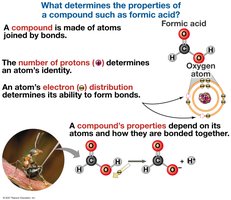
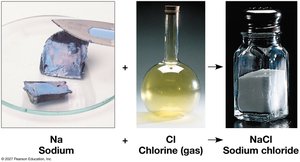
Element: A substance that cannot be broken down into other substances by chemical reactions.
Compound: A substance consisting of two or more elements in a fixed ratio, with properties different from its constituent elements.
Emergent properties arise when elements combine to form compounds, resulting in new characteristics.
The Elements of Life
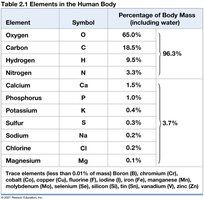
Of the 92 natural elements, about 20–25% are essential for life.
Carbon, hydrogen, oxygen, and nitrogen make up 96% of living matter.
The remaining 4% includes calcium, phosphorus, potassium, and sulfur.
Trace elements are required in minute quantities for proper physiological function.
Element | Symbol | Percentage of Body Mass |
|---|---|---|
Oxygen | O | 65.0% |
Carbon | C | 18.5% |
Hydrogen | H | 9.5% |
Nitrogen | N | 3.3% |
Calcium | Ca | 1.5% |
Phosphorus | P | 1.0% |
Potassium | K | 0.4% |
Sulfur | S | 0.3% |
Sodium | Na | 0.2% |
Chlorine | Cl | 0.2% |
Magnesium | Mg | 0.1% |
Adaptation to Toxic Elements
Some elements are toxic, but certain species adapt to environments containing these elements.
Example: Plant communities adapted to serpentine soil, which contains toxic metals.

Concept 2.2: Atomic Structure and Properties
Atoms and Subatomic Particles
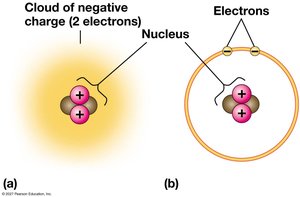
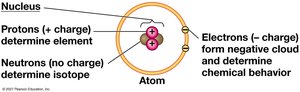
Atom: The smallest unit of matter retaining the properties of an element.
Subatomic particles: Protons (positive charge), Neutrons (no charge), Electrons (negative charge).
Protons and neutrons form the nucleus; electrons form a cloud around the nucleus.
Mass of protons and neutrons is nearly identical and measured in daltons.
Atomic Number, Mass Number, and Isotopes
Atomic number: Number of protons in the nucleus.
Mass number: Sum of protons and neutrons.
Isotopes: Atoms of the same element with different numbers of neutrons.
Radioactive isotopes: Unstable isotopes that decay, emitting energy and particles.
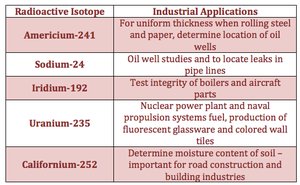
Applications of Radioactive Isotopes
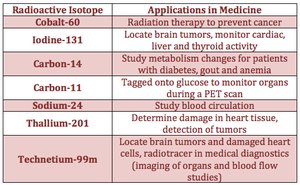
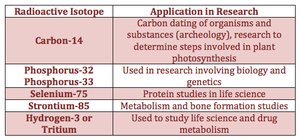
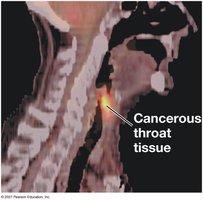
Used in medicine (diagnostic imaging, PET scans), industry, and research.
Radioactive Isotope | Industrial Applications |
|---|---|
Americium-241 | Uniform thickness, oil wells |
Sodium-24 | Oil well studies, leak detection |
Iridium-192 | Boiler and aircraft part integrity |
Uranium-235 | Nuclear fuel, glassware, wall tiles |
Californium-252 | Soil moisture content |
Radioactive Isotope | Applications in Medicine |
|---|---|
Cobalt-60 | Radiation therapy |
Iodine-131 | Brain tumor location, thyroid activity |
Carbon-14 | Metabolism studies |
Carbon-11 | PET scan glucose monitoring |
Sodium-24 | Blood circulation studies |
Thallium-201 | Heart tissue damage detection |
Technetium-99m | Heart cell imaging, diagnostics |
Radioactive Isotope | Application in Research |
|---|---|
Carbon-14 | Carbon dating, photosynthesis research |
Phosphorus-32, Phosphorus-33 | Biology and genetics research |
Selenium-75 | Protein studies |
Strontium-85 | Metabolism, bone formation |
Hydrogen-3 (Tritium) | Life science, drug metabolism |
Radiometric Dating
Uses the decay rate (half-life) of radioactive isotopes to date fossils and rocks.
Half-life: Time required for half the atoms of a radioactive isotope to decay.
Concept 2.2: Energy Levels of Electrons
Potential Energy and Electron Shells
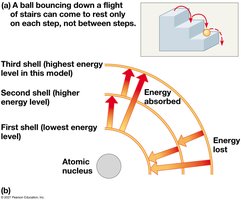
Energy: Capacity to cause change.
Potential energy: Energy due to location or structure.
Electrons have different potential energies based on their distance from the nucleus.
Electrons occupy discrete energy levels called shells.
Electron Distribution and Chemical Properties
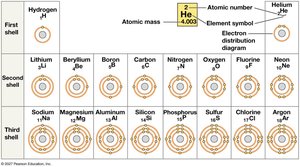
The arrangement of electrons in shells determines an atom's chemical behavior.
Valence electrons in the outermost shell are most important for chemical reactions.
Elements with full valence shells are chemically inert.
Electron Orbitals
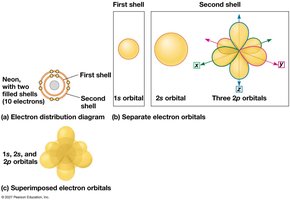
An orbital is a three-dimensional region where an electron is likely found.
Each shell contains a specific number of orbitals; each orbital holds up to two electrons.
Concept 2.3: Chemical Bonding
Covalent Bonds
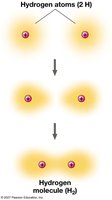
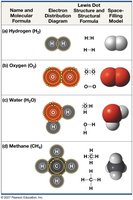
Covalent bond: Sharing of a pair of valence electrons between atoms.
Single bond: One pair shared; double bond: Two pairs shared.
Bonding capacity is called valence.
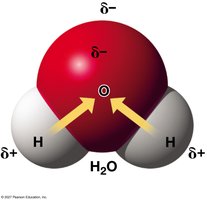
Electronegativity: Atom's ability to attract electrons in a bond.
Nonpolar covalent bond: Equal sharing; polar covalent bond: Unequal sharing, resulting in partial charges.
Ionic Bonds
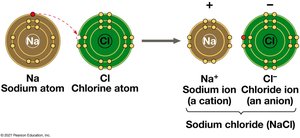
Formed when electrons are transferred from one atom to another, creating ions.
Cation: Positively charged ion; Anion: Negatively charged ion.
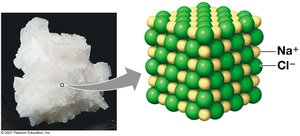
Ionic bond: Attraction between cation and anion.
Ionic compounds (salts) are stable when dry, but dissociate in water.
Weak Chemical Interactions
Weak bonds (hydrogen bonds, van der Waals interactions) stabilize large biological molecules.
Hydrogen bonds: Attraction between hydrogen atom and electronegative atom (usually O or N).
Van der Waals interactions: Weak attractions due to transient charge differences.
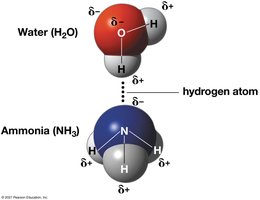

Molecular Shape and Function
Shape Determines Function
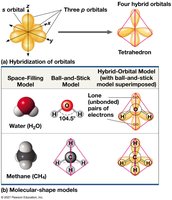
Molecular shape is determined by the positions of atom orbitals.
Hybridization of orbitals creates specific shapes (e.g., tetrahedral).
Shape is critical for biological recognition and response (e.g., drug-receptor interactions).
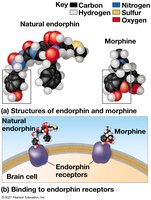
Concept 2.4: Chemical Reactions
Making and Breaking Bonds
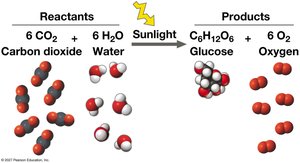
Chemical reactions involve the making and breaking of chemical bonds.
Reactants: Starting molecules; Products: Resulting molecules.
All reactions are reversible; equilibrium is reached when forward and reverse rates are equal.
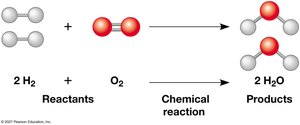
Summary of Key Concepts
An element’s properties depend on atomic structure (protons, neutrons, electrons).
Molecules and compounds form through chemical bonding (covalent, ionic, weak interactions).
Molecular shape is essential for biological function.
Chemical reactions are fundamental to life processes.

Equations and Formulas
Photosynthesis:
Water formation:
Additional info: This chapter provides essential chemical principles for understanding cell chemistry, energy, and molecular interactions, which are foundational for anatomy and physiology.
