 Back
Chemical Principles in Microbiology: Foundations for Anatomy & Physiology
Study Guide - Smart Notes
 Tailored notes based on your materials, expanded with key definitions, examples, and context.
Chemical Principles in Microbiology
Introduction
Chemical principles are fundamental to understanding the structure and function of living organisms, including microbes. These principles explain how atoms combine to form molecules, how chemical bonds are formed and broken, and how these processes underpin metabolism and physiology. Mastery of these concepts is essential for students of anatomy and physiology, as they provide the molecular basis for cellular structure, function, and disease processes.
Atoms, Elements, Ions, and Isotopes
Atoms
An atom is the smallest unit of matter that retains the properties of an element. Atoms are composed of three types of subatomic particles:
Protons (p+): Positively charged particles located in the nucleus.
Neutrons (n0): Uncharged particles also found in the nucleus.
Electrons (e-): Negatively charged particles that orbit the nucleus in electron shells.
Atoms are electrically neutral when the number of protons equals the number of electrons.

Elements
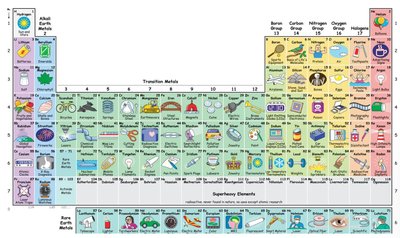
An element is a pure substance consisting of only one type of atom, defined by its atomic number (the number of protons in its nucleus). The Periodic Table of Elements organizes all known elements by their properties and atomic numbers.
Isotopes
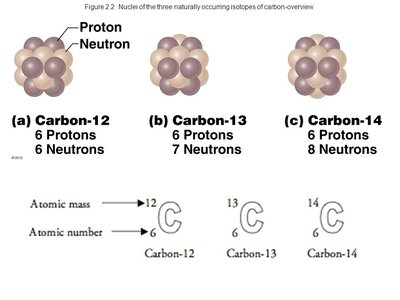
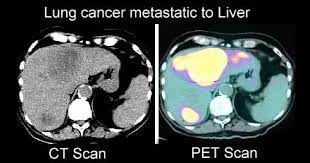
Isotopes are variants of a particular chemical element that have the same number of protons and electrons but different numbers of neutrons, resulting in different atomic masses. Some isotopes are radioactive (unstable) and can emit particles or energy to become more stable. Radioactive isotopes are used in medical diagnostics, such as PET scans for cancer detection.
Electron Configuration and Valence Electrons
Electron Configuration
The electron configuration describes the arrangement of electrons in an atom's electron shells. The outermost shell contains the valence electrons, which are involved in forming chemical bonds. Atoms tend to gain, lose, or share electrons to achieve a full outer shell, leading to chemical stability.
Chemical Bonds
Ionic Bonds
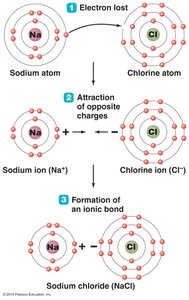
Ionic bonds form when one atom donates electrons to another, resulting in the formation of oppositely charged ions that attract each other. For example, sodium (Na) loses an electron to become Na+, while chlorine (Cl) gains an electron to become Cl-, forming sodium chloride (NaCl).
Covalent Bonds
Covalent bonds occur when two atoms share one or more pairs of electrons. These are the strongest type of chemical bond and are common in organic molecules. For example, two hydrogen atoms share electrons to form H2, and carbon forms four covalent bonds in methane (CH4).

Hydrogen Bonds
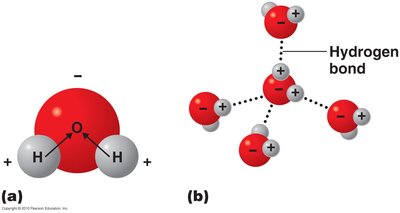
Hydrogen bonds are weak attractions between a hydrogen atom covalently bonded to a highly electronegative atom (such as oxygen or nitrogen) and another electronegative atom. These bonds are crucial for the properties of water and the structure of biological macromolecules.
Chemical Reactions
Types of Chemical Reactions
Chemical reactions involve the making or breaking of bonds between atoms. The three main types are:
Synthesis Reactions: Two or more atoms or molecules combine to form a larger molecule. These reactions are endergonic (require energy input) and often involve dehydration synthesis (removal of water to form a bond).
Decomposition Reactions: A molecule is broken down into smaller components. These reactions are exergonic (release energy) and often involve hydrolysis (addition of water to break a bond).
Exchange Reactions: Bonds are both broken and formed, resulting in the exchange of components between molecules.
Anabolism and Catabolism
Anabolism refers to all synthesis reactions in living organisms, building complex molecules from simpler ones (e.g., amino acids forming proteins). Catabolism refers to all decomposition reactions, breaking down complex molecules into simpler ones (e.g., digestion of starch into glucose). Together, these processes constitute metabolism.
Examples and Applications
Dehydration Synthesis: Formation of a peptide bond between amino acids, releasing water.
Hydrolysis: Digestion of carbohydrates into simple sugars by adding water.
Exchange Reaction: Neutralization of an acid by a base, forming water and a salt.
Summary Table: Types of Chemical Bonds
Bond Type | How Formed | Relative Strength | Example |
|---|---|---|---|
Ionic | Transfer of electrons | Intermediate | NaCl (table salt) |
Covalent | Sharing of electrons | Strongest | H2O (water), CH4 (methane) |
Hydrogen | Attraction between polar molecules | Weakest | Between water molecules |
Key Equations
Synthesis Reaction:
Decomposition Reaction:
Exchange Reaction:
Dehydration Synthesis:
Hydrolysis:
Conclusion
Understanding chemical principles is essential for grasping the molecular basis of anatomy and physiology. These concepts explain how atoms and molecules interact to form the structures and carry out the functions necessary for life, including metabolism, cellular structure, and the mechanisms of disease and medical diagnostics.
