 Back
Chemistry Comes Alive: Biochemistry for Anatomy & Physiology
Study Guide - Smart Notes
 Tailored notes based on your materials, expanded with key definitions, examples, and context.
Biochemistry: The Chemical Basis of Life
Introduction to Biochemistry
Biochemistry is the study of the chemical composition and reactions that occur in living matter. All chemicals in the body are classified as either organic or inorganic compounds. Both types are essential for life and play distinct roles in cellular structure and function.
Inorganic compounds: Include water, salts, acids, and bases; generally do not contain carbon.
Organic compounds: Include carbohydrates, lipids, proteins, and nucleic acids; always contain carbon and are usually large, covalently bonded molecules.
Inorganic Compounds
Water
Water is the most abundant inorganic compound in the body, making up 60–80% of the volume of living cells. Its unique properties make it vital for life.
High heat capacity: Absorbs and releases heat with little temperature change, preventing sudden temperature fluctuations.
High heat of vaporization: Requires significant energy to evaporate, providing an effective cooling mechanism (e.g., sweating).
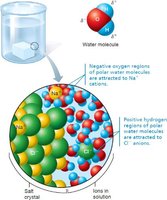
Polar solvent properties: Dissolves and dissociates ionic substances, forms hydration layers around large molecules, and serves as the body's major transport medium.
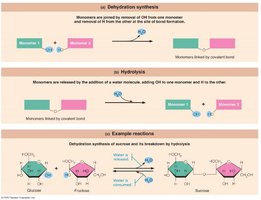
Reactivity: Participates in hydrolysis and dehydration synthesis reactions.
Cushioning: Protects organs from physical trauma (e.g., cerebrospinal fluid cushions the brain).
Salts
Salts are ionic compounds that dissociate into cations and anions in water (excluding H+ and OH−). All ions are called electrolytes because they conduct electrical currents in solution. Ionic balance is vital for homeostasis.
Common body salts: NaCl, CaCO3, KCl, calcium phosphates.
Important ions: sodium, potassium, calcium, iron.
Acids and Bases
Acids and bases are electrolytes that ionize and dissociate in water.
Acids: Proton donors; release H+ ions (e.g., HCl, acetic acid, carbonic acid).
Bases: Proton acceptors; release OH− ions (e.g., bicarbonate, ammonia).
pH: Acid-Base Concentration
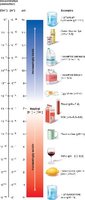
The pH scale measures the concentration of hydrogen ions in a solution, ranging from 0 (most acidic) to 14 (most basic). Each pH unit represents a tenfold difference in H+ concentration.
Acidic solutions: pH 0–6.99 (high [H+])
Neutral solutions: pH 7 (equal [H+] and [OH−])
Alkaline (basic) solutions: pH 7.01–14 (low [H+])
Neutralization and Buffers
Neutralization: Mixing acids and bases forms water and a salt.
Buffers: Resist abrupt changes in pH by releasing or binding H+ ions. The carbonic acid–bicarbonate system is a key buffer in blood.
Clinical Note: Enzymes function within a narrow pH range; arterial pH below 7.0 is life-threatening.
Organic Compounds
Synthesis and Hydrolysis
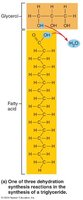
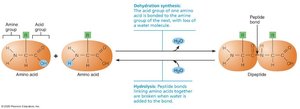
Organic compounds are often polymers, chains of similar units called monomers. They are synthesized by dehydration synthesis (removal of water to form bonds) and broken down by hydrolysis (addition of water to break bonds).
Carbohydrates
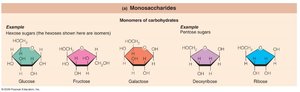
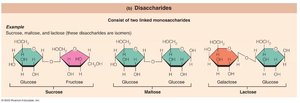
Carbohydrates include sugars and starches, containing carbon, hydrogen, and oxygen (H:O ratio is 2:1). They are classified by size and solubility:
Monosaccharides: Simple sugars (e.g., glucose, fructose, galactose, ribose, deoxyribose).
Disaccharides: Double sugars (e.g., sucrose, maltose, lactose); formed by dehydration synthesis of two monosaccharides.
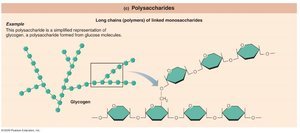
Polysaccharides: Long chains of monosaccharides (e.g., starch in plants, glycogen in animals); ideal for storage, not very soluble.
Lipids
Lipids are hydrophobic molecules containing C, H, O (less O than carbohydrates), and sometimes P. Main types include triglycerides, phospholipids, steroids, and eicosanoids.
Triglycerides
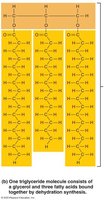
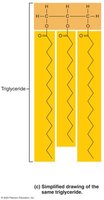
Composed of three fatty acids bonded to a glycerol molecule by dehydration synthesis. Main functions: energy storage, insulation, and protection.
Saturated vs. Unsaturated Fatty Acids
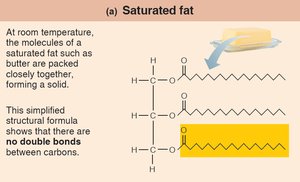
Saturated fatty acids: Only single bonds between carbons; solid at room temperature (e.g., animal fats, butter).
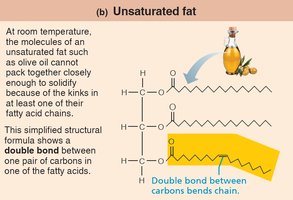
Unsaturated fatty acids: One or more double bonds; liquid at room temperature (e.g., plant oils).
Trans fats: Unhealthy, artificially modified unsaturated fats.
Omega-3 fatty acids: Heart-healthy polyunsaturated fats.
Phospholipids
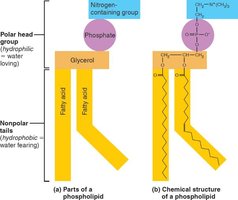
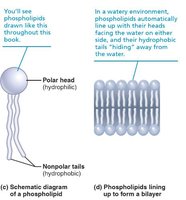
Modified triglycerides with a glycerol, two fatty acids, and a phosphate group. They have a polar, hydrophilic head and nonpolar, hydrophobic tails, making them essential for cell membrane structure.
Steroids
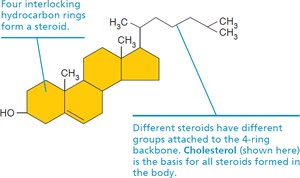
Steroids have four interlocking hydrocarbon rings. Cholesterol is the most important steroid, serving as a precursor for vitamin D, steroid hormones, and bile salts, and is a component of cell membranes.
Eicosanoids
Derived from arachidonic acid, eicosanoids (e.g., prostaglandins) are involved in blood clotting, inflammation, and other regulatory functions. NSAIDs block their inflammatory actions.
Proteins
Structure and Function
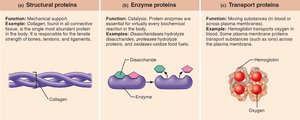
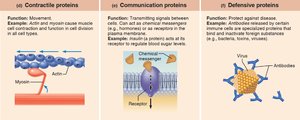
Proteins make up 20–30% of cell mass and perform a wide variety of functions, including structural support, catalysis, movement, and defense. They are polymers of amino acids joined by peptide bonds.
Amino Acids and Peptide Bonds
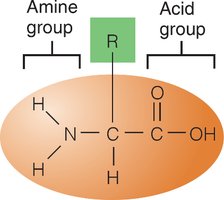
There are 20 different amino acids, each with an amine group, acid group, and a unique "R group." Peptide bonds form between amino acids via dehydration synthesis.
Levels of Protein Structure
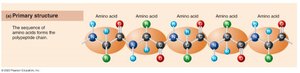
Primary: Linear sequence of amino acids.
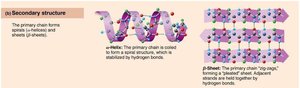
Secondary: Alpha helices and beta sheets formed by hydrogen bonding.
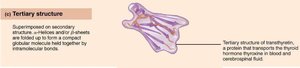
Tertiary: 3D folding due to interactions among R groups.
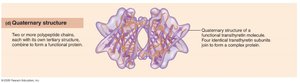
Quaternary: Association of two or more polypeptide chains.
Fibrous vs. Globular Proteins
Fibrous proteins: Structural, water-insoluble, stable (e.g., collagen, keratin).
Globular proteins: Functional, water-soluble, sensitive to environmental changes (e.g., enzymes, antibodies).
Protein Denaturation
Denaturation is the loss of a protein's functional shape due to changes in pH or temperature. It is usually reversible unless the changes are extreme.
Enzymes and Enzyme Activity
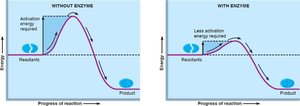
Enzymes are globular proteins that act as biological catalysts, speeding up reactions by lowering activation energy. Most enzymes are holoenzymes, consisting of an apoenzyme and a cofactor or coenzyme.
Enzymes are specific for their substrates.
Names often end in –ase (e.g., hydrolase, oxidase).
Mechanism of Enzyme Action
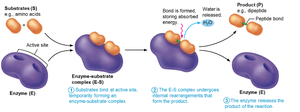
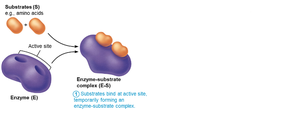
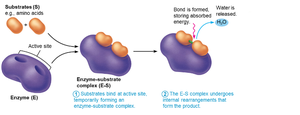
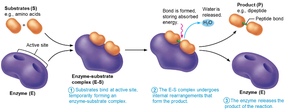
Substrate binds to enzyme's active site, forming an enzyme-substrate complex.
The complex undergoes rearrangement, forming the product.
The product is released, and the enzyme is free to catalyze another reaction.
Nucleic Acids
Structure and Function
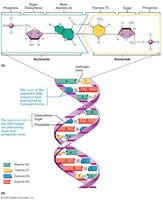
Nucleic acids (DNA and RNA) are the largest molecules in the body, composed of nucleotides (nitrogen base, pentose sugar, phosphate group). DNA stores genetic information; RNA is involved in protein synthesis.
DNA: Double helix, located in the nucleus, bases: adenine (A), guanine (G), cytosine (C), thymine (T).
RNA: Single-stranded, bases: adenine (A), guanine (G), cytosine (C), uracil (U).
ATP: The Energy Currency of the Cell
Structure and Function
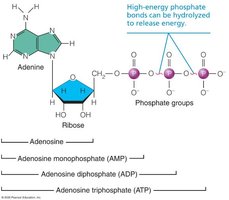
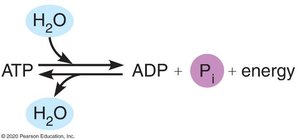
ATP (adenosine triphosphate) stores and provides energy for cellular work. It consists of an adenine-containing RNA nucleotide with two additional phosphate groups. Hydrolysis of ATP releases energy by removing phosphate groups, converting ATP to ADP or AMP.
Cellular Work Driven by ATP
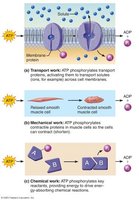
Transport work: ATP phosphorylates transport proteins, enabling movement across membranes.
Mechanical work: ATP phosphorylates contractile proteins in muscle cells.
Chemical work: ATP phosphorylates key reactants, providing energy for chemical reactions.
Additional info: The chemical equation for ATP hydrolysis is:
