 Back
Chemistry Comes Alive: Biochemistry for Human Anatomy & Physiology
Study Guide - Smart Notes
 Tailored notes based on your materials, expanded with key definitions, examples, and context.
Part 2 – Biochemistry
Introduction to Biochemistry
Biochemistry is the study of the chemical composition and reactions of living matter. All chemicals in the body are classified as either organic or inorganic compounds. Both types are essential for life and play critical roles in physiological processes.
Inorganic compounds: Include water, salts, acids, and bases; generally do not contain carbon.
Organic compounds: Include carbohydrates, lipids, proteins, and nucleic acids; always contain carbon and are usually large, covalently bonded molecules.
2.6 Inorganic Compounds
Water
Water is the most abundant inorganic compound in the body, accounting for 60%–80% of the volume of living cells. Its unique properties make it vital for life.
High heat capacity: Absorbs and releases heat with little temperature change, preventing sudden temperature shifts.
High heat of vaporization: Requires significant energy to evaporate, providing an effective cooling mechanism.
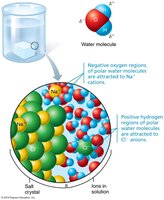
Polar solvent properties: Dissolves and dissociates ionic substances, forms hydration layers around large molecules, and serves as the body's major transport medium.
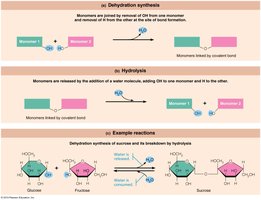
Reactivity: Participates in hydrolysis and dehydration synthesis reactions.
Cushioning: Protects organs from physical trauma (e.g., cerebrospinal fluid cushions the nervous system).
Salts
Salts are ionic compounds that dissociate into cations and anions in water (excluding H+ and OH–). All ions are called electrolytes because they conduct electrical currents in solution. Ionic balance is vital for homeostasis.
Examples: NaCl, CaCO3, KCl, calcium phosphates.
Roles: Sodium, potassium, calcium, and iron ions are essential for nerve impulse transmission, muscle contraction, and other physiological functions.
Acids and Bases
Acids and bases are electrolytes that ionize and dissociate in water.
Acids: Proton donors; release H+ ions in solution. Examples: HCl, acetic acid (HAc), H2CO3.
Bases: Proton acceptors; pick up H+ ions or release OH– ions. Examples: Bicarbonate (HCO3–), ammonia (NH3).
pH: Acid-Base Concentration
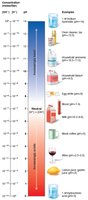
The pH scale measures the concentration of hydrogen ions [H+] in a solution, ranging from 0 (most acidic) to 14 (most basic). Each pH unit represents a tenfold difference in [H+].
Acidic solutions: pH 0–6.99, high [H+].
Neutral solutions: pH 7, equal [H+] and [OH–].
Alkaline (basic) solutions: pH 7.01–14, low [H+].
Neutralization: When acids and bases are mixed, they form water and a salt via displacement reactions.
Buffers: Systems that resist abrupt changes in pH by releasing or binding H+ ions. The carbonic acid–bicarbonate system is a key buffer in blood.
2.7 Organic Compounds: Synthesis and Hydrolysis
Polymers and Reactions
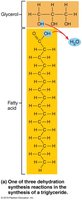
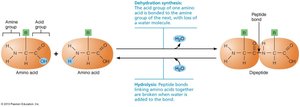
Many organic compounds are polymers, chains of similar units called monomers. They are synthesized by dehydration synthesis (removal of water) and broken down by hydrolysis (addition of water).
2.8 Carbohydrates
Overview
Carbohydrates include sugars and starches, containing carbon, hydrogen, and oxygen (H:O ratio is 2:1). They are classified as monosaccharides, disaccharides, or polysaccharides.
Monosaccharides: Simple sugars (3–7 carbons). Examples: Glucose, fructose, galactose, ribose, deoxyribose.
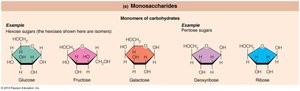
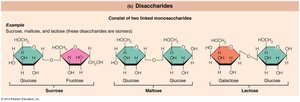
Disaccharides: Double sugars, formed by dehydration synthesis of two monosaccharides. Examples: Sucrose, maltose, lactose.
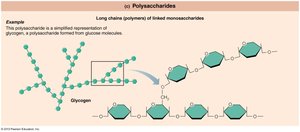
Polysaccharides: Long chains of monosaccharides. Examples: Starch (plants), glycogen (animals). Not very soluble in water.
2.9 Lipids
Overview
Lipids are hydrophobic molecules containing C, H, and O (sometimes P). Main types include triglycerides, phospholipids, steroids, and eicosanoids.
Triglycerides
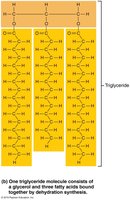
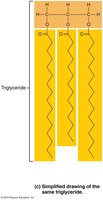
Composed of three fatty acids bonded to a glycerol molecule. Main functions: energy storage, insulation, and protection.
Saturated vs. Unsaturated Fatty Acids
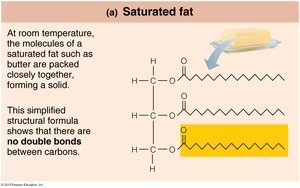
Saturated fatty acids: Only single bonds between carbons; solid at room temperature (e.g., butter).
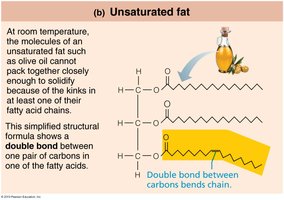
Unsaturated fatty acids: One or more double bonds; liquid at room temperature (e.g., olive oil). Includes trans fats and omega-3 fatty acids.
Phospholipids
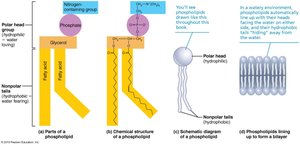
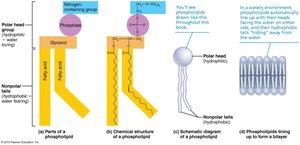
Modified triglycerides with a phosphate group. They have a polar, hydrophilic head and nonpolar, hydrophobic tails, making them essential for cell membrane structure.
Steroids
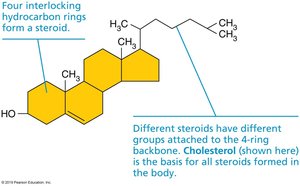
Steroids have four interlocking hydrocarbon rings. Cholesterol is the most important steroid, serving as a precursor for vitamin D, steroid hormones, and bile salts.
Eicosanoids
Derived from arachidonic acid, eicosanoids (e.g., prostaglandins) are involved in blood clotting, inflammation, and other processes. NSAIDs block their inflammatory actions.
2.10 Proteins
Overview
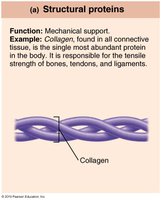
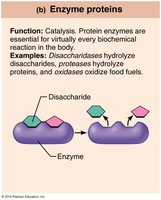
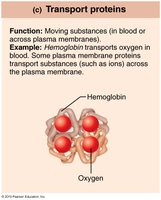
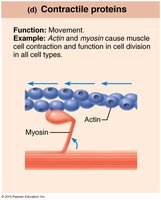
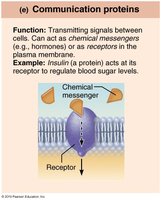
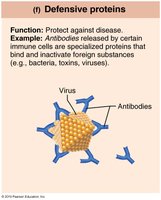
Proteins make up 20–30% of cell mass and have diverse functions, including structural support, catalysis, transport, movement, communication, and defense. They are polymers of amino acids joined by peptide bonds.
Amino Acids and Peptide Bonds
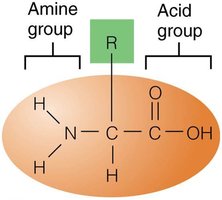
All proteins are made from 20 amino acids, each with an amine group, acid group, and unique R group. Peptide bonds form between amino acids via dehydration synthesis.
Structural Levels of Proteins
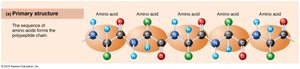
Primary: Linear sequence of amino acids.
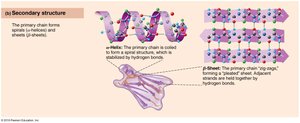
Secondary: Alpha helices and beta sheets formed by hydrogen bonding.
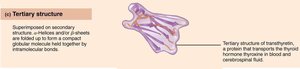
Tertiary: 3D folding due to interactions among R groups.
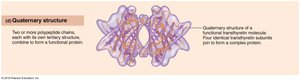
Quaternary: Arrangement of multiple polypeptide chains.
Fibrous and Globular Proteins
Fibrous proteins: Structural, water-insoluble, stable (e.g., collagen, keratin).
Globular proteins: Functional, water-soluble, sensitive to environmental changes (e.g., enzymes, antibodies).
Protein Denaturation
Denaturation is the loss of a protein's functional shape due to changes in pH or temperature. It is usually reversible unless the changes are extreme.
Enzymes and Enzyme Activity
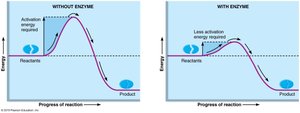
Enzymes are globular proteins that act as biological catalysts, lowering the activation energy of reactions. Most enzymes are holoenzymes (protein + cofactor/coenzyme). Enzyme names often end in –ase.
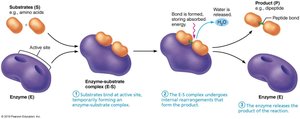
Mechanism of Enzyme Action
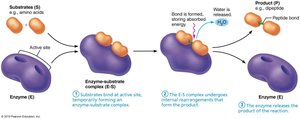
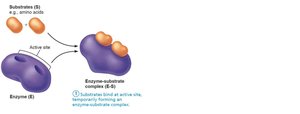
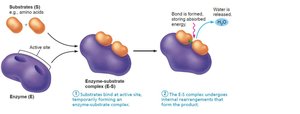
Substrate binds to enzyme's active site, forming an enzyme-substrate complex.
Complex undergoes rearrangement, forming the product.
Product is released from the enzyme.
2.11 Nucleic Acids
Overview
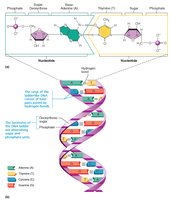
Nucleic acids (DNA and RNA) are the largest molecules in the body, composed of nucleotides (nitrogen base, pentose sugar, phosphate group).
DNA: Double-stranded helix in the nucleus; stores genetic information. Bases: adenine (A), guanine (G), cytosine (C), thymine (T). A pairs with T, G pairs with C.
RNA: Single-stranded, active outside the nucleus; bases include uracil (U) instead of thymine. Types: mRNA, tRNA, rRNA.
2.12 ATP (Adenosine Triphosphate)
Overview
ATP is the primary energy currency of the cell, capturing chemical energy released from glucose breakdown. It consists of an adenine-containing RNA nucleotide with two additional phosphate groups.
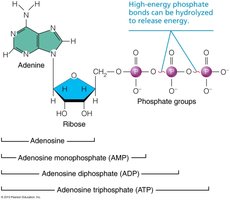
ATP Hydrolysis and Cellular Work
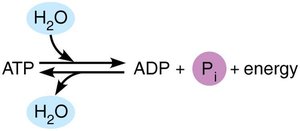
The terminal phosphate group of ATP can be transferred to other compounds, releasing energy for cellular work. Hydrolysis of ATP forms ADP and inorganic phosphate, releasing energy:
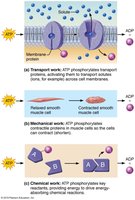
Examples of Cellular Work Driven by ATP
Transport work: ATP phosphorylates transport proteins, enabling solute movement across membranes.
Mechanical work: ATP phosphorylates contractile proteins in muscle cells.
Chemical work: ATP provides energy for chemical reactions.
Additional info: This summary covers the essential biochemical concepts foundational to understanding human anatomy and physiology, including the structure and function of water, salts, acids, bases, carbohydrates, lipids, proteins, nucleic acids, and ATP.
