Back
BackChemistry Comes Alive: Biochemistry for Human Anatomy & Physiology
Study Guide - Smart Notes
 Tailored notes based on your materials, expanded with key definitions, examples, and context.
Part 2 – Biochemistry
Introduction to Biochemistry
Biochemistry is the study of the chemical composition and reactions of living matter. All chemicals in the body are classified as either organic or inorganic compounds. Both types are essential for life and play critical roles in physiological processes.
Inorganic compounds: Water, salts, acids, and bases; generally do not contain carbon.
Organic compounds: Carbohydrates, lipids, proteins, and nucleic acids; always contain carbon, are usually large, and are covalently bonded.
2.6 Inorganic Compounds
Water
Water is the most abundant inorganic compound in the body, accounting for 60–80% of the volume of living cells. Its unique properties make it vital for life:
High heat capacity: Absorbs and releases heat with little temperature change, preventing sudden temperature fluctuations.
High heat of vaporization: Requires significant energy to evaporate, providing an effective cooling mechanism.
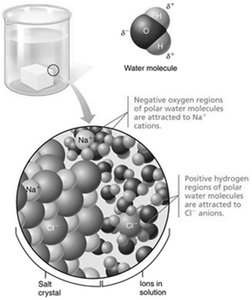
Polar solvent properties: Dissolves and dissociates ionic substances, forms hydration layers around large molecules, and serves as the body's major transport medium.
Reactivity: Participates in hydrolysis and dehydration synthesis reactions.
Cushioning: Protects organs from physical trauma (e.g., cerebrospinal fluid cushions the nervous system).
Salts
Salts are ionic compounds that dissociate into cations and anions (excluding H+ and OH–) in water. All ions are called electrolytes because they conduct electrical currents in solution. Ions such as sodium, potassium, calcium, and iron play specialized roles in body functions, and ionic balance is vital for homeostasis.
Common salts in the body: NaCl, CaCO3, KCl, calcium phosphates.
Acids and Bases
Acids and bases are electrolytes that ionize and dissociate in water:
Acids: Proton donors; release H+ ions in solution (e.g., HCl, acetic acid, carbonic acid).
Bases: Proton acceptors; pick up H+ ions or release OH– ions (e.g., bicarbonate, ammonia).
pH: Acid-Base Concentration
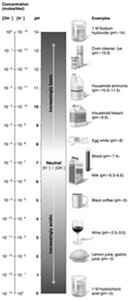
The pH scale measures the concentration of hydrogen ions [H+] in a solution, ranging from 0 (most acidic) to 14 (most basic). The scale is logarithmic; each unit represents a tenfold difference in [H+].
Acidic solutions: High [H+], low pH (0–6.99).
Neutral solutions: Equal H+ and OH– (pH 7; pure water).
Alkaline (basic) solutions: Low [H+], high pH (7.01–14).
Buffers
Buffers resist abrupt changes in pH by releasing H+ if pH rises or binding H+ if pH falls. They convert strong acids or bases into weak ones. The carbonic acid–bicarbonate system is an important buffer in blood.
2.7 Organic Compounds: Synthesis and Hydrolysis
Organic Molecules
Organic molecules contain carbon (except CO2 and CO). Carbon forms four covalent bonds, making it uniquely suited for building large, complex molecules. Major organic compounds include carbohydrates, lipids, proteins, and nucleic acids.
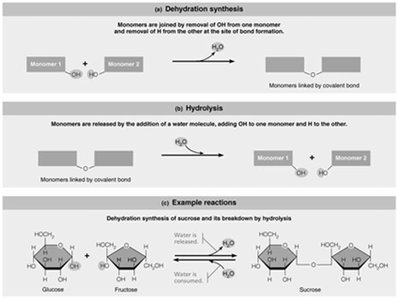
Many are polymers: chains of similar units called monomers.
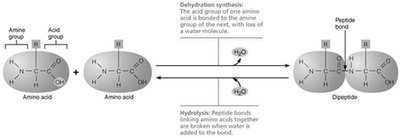
Synthesized by dehydration synthesis (removal of water to form bonds).
Broken down by hydrolysis (addition of water to break bonds).
2.8 Carbohydrates
Overview
Carbohydrates include sugars and starches, containing C, H, and O (H:O ratio is 2:1). They are classified into three groups:
Monosaccharides: Single sugars; monomers of carbohydrates.
Disaccharides: Two sugars joined together.
Polysaccharides: Many sugars; polymers of monosaccharides.
Monosaccharides
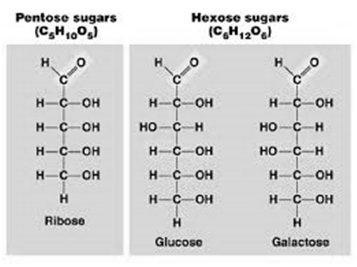
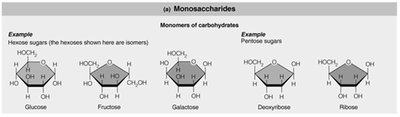
Simple sugars with three to seven carbon atoms. General formula: (CH2O)n. Important monosaccharides include pentose sugars (ribose, deoxyribose) and hexose sugars (glucose).
Disaccharides
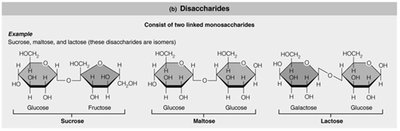
Formed by dehydration synthesis of two monosaccharides. Important examples: sucrose, maltose, lactose. Disaccharides are too large to pass through cell membranes.
Polysaccharides
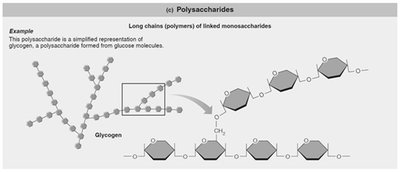
Polymers of monosaccharides formed by dehydration synthesis. Important polysaccharides include starch (plants) and glycogen (animals). Polysaccharides are not very soluble.
2.9 Lipids
Overview
Lipids contain C, H, and O (less O than carbohydrates) and sometimes P. They are insoluble in water and include triglycerides, phospholipids, steroids, and eicosanoids.
Triglycerides
Composed of three fatty acids bonded to a glycerol molecule by dehydration synthesis. Main functions: energy storage, insulation, and protection.
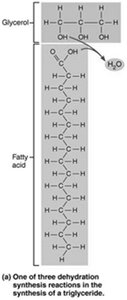
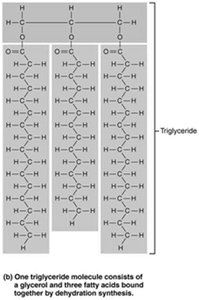
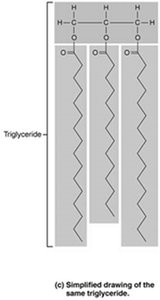
Saturated and Unsaturated Fatty Acids
Saturated fatty acids: All carbons linked by single bonds; solid at room temperature (e.g., animal fats, butter).
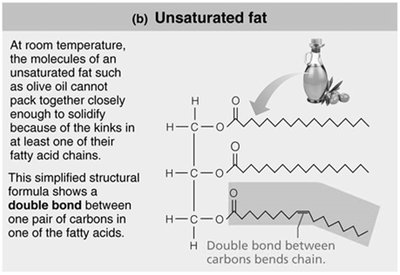
Unsaturated fatty acids: One or more double bonds; liquid at room temperature (e.g., plant oils). Includes trans fats (unhealthy) and omega-3 fatty acids (heart healthy).
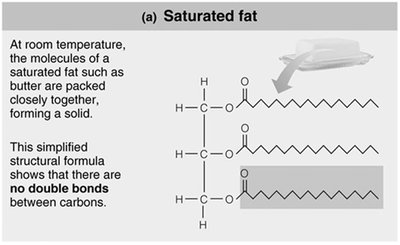
Phospholipids
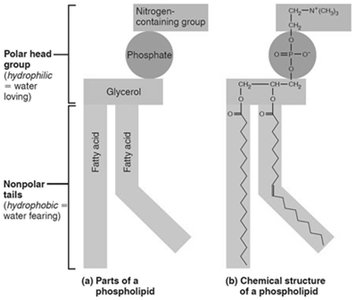
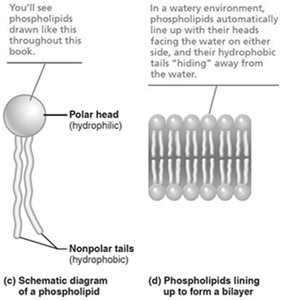
Modified triglycerides with a glycerol, two fatty acids, and a phosphorus-containing group. They have polar (hydrophilic) heads and nonpolar (hydrophobic) tails, making them essential for cell membrane structure (amphipathic).
Steroids
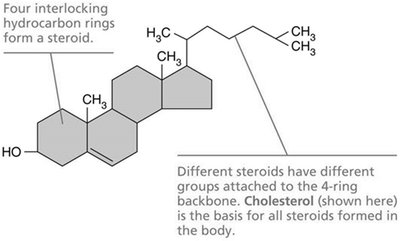
Steroids consist of four interlocking hydrocarbon rings. The most important steroid is cholesterol, which is a precursor for vitamin D, steroid hormones, and bile salts, and is important in cell membrane structure.
2.10 Proteins
Overview
Proteins comprise 20–30% of cell mass and have the most varied functions of any molecules, including structural, enzymatic, and contractile roles. They are polymers of amino acids joined by peptide bonds, and their shape and function are determined by four structural levels.
Examples of Protein Functions
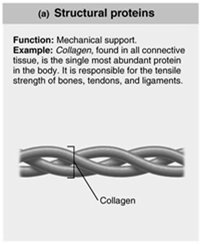
Structural proteins: Provide mechanical support (e.g., collagen).
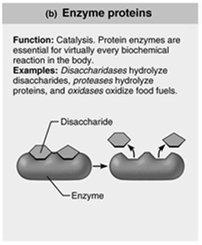
Enzyme proteins: Catalyze biochemical reactions (e.g., hydrolases, oxidases).
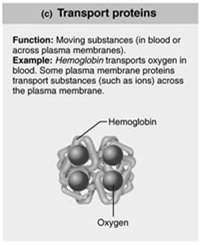
Transport proteins: Move substances (e.g., hemoglobin).
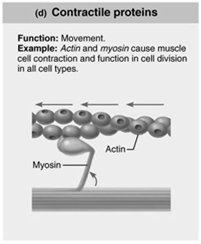
Contractile proteins: Cause movement (e.g., actin, myosin).
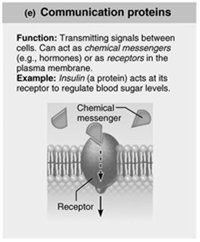
Communication proteins: Transmit signals (e.g., insulin).
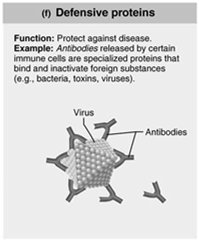
Defensive proteins: Protect against disease (e.g., antibodies).
Amino Acids and Peptide Bonds
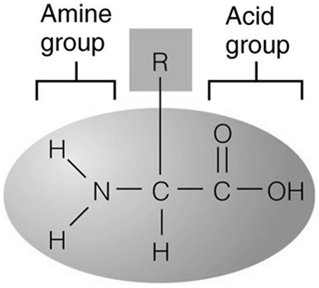
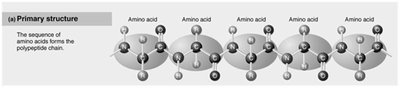
Proteins are made from 20 types of amino acids, each with an amine group, acid group, and unique R group. Amino acids are joined by peptide bonds through dehydration synthesis.
Structural Levels of Proteins
Primary: Linear sequence of amino acids.
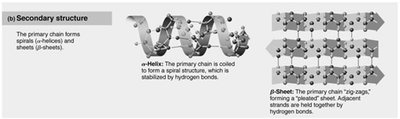
Secondary: Alpha helices and beta sheets formed by hydrogen bonding.
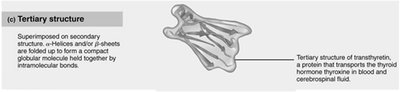
Tertiary: 3D folding due to interactions among R groups.
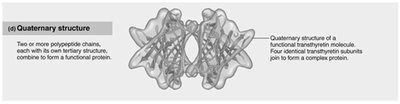
Quaternary: Association of two or more polypeptide chains.
Fibrous and Globular Proteins
Fibrous proteins: Strandlike, water-insoluble, stable; provide support and strength (e.g., collagen).
Globular proteins: Compact, spherical, water-soluble, sensitive to environmental changes; have active sites (e.g., enzymes, antibodies).
Protein Denaturation
Denaturation is the unfolding and loss of functional 3D shape of globular proteins, often caused by changes in pH or temperature. It is usually reversible unless the changes are extreme.
Enzymes and Enzyme Activity
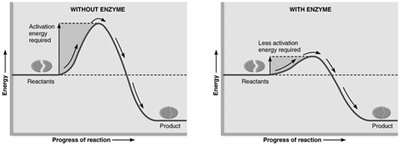
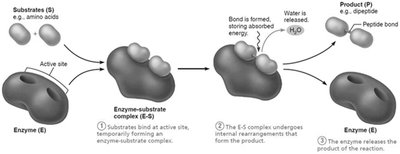
Enzymes are globular proteins that act as biological catalysts, increasing the speed of chemical reactions by lowering activation energy. They are highly specific for their substrates and are not consumed in the reaction.
Three steps of enzyme action:
Substrate binds to enzyme's active site, forming an enzyme-substrate complex.
Complex undergoes rearrangement to form product.
Product is released from enzyme.
2.11 Nucleic Acids
Overview
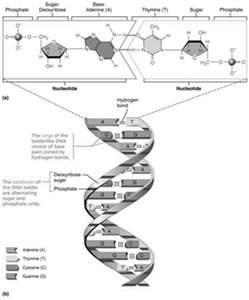
Nucleic acids (DNA and RNA) are the largest molecules in the body, composed of C, H, O, N, and P. They are polymers of nucleotides, each consisting of a nitrogen base, pentose sugar, and phosphate group.
DNA (Deoxyribonucleic Acid)
DNA holds the genetic blueprint for protein synthesis. It is a double-stranded helix located in the nucleus, with nucleotides containing deoxyribose, a phosphate group, and one of four nitrogen bases (A, T, C, G). Base pairing is specific: A with T, G with C.
RNA (Ribonucleic Acid)
RNA links DNA to protein synthesis. It is single-stranded, contains ribose, and uses uracil instead of thymine. Three types of RNA (mRNA, tRNA, rRNA) carry out protein synthesis.
2.12 ATP (Adenosine Triphosphate)
Structure and Function
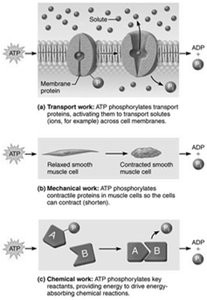
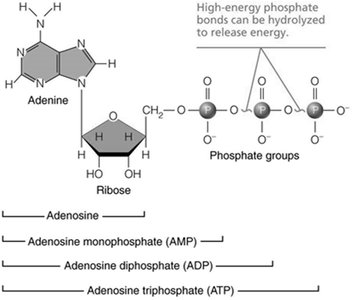
ATP is the energy currency of the cell, capturing chemical energy released from glucose breakdown. It consists of an adenine-containing RNA nucleotide with two additional phosphate groups. The terminal phosphate group can be transferred to other compounds to do cellular work.
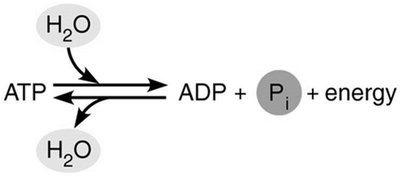
Cellular Work Driven by ATP
Transport work: ATP phosphorylates transport proteins, enabling solute movement across membranes.
Mechanical work: ATP phosphorylates contractile proteins, allowing muscle contraction.
Chemical work: ATP provides energy for endergonic reactions.