 Back
BackChemistry Comes Alive: Essential Concepts for Anatomy & Physiology
Study Guide - Smart Notes
 Tailored notes based on your materials, expanded with key definitions, examples, and context.
Basic Chemistry
Matter and Energy
Understanding matter and energy is fundamental to the study of anatomy and physiology, as all biological processes depend on chemical interactions.
Matter: Anything that occupies space and has mass. The mass of an object is the amount of matter it contains.
States of Matter: Solid, liquid, and gas.
Energy: The capacity to do work. Exists as kinetic (movement) and potential (stored) energy.
Forms of Energy:
Chemical energy: Stored in chemical bonds (e.g., food molecules).
Electrical energy: Movement of charged particles (e.g., ions across membranes).
Mechanical energy: Directly moves matter (e.g., muscle contraction).
Radiant energy: Travels in waves (e.g., light).
Energy conversions in the body release heat, some of which is lost to the environment.
Atoms and Elements
Structure of Atoms
Atoms are the basic units of matter, and their structure determines the properties of elements and compounds.
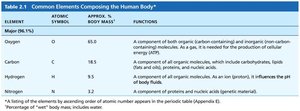
Elements: Unique substances that cannot be broken down into simpler substances. Four elements (carbon, hydrogen, oxygen, nitrogen) make up 96% of body weight.
Each element is composed of atoms, which are mostly identical building blocks.
Atomic Structure:
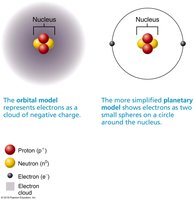
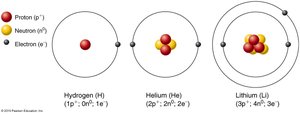
Nucleus: Contains protons (positive charge) and neutrons (no charge).
Electrons: Negatively charged, occupy orbitals around the nucleus.
Atomic Number: Number of protons in an atom.
Mass Number: Number of protons plus neutrons.
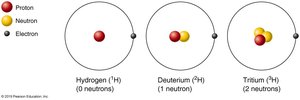
Isotopes: Variants of an element with the same number of protons but different numbers of neutrons.
Radioisotopes: Unstable isotopes that decay, releasing radioactivity. Half-life is the time for half the radioactivity to decay.
Elements in the Human Body
Major, lesser, and trace elements are required for normal body function.
Element | Atomic Symbol | Approx. % Body Mass | Functions |
|---|---|---|---|
Oxygen | O | 65.0 | Component of water, needed for ATP production |
Carbon | C | 18.5 | Component of all organic molecules |
Hydrogen | H | 9.5 | Component of all organic molecules, influences pH |
Nitrogen | N | 3.2 | Component of proteins and nucleic acids |
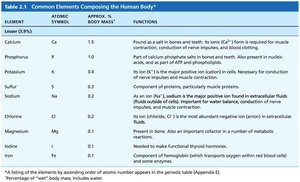
Element | Atomic Symbol | Approx. % Body Mass | Functions |
|---|---|---|---|
Calcium | Ca | 1.5 | Bones, teeth, muscle contraction, blood clotting |
Phosphorus | P | 1.0 | Bones, teeth, nucleic acids, ATP |
Potassium | K | 0.4 | Cell function, nerve impulse conduction |
Sulfur | S | 0.3 | Proteins |
Sodium | Na | 0.2 | Fluid balance, nerve impulse conduction |
Chlorine | Cl | 0.2 | Fluid balance |
Magnesium | Mg | 0.1 | Enzyme function |
Iodine | I | 0.1 | Thyroid hormone production |
Element | Atomic Symbol | Functions |
|---|---|---|
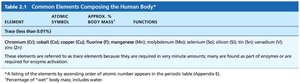
Chromium, Cobalt, Copper, Fluorine, Manganese, Molybdenum, Selenium, Silicon, Tin, Vanadium, Zinc | Various | Required in trace amounts, often as enzyme cofactors |
Molecules, Mixtures, and Compounds
Molecules and Compounds
Molecules are combinations of atoms, and compounds are molecules made of different elements.
Molecule: Two or more atoms bonded together.
Compound: Two or more different atoms bonded together.
Mixtures
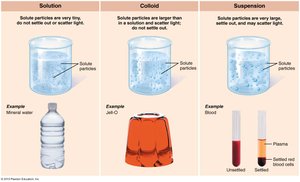
Mixtures are physical combinations of substances, classified as solutions, colloids, or suspensions.
Solution: Homogeneous mixture; solute particles are tiny and do not settle out.
Colloid: Heterogeneous mixture; solute particles are larger and do not settle out.
Suspension: Heterogeneous mixture; solute particles are large and settle out.
Mixtures vs. Compounds
Mixtures: No chemical bonding, can be separated physically, may be heterogeneous.
Compounds: Chemical bonding, require chemical processes to separate, always homogeneous.
Chemical Bonds
Types of Chemical Bonds
Chemical bonds are energy relationships between atoms, crucial for forming molecules and compounds.
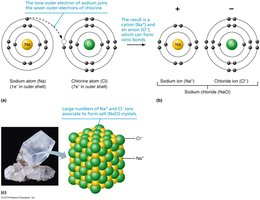
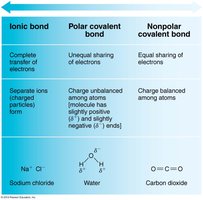
Ionic Bonds: Formed by transfer of electrons from one atom to another, resulting in charged ions (cations and anions). Most ionic compounds are salts.
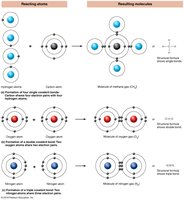
Covalent Bonds: Formed by sharing pairs of electrons. Can be single, double, or triple bonds.
Nonpolar covalent: Equal sharing of electrons.
Polar covalent: Unequal sharing, resulting in partial charges (dipoles).
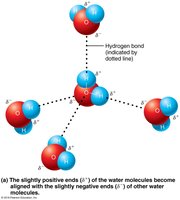
Hydrogen Bonds: Weak attractions between a hydrogen atom and an electronegative atom (often oxygen or nitrogen). Important for water properties and stabilizing large molecules.
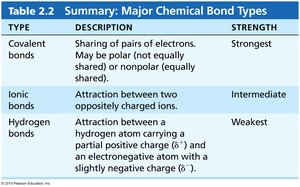
Type | Description | Strength |
|---|---|---|
Covalent bonds | Sharing of pairs of electrons (polar or nonpolar) | Strongest |
Ionic bonds | Attraction between oppositely charged ions | Intermediate |
Hydrogen bonds | Attraction between hydrogen atom and electronegative atom | Weakest |
Chemical Reactions
Types of Chemical Reactions
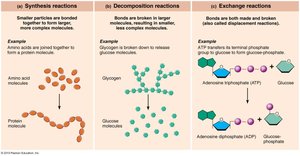
Chemical reactions involve the making or breaking of bonds, essential for metabolism and cellular function.
Synthesis (Combination): Formation of bonds; basis of anabolic processes.
Decomposition: Breaking down molecules; basis of catabolic processes.
Exchange (Displacement): Both synthesis and decomposition; parts of reactants trade places.
Oxidation-Reduction (Redox): Electrons are transferred; basis for ATP production.
Energy Flow in Reactions
Exergonic reactions: Release energy; products have lower potential energy.
Endergonic reactions: Absorb energy; products have higher potential energy.
Reversibility and Equilibrium
Reversible reactions: Indicated by double arrows; equilibrium occurs when forward and reverse rates are equal.
Many reactions in the body are irreversible due to energy loss.
Factors Influencing Reaction Rate
Temperature: Higher temperature increases reaction rate.
Concentration: Higher concentration increases reaction rate.
Particle size: Smaller molecules react faster.
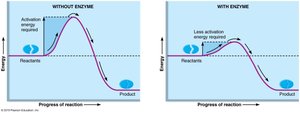
Catalysts: Speed up reactions without being consumed (e.g., enzymes).
Biochemistry: Inorganic and Organic Compounds
Inorganic Compounds
Water
Water is the most important inorganic molecule in living systems.
High heat capacity and heat of vaporization.
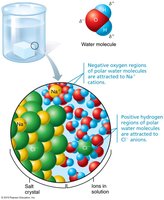
Universal solvent; forms hydration layers and dissociates ionic molecules.
Important reactant and protective cushion.
Salts
Ionic compounds that dissociate in water to form electrolytes, essential for electrical activity in the body.
Acids and Bases
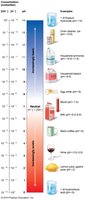
Acids: Proton donors; release H+ ions.
Bases: Proton acceptors; absorb H+ ions.
pH Scale: Measures H+ concentration; ranges from 0 (acidic) to 14 (basic), with 7 as neutral.
Neutralization: Mixing acids and bases forms salt and water.
Buffers
Combinations of weak acids and bases that resist changes in pH, crucial for maintaining homeostasis.
Organic Compounds
Macromolecules and Polymers
Organic compounds contain carbon and include carbohydrates, lipids, proteins, and nucleic acids.
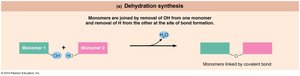
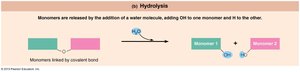
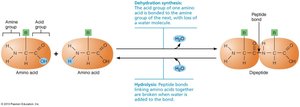
Macromolecules are large, complex molecules; most are polymers made of monomers joined by dehydration synthesis.
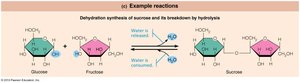
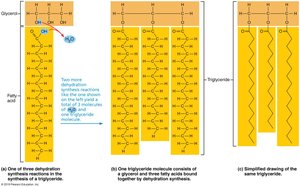
Dehydration synthesis: Removes water to form bonds.
Hydrolysis: Adds water to break bonds.
Carbohydrates
Structure and Function
Carbohydrates are the primary energy source for the body and are classified by their complexity.
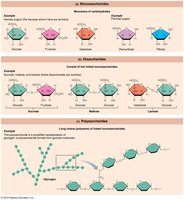
Monosaccharides: Simple sugars (e.g., glucose, fructose).
Disaccharides: Two monosaccharides joined by dehydration synthesis (e.g., sucrose, lactose).
Polysaccharides: Long chains of monosaccharides (e.g., starch, glycogen).
Lipids
Structure and Function
Lipids are diverse molecules that provide energy storage, insulation, and are key components of cell membranes.
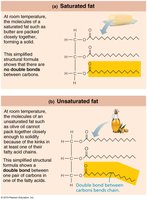
Triglycerides: Glycerol and three fatty acids; main energy storage and insulation.
Fatty Acids:
Saturated: Only single bonds; solid at room temperature.
Unsaturated: At least one double bond; liquid at room temperature.
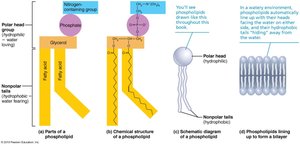
Phospholipids: Diglycerides with a phosphate group; form cell membranes with hydrophilic heads and hydrophobic tails.
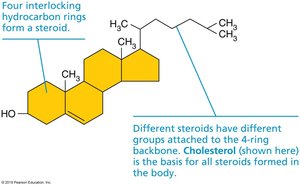
Steroids: Four interlocking rings; include cholesterol and hormones.
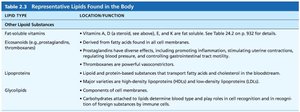
Eicosanoids: Derived from arachidonic acid; involved in blood clotting and inflammation.
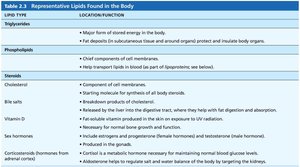
Lipid Type | Location/Function |
|---|---|
Triglycerides | Energy storage, insulation, protection |
Phospholipids | Cell membrane structure |
Steroids | Cell membranes, hormones |
Eicosanoids | Blood clotting, inflammation |
Proteins
Structure and Function
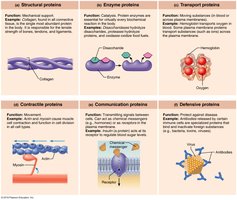
Proteins are the basic structural material of the body and perform a wide range of functions.
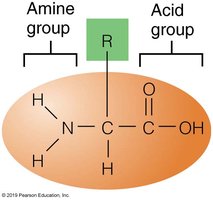
Made of amino acids joined by peptide bonds.
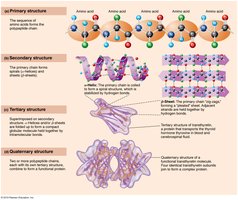
Levels of Structure:
Primary: Linear sequence of amino acids.
Secondary: α-helices and β-pleated sheets.
Tertiary: Folding into a three-dimensional shape.
Quaternary: Two or more polypeptide chains combined.
Fibrous proteins: Provide support and strength (e.g., collagen).
Globular proteins: Water-soluble, chemically active (e.g., enzymes).
Denaturation: Loss of structure and function due to environmental changes.
Enzymes
Enzymes are proteins that act as biological catalysts, speeding up reactions by lowering activation energy.
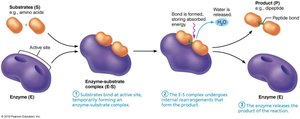
Enzyme specificity: Each enzyme binds only certain substrates at its active site.
Enzyme action: Substrate binds, rearrangement occurs, product is released.
Nucleic Acids
DNA and RNA
Nucleic acids store, transmit, and express genetic information.
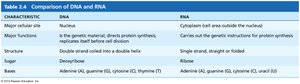
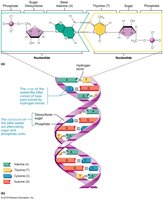
DNA: Double-stranded, found in nucleus, stores genetic information, directs protein synthesis.
RNA: Single-stranded, found outside nucleus, carries out protein synthesis.
Nucleotides: Monomers of nucleic acids; consist of a nitrogenous base, pentose sugar, and phosphate group.
Base pairing: DNA (A-T, G-C), RNA (A-U, G-C).
Characteristic | DNA | RNA |
|---|---|---|
Major cellular site | Nucleus | Cytoplasm |
Major functions | Genetic material, directs protein synthesis | Protein synthesis |
Structure | Double-stranded helix | Single-stranded |
Sugar | Deoxyribose | Ribose |
Bases | A, G, C, T | A, G, C, U |
ATP: The Energy Molecule
Structure and Function
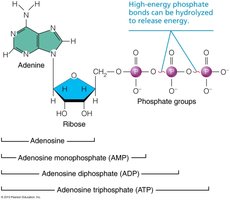
ATP (adenosine triphosphate) is the primary energy transfer molecule in cells.
ATP is an adenine-containing RNA nucleotide with three phosphate groups.
Energy is released by removing the terminal phosphate (phosphorylation).
ATP drives transport, mechanical, and chemical work in cells.
Summary Table: Monomers and Polymers of Organic Molecules
Organic Molecule | Monomer | Polymer |
|---|---|---|
Carbohydrates | Monosaccharide | Polysaccharide |
Lipids | Fatty acid, glycerol | Triglyceride, phospholipid |
Proteins | Amino acid | Polypeptide |
Nucleic acids | Nucleotide | DNA, RNA |
