Back
Chemistry Comes Alive: Essential Concepts for ANP College Students chap 2
Study Guide - Smart Notes
 Tailored notes based on your materials, expanded with key definitions, examples, and context.
Chemistry Comes Alive
Matter and Its States
Matter is defined as anything that has mass and occupies space. It exists in three primary states: solid, liquid, and gas, each with distinct properties regarding shape and volume.
Solid: Definite shape and volume.
Liquid: Changeable shape, definite volume.
Gas: Changeable shape and volume.
Energy and Its Forms
Energy is the capacity to do work or put matter into motion. It exists in two main types: kinetic (energy in action) and potential (stored energy). Energy can be transferred between these forms.
Chemical energy: Stored in chemical bonds.
Electrical energy: Movement of charged particles.
Mechanical energy: Directly involved in moving matter.
Radiant energy: Travels in waves (e.g., light, x-rays).
Composition of Matter: Elements and Atoms
Elements
Elements are the fundamental substances that make up matter. They cannot be broken down by ordinary chemical methods and possess unique physical and chemical properties.
Physical properties: Detectable or measurable.
Chemical properties: Describe how atoms interact or bond.
Atoms and Atomic Structure
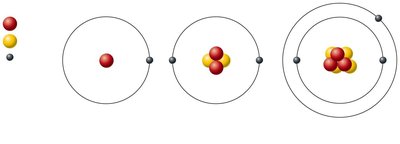
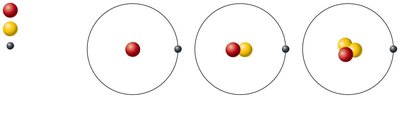
Atoms are the smallest units of elements, consisting of subatomic particles: protons, neutrons, and electrons. Protons and neutrons reside in the nucleus, while electrons orbit in the electron cloud.
Protons: Positive charge, mass = 1 amu.
Neutrons: No charge, mass = 1 amu.
Electrons: Negative charge, mass ≈ 0 amu.
Isotopes and Atomic Weight
Isotopes are atoms of the same element with different numbers of neutrons. Atomic weight is the average mass of all isotopes of an element.
Major, Lesser, and Trace Elements of the Human Body
Major Elements
Four elements—carbon, hydrogen, oxygen, and nitrogen—make up 96.1% of body mass.
Lesser Elements
Nine elements, including calcium, phosphorus, potassium, and others, make up 3.9% of body mass.
Trace Elements
Eleven elements are present in minute amounts (<0.01%) and often function as enzyme activators.
Mixtures and Compounds
Types of Mixtures
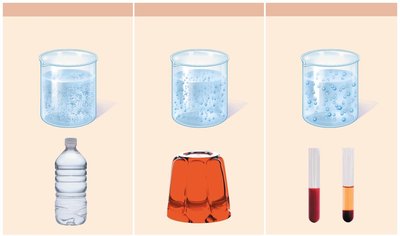
Mixtures are physical combinations of substances. The three main types are solutions, colloids, and suspensions.
Solutions: Homogeneous mixtures; solute particles do not settle out.
Colloids: Heterogeneous mixtures; larger particles that do not settle out.
Suspensions: Heterogeneous mixtures; large particles that settle out.
Mixtures vs. Compounds
Mixtures: No chemical bonding, can be separated physically, may be heterogeneous or homogeneous.
Compounds: Chemical bonding, can only be separated by breaking bonds, always homogeneous.
Chemical Bonds
Ionic Bonds
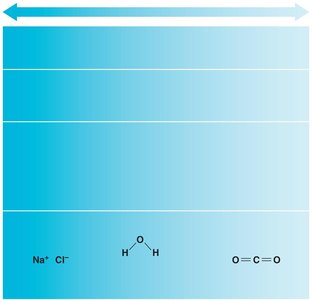
Ionic bonds form when atoms transfer electrons, resulting in charged ions. Anions gain electrons (negative), cations lose electrons (positive). The attraction between opposite charges forms the bond.
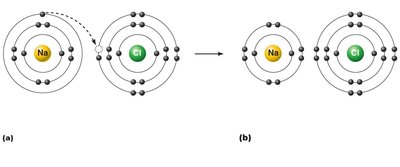
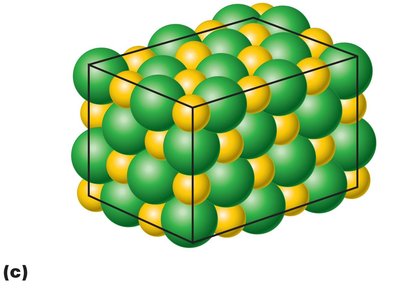
Most ionic compounds are salts, such as sodium chloride (NaCl).
Covalent Bonds
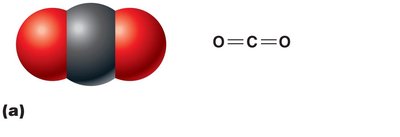
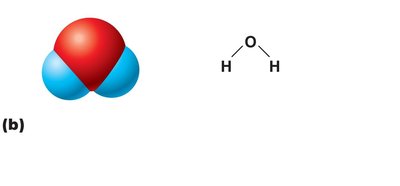
Covalent bonds are formed by sharing electrons between atoms. This allows atoms to fill their valence shells.
Nonpolar covalent bonds: Electrons shared equally, resulting in balanced molecules (e.g., CO2).
Polar covalent bonds: Electrons shared unequally, creating dipole molecules (e.g., H2O).
Bond Types Compared
Ionic, polar covalent, and nonpolar covalent bonds differ in electron sharing and charge distribution.
Hydrogen Bonds
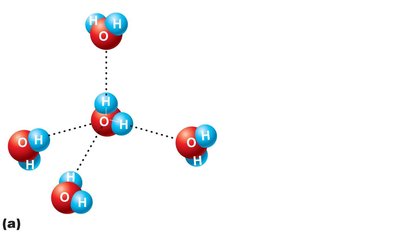
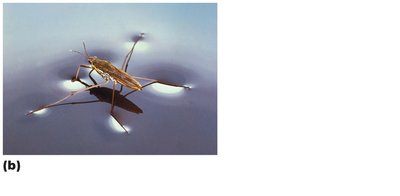
Hydrogen bonds are attractive forces between electropositive hydrogen and electronegative atoms. They are common in water and help maintain three-dimensional shapes in large molecules.
Chemical Reactions
Types of Chemical Reactions
Synthesis: Two or more reactants combine to form a complex product.
Decomposition: Complex molecules break down into simpler parts.
All chemical reactions are theoretically reversible, but many biological reactions are essentially irreversible due to energy requirements or product removal.
Energy Flow in Reactions
Exergonic: Release energy.
Endergonic: Absorb energy.
Biochemistry: Organic and Inorganic Compounds
Classes of Compounds
Inorganic: Water, salts, acids, bases; do not contain carbon.
Organic: Carbohydrates, lipids, proteins, nucleic acids; contain carbon, usually large and covalently bonded.
Water
Water is the most abundant and important inorganic compound in living organisms, making up 60–80% of cell volume.
Salts
Salts are ionic compounds that dissociate in water, forming electrolytes that conduct electricity and are vital for homeostasis.
Acids and Bases
Acids are proton donors (release H+), while bases are proton acceptors (take up H+). Both are electrolytes and ionize in water.
pH: Acid-Base Concentration
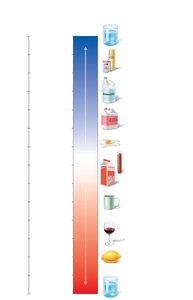
The pH scale measures the concentration of hydrogen ions. Acidic solutions have higher H+ and lower pH (0–6.99), neutral solutions have equal H+ and OH– (pH 7), and alkaline solutions have lower H+ and higher pH (7.01–14).
Acid-Base Homeostasis and Buffers
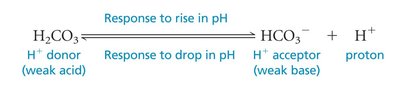
pH changes can interfere with cell function and be fatal. Buffers resist abrupt changes in pH by releasing or binding H+. The carbonic acid-bicarbonate system is an important blood buffer.
Organic Compounds
Carbohydrates
Carbohydrates are sugars and starches containing C, H, and O. They are classified as monosaccharides, disaccharides, or polysaccharides and serve as major cellular fuel and structural molecules.
Lipids
Lipids contain C, H, O (sometimes P), are insoluble in water, and include triglycerides, phospholipids, steroids, and eicosanoids. Saturated fats have single bonds, unsaturated fats have double bonds, and omega-3 fatty acids are heart healthy.
Proteins
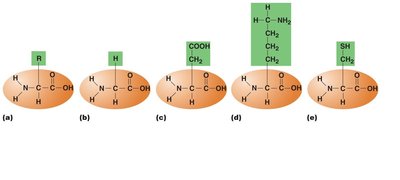
Proteins are polymers of amino acids (20 types), joined by peptide bonds. Amino acids contain an amine group, acid group, and a variable R group.
Enzymes
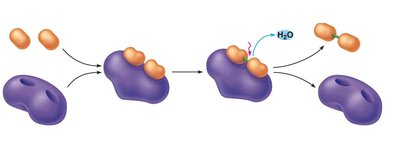
Enzymes are globular proteins that act as biological catalysts, lowering activation energy and increasing reaction speed.
Nucleic Acids
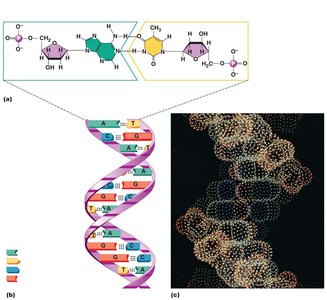
Nucleic acids include DNA and RNA, which are polymers of nucleotides (nitrogen base, pentose sugar, phosphate group).
DNA
DNA is a double-stranded helix in the nucleus, providing instructions for protein synthesis and genetic continuity.
RNA
RNA is single-stranded and active outside the nucleus, with three types: mRNA, tRNA, and rRNA.
Adenosine Triphosphate (ATP)
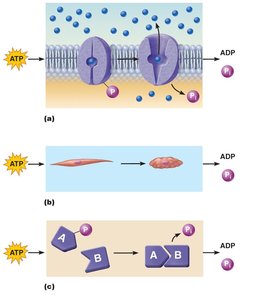
ATP is the energy currency of cells, capturing chemical energy from glucose and powering cellular reactions.
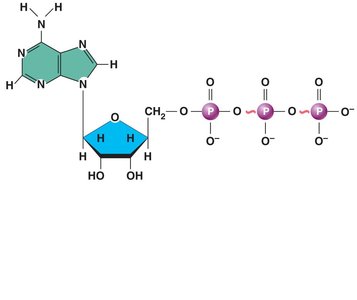
ATP drives transport, mechanical, and chemical work in cells.