 Back
Chemistry Comes Alive: Essential Concepts for Human Anatomy & Physiology
Study Guide - Smart Notes
 Tailored notes based on your materials, expanded with key definitions, examples, and context.
Chapter Overview
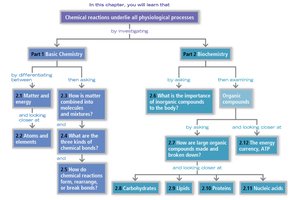
This chapter introduces foundational chemical concepts essential for understanding physiological processes in the human body. It covers matter, energy, chemical bonds, reactions, and the major classes of organic and inorganic compounds relevant to anatomy and physiology.
Matter and Energy
Definition and Forms of Matter
Matter is anything that occupies space and has mass. It exists in three primary states: solid, liquid, and gas. Mass is a measure of the amount of matter in an object.
Solid: Definite shape and volume
Liquid: Definite volume, shape conforms to container
Gas: No definite shape or volume
Energy and Its Forms
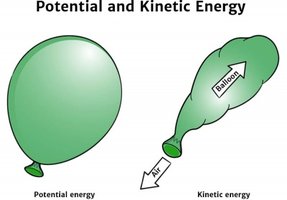
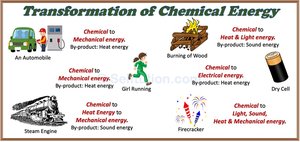
Energy is the capacity to do work or cause change. It is measured by its effect on matter and exists in several forms:
Chemical Energy: Stored in chemical bonds (e.g., ATP)
Electrical Energy: Movement of charged particles (e.g., ions across membranes)
Mechanical Energy: Direct movement of matter (e.g., muscle contraction)
Radiant Energy: Electromagnetic waves (e.g., X-rays, UV light)
Elements and Atoms
Common Elements in the Human Body
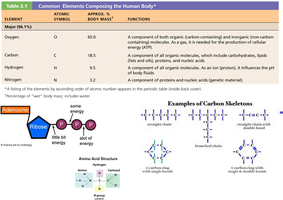
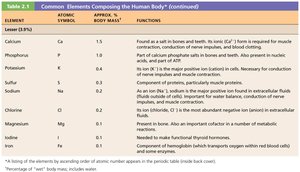
The human body is composed primarily of a few elements, each with specific functions:
Element | Atomic Symbol | Approx. % Body Mass | Function |
|---|---|---|---|
Oxygen | O | 65.0 | Component of organic/inorganic molecules; needed for ATP production |
Carbon | C | 18.5 | Component of all organic molecules |
Hydrogen | H | 9.5 | Influences pH; component of organic molecules |
Nitrogen | N | 3.2 | Component of proteins and nucleic acids |
Element | Atomic Symbol | Approx. % Body Mass | Function |
|---|---|---|---|
Calcium | Ca | 1.5 | Bone/teeth structure, muscle contraction, blood clotting |
Phosphorus | P | 1.0 | Component of bones, nucleic acids, ATP |
Potassium | K | 0.4 | Major positive ion inside cells, nerve impulse transmission |
Sulfur | S | 0.3 | Component of proteins |
Sodium | Na | 0.2 | Major positive ion outside cells, water balance |
Chlorine | Cl | 0.2 | Major negative ion in extracellular fluids |
Magnesium | Mg | 0.1 | Enzyme cofactor |
Iodine | I | 0.1 | Thyroid hormone production |
Iron | Fe | 0.1 | Hemoglobin component |
Combining Matter: Molecules, Compounds, and Mixtures
Molecules and Compounds
Atoms combine to form molecules and compounds:
Molecule: Two or more atoms bonded together (e.g., O2)
Compound: Molecule with two or more different kinds of atoms (e.g., H2O)
Mixtures
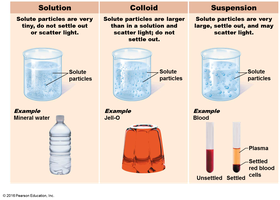
Mixtures are combinations of two or more substances physically intermixed. There are three main types:
Solutions: Homogeneous mixtures; solute particles are very tiny and do not settle out or scatter light (e.g., mineral water)
Colloids: Heterogeneous mixtures; solute particles are larger and scatter light but do not settle out (e.g., Jell-O)
Suspensions: Heterogeneous mixtures; solute particles are very large, settle out, and may scatter light (e.g., blood)
Chemical Bonds
Types of Chemical Bonds
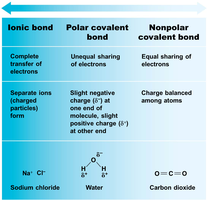
Chemical bonds are energy relationships between electrons of reacting atoms. The main types are:
Ionic Bonds: Complete transfer of electrons; forms charged ions (e.g., NaCl)
Covalent Bonds: Sharing of electrons; can be polar (unequal sharing, e.g., water) or nonpolar (equal sharing, e.g., CO2)
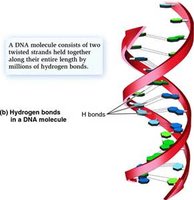
Hydrogen Bonds: Weak attractions between electropositive hydrogen and electronegative atoms; important in maintaining three-dimensional shapes of molecules
Chemical Reactions
Main Types of Chemical Reactions
Chemical reactions involve the making or breaking of bonds between atoms. The three main types are:
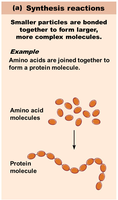
Synthesis (Combination) Reactions: Atoms or molecules combine to form larger, more complex molecules. Used in anabolic (building) processes.
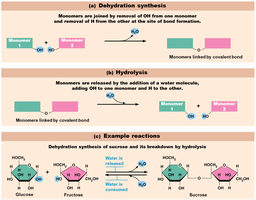
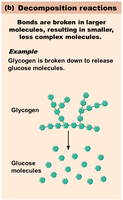
Decomposition Reactions: Breakdown of a molecule into smaller molecules or atoms. Used in catabolic (bond-breaking) processes.
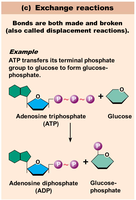
Exchange (Displacement) Reactions: Bonds are both made and broken; parts of reactants are exchanged.
Energy in Chemical Reactions
Exergonic Reactions: Net release of energy; products have less potential energy than reactants (e.g., catabolic and oxidative reactions)
Endergonic Reactions: Net absorption of energy; products have more potential energy than reactants (e.g., anabolic reactions)
Inorganic Compounds
Water
Water is the most abundant inorganic compound in living cells, accounting for 60–80% of cell volume. Its properties make it essential for life.
Salts, Acids, and Bases
Salts: Ionic compounds that dissociate into ions in water; conduct electrical currents (electrolytes)
Acids: Proton donors; release H+ ions (e.g., HCl)
Bases: Proton acceptors; release OH– ions (e.g., NaOH)
pH Scale
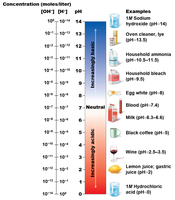
The pH scale measures the concentration of hydrogen ions in solution. It is logarithmic, so each unit represents a tenfold difference in H+ concentration.
Acidic: pH 0–6.99; high [H+]
Neutral: pH 7; equal [H+] and [OH–]
Basic (Alkaline): pH 7.01–14; low [H+]
Organic Compounds
Major Classes of Organic Molecules
Organic molecules contain carbon (except CO2 and CO). The four major classes are:
Carbohydrates: Provide energy; include sugars and starches
Lipids: Energy storage, cell membrane structure
Proteins: Structure, function, enzymes
Nucleic Acids: Genetic information (DNA, RNA)
Carbohydrates
Carbohydrates contain C, H, and O. They are classified by size and solubility:
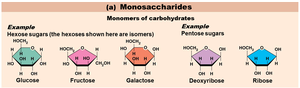
Monosaccharides: Simple sugars (e.g., glucose, fructose, galactose, ribose, deoxyribose)
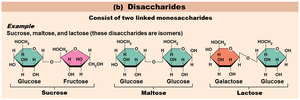
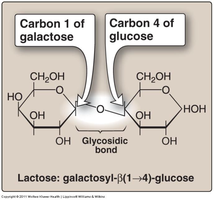
Disaccharides: Two monosaccharides joined (e.g., sucrose, maltose, lactose)
Polysaccharides: Long chains of monosaccharides (e.g., glycogen, starch)
Lipids
Lipids contain C, H, and O (less O than carbohydrates), and sometimes P. They include:
Triglycerides: Energy storage
Phospholipids: Major component of cell membranes
Steroids: Four interlocking rings; cholesterol is the most important steroid, serving as a precursor for vitamin D, steroid hormones, and bile salts
Proteins
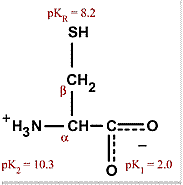
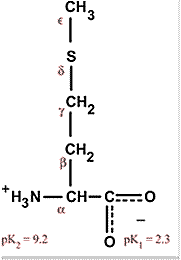
Proteins are polymers of amino acids, joined by peptide bonds. Each amino acid contains an amino group, carboxyl group, alpha carbon, and a unique side chain (R group).
Fibrous Proteins: Structural, water-insoluble, stable (e.g., collagen, keratin)
Globular Proteins: Functional, water-soluble, sensitive to environmental changes (e.g., enzymes, antibodies)
Enzymes
Enzymes are globular proteins that act as biological catalysts, speeding up chemical reactions without being consumed. They lower activation energy and are highly specific.
Enzyme Nomenclature: Names usually end in -ase and are often named for the reaction they catalyze
Enzyme Action: Substrate binds to active site, undergoes rearrangement, and product is released
Nucleic Acids
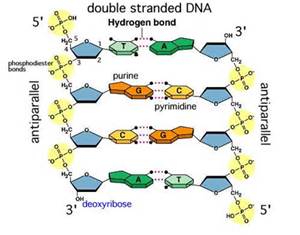
Nucleic acids (DNA and RNA) are polymers of nucleotides, each composed of a nitrogen base, pentose sugar, and phosphate group.
DNA: Double-stranded helix; contains deoxyribose; bases are adenine, guanine, cytosine, thymine
RNA: Single-stranded; contains ribose; bases are adenine, guanine, cytosine, uracil
ATP (Adenosine Triphosphate)
ATP is the primary energy carrier in cells. Chemical energy released from glucose breakdown is captured in ATP, which powers cellular activities.
Structure: Adenine, ribose, three phosphate groups
Function: Transfers energy for cellular work
Summary Table: Types of Chemical Bonds
Bond Type | Electron Sharing/Transfer | Example |
|---|---|---|
Ionic | Complete transfer | NaCl |
Polar Covalent | Unequal sharing | H2O |
Nonpolar Covalent | Equal sharing | CO2 |
Summary Table: Types of Mixtures
Type | Particle Size | Settling | Example |
|---|---|---|---|
Solution | Tiny | No | Mineral water |
Colloid | Larger | No | Jell-O |
Suspension | Very large | Yes | Blood |
Additional info: Academic context was added to clarify definitions, examples, and the importance of each topic for human anatomy and physiology.
