 Back
Chemistry Comes Alive: Foundations for Anatomy & Physiology
Study Guide - Smart Notes
 Tailored notes based on your materials, expanded with key definitions, examples, and context.
Chemistry & Physiological Reactions
Introduction to Chemistry in Physiology
Chemistry is fundamental to all physiological processes in the human body, including movement, digestion, heart function, and nervous system activity. Understanding basic chemistry and biochemistry is essential for comprehending how the body functions at the molecular level.
Basic Chemistry: The study of matter and its interactions.
Biochemistry: Focuses on the chemical processes within and related to living organisms.
Matter
Definition and States of Matter
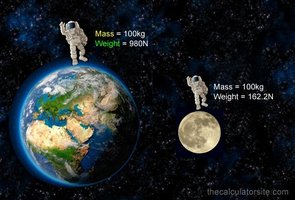
Matter is anything that has mass and occupies space. It can be observed, smelled, or felt. Weight is the measure of mass plus the effects of gravity.
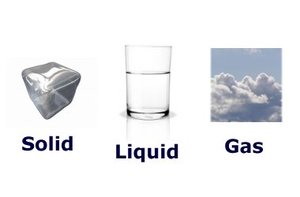
Solid: Definite shape and volume.
Liquid: Changeable shape, definite volume.
Gas: Changeable shape and volume.
Energy
Definition and Forms of Energy
Energy is the capacity to do work or put matter into motion. It does not have mass or occupy space. The more work done, the more energy is used.
Chemical Energy: Stored in the bonds of chemical substances.
Electrical Energy: Results from the movement of charged particles.
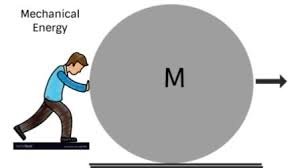
Mechanical Energy: Directly involved in moving matter.
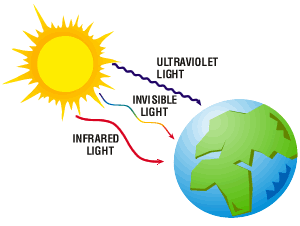
Radiant/Electromagnetic Energy: Travels in waves (e.g., heat, visible light, ultraviolet light, X-rays).


Energy Conversions
Energy can be converted from one form to another, but conversion is inefficient—some energy is always lost as heat, which helps maintain body temperature.
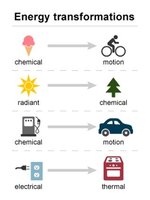
Kinetic vs. Potential Energy
Energy exists in two states:
Kinetic Energy: Energy in action.
Potential Energy: Stored (inactive) energy that can be released to do work.

Atoms & Elements
Basic Structure and Properties
All matter is composed of elements, substances that cannot be broken down into simpler substances by ordinary chemical methods. Each element is made up of atoms, which are the smallest particles retaining the properties of that element. Elements are represented by atomic symbols (e.g., O for oxygen, C for carbon, Na for sodium).
Common Elements in the Human Body
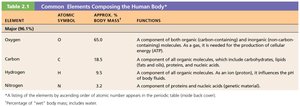
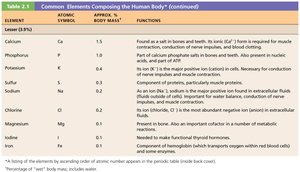
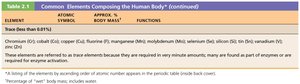
Four elements—carbon, oxygen, hydrogen, and nitrogen—make up 96% of the human body. Nine additional elements account for 3.9%, and eleven trace elements make up less than 0.01%.
Element | Atomic Symbol | Approx. % Body Mass | Functions |
|---|---|---|---|
Oxygen | O | 65.0 | Component of organic/inorganic molecules; needed for ATP production |
Carbon | C | 18.5 | Component of all organic molecules |
Hydrogen | H | 9.5 | Component of organic molecules; influences pH |
Nitrogen | N | 3.2 | Component of proteins and nucleic acids |
Combining Matter: Molecules & Compounds
Definitions and Examples
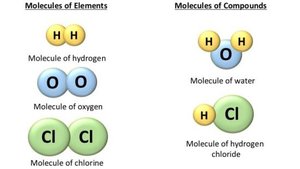
Molecule: Two or more atoms held together by chemical bonds.
Molecule of an Element: Two or more atoms of the same element bonded together (e.g., H2, O2).
Molecule of a Compound: Two or more different kinds of atoms bonded together (e.g., C6H12O6).
Chemical Reactions
Types of Chemical Reactions
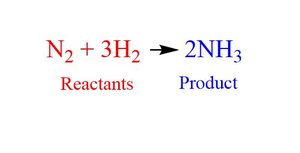
Chemical reactions occur when chemical bonds are formed, rearranged, or broken. These reactions are represented by chemical equations, which show reactants (starting substances) and products (end substances).
Synthesis Reactions
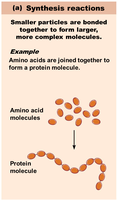
Atoms or molecules combine to form a larger, more complex molecule. These are anabolic (building) processes.
General equation:
Decomposition Reactions
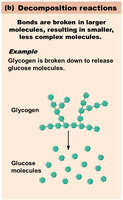
A molecule is broken down into smaller molecules or its constituent atoms. These are catabolic (bond-breaking) reactions.
General equation:
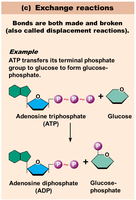
Exchange Reactions
Involve both synthesis and decomposition; bonds are both made and broken.
General equations: or
Catalysts
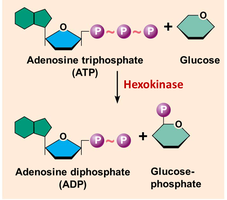
Catalysts increase the rate of chemical reactions without being chemically changed or becoming part of the product. Enzymes are biological catalysts.
Biochemistry: Organic and Inorganic Compounds
Classification
Organic Compounds: Contain carbon, usually large, covalently bonded (e.g., carbohydrates, fats, proteins, nucleic acids).
Inorganic Compounds: Do not contain carbon (with few exceptions); include water, salts, acids, and bases.
Both types are essential for life.
Inorganic Compounds
Water: Most abundant inorganic compound; universal solvent; 60–80% of cell volume.
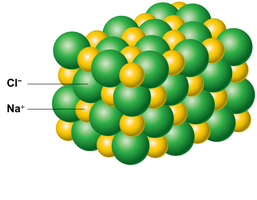
Salts: Dissociate in water into ions (electrolytes) that conduct electrical currents; vital for homeostasis (e.g., NaCl, CaCO3, KCl).
Organic Compounds: Synthesis & Hydrolysis
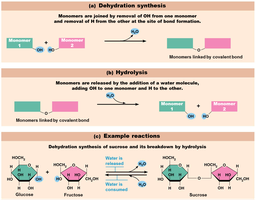
Many organic compounds are polymers (chains of monomers). They are formed by dehydration synthesis (removal of water) and broken down by hydrolysis (addition of water).
Organic Compounds: Carbohydrates
Structure and Function
Carbohydrates include sugars and starches, containing C, H, and O (with H and O in a 2:1 ratio). They are classified as:
Monosaccharides: Single sugars (monomers).
Disaccharides: Two sugars.
Polysaccharides: Many sugars (polymers of monosaccharides).
Organic Compounds: Lipids
Types and Functions
Lipids are insoluble in water, contain C, H, and O (less O than carbohydrates), and sometimes P. Main types include:
Triglycerides (fats and oils): Three fatty acids bonded to glycerol; used for energy storage, insulation, and protection.
Phospholipids: Modified triglycerides with a phosphate group; major component of cell membranes.
Steroids: Four interlocking ring structures (e.g., cholesterol, vitamin D, steroid hormones, bile salts).
Eicosanoids: Derived from arachidonic acid; important in blood clotting, inflammation, and other processes.
Organic Compounds: Proteins
Structure and Function
Proteins make up 10–30% of cell mass and have diverse functions (structural, enzymatic, contractile). They are polymers of amino acids joined by peptide bonds. Protein shape and function depend on four structural levels (primary, secondary, tertiary, quaternary).
Fibrous Proteins: Structural, strand-like, water-insoluble, stable (e.g., collagen, keratin).
Globular Proteins: Functional, compact, spherical, water-soluble, sensitive to environmental changes (e.g., enzymes, antibodies).
Enzymes & Enzymatic Activity
Enzymes are globular proteins that act as biological catalysts, lowering activation energy and increasing reaction speed. They allow reactions to proceed rapidly at body temperature.
Step 1: Substrate binds to enzyme's active site, forming an enzyme-substrate complex.
Step 2: Complex undergoes rearrangement, forming the product.
Step 3: Product is released from the enzyme.
Organic Compounds: Nucleic Acids
Structure and Function
Nucleic acids (DNA and RNA) are composed of C, H, O, N, and P. They are the largest molecules in the body, made of nucleotide monomers (pentose sugar, phosphate group, nitrogen base: A, G, C, T, U).
ATP – Adenosine Triphosphate
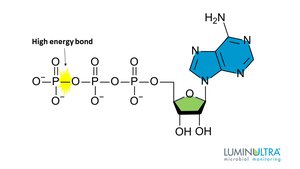
ATP is an adenine-containing RNA nucleotide with two additional phosphate groups. It stores and releases chemical energy for cellular processes. When glucose is broken down, energy is captured in ATP, which directly powers cellular work.
Summary Table: Major Chemical Concepts for Anatomy & Physiology
Concept | Definition | Example/Application |
|---|---|---|
Matter | Anything with mass and volume | Solid (bone), liquid (blood), gas (oxygen) |
Energy | Capacity to do work | Chemical energy in ATP powers muscle contraction |
Element | Pure substance of one type of atom | Oxygen, carbon |
Molecule | Two or more atoms bonded | H2O, O2 |
Compound | Two or more different atoms bonded | CO2, NaCl |
Catalyst | Speeds up reactions without being used up | Enzymes in digestion |
